China’s economy is increasingly leaning on newer engines of expansion rather than the property-and-infrastructure model that long defined its growth, a shift that matters because it suggests Beijing is trying to preserve momentum without reviving the old credit-heavy playbook.
China Growth Shifts Toward Tech and Renewables
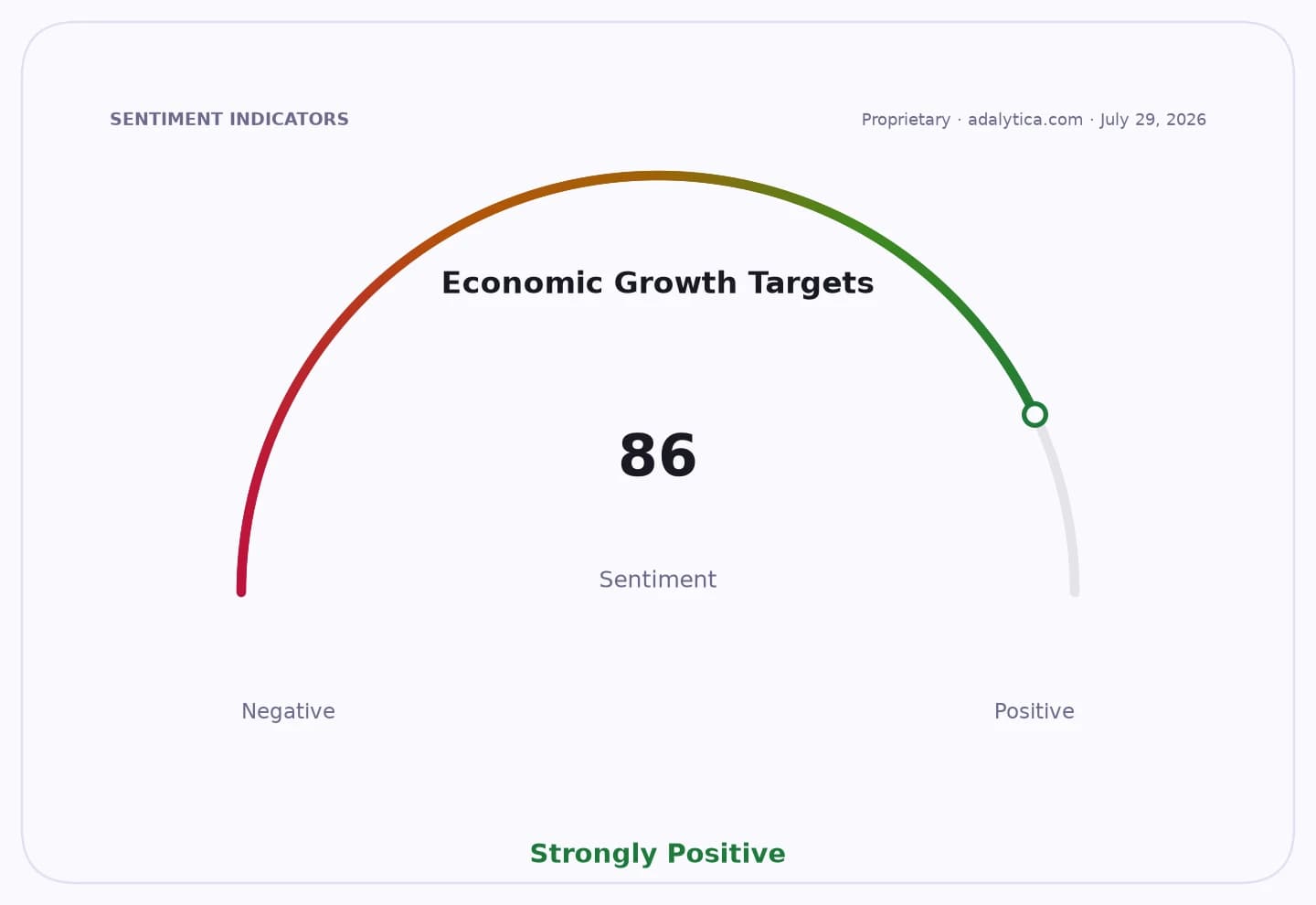
Official commentary and first-half data point to industrial profits rising steadily in 2026, helped by artificial intelligence, renewable energy and high-tech manufacturing. That has supported 4.7% GDP growth in the period and given policymakers evidence that the economy can still generate output even as legacy sectors remain under pressure. For investors, the implication is not simply that China is growing, but that the composition of that growth is changing in ways that could alter capital allocation, earnings leadership and policy priorities.
Sentiment IndicatorsⓘProprietary · adalytica.com · July 29, 2026
This is a snapshot — live sentiment, awareness and momentum for 130+ markets update continuously in the dashboard.Open AlphaPulse
The narrative also helps explain the renewed resilience in Chinese market proxies. The iShares China Large-Cap ETF, FXI, rose to 35.65 on July 28 from 34.13 on July 17, while the MSCI China ETF, MCHI, climbed to 54.41 from 52.95 over the same stretch. Both are still below their 200-day moving averages, underscoring that sentiment has improved but conviction remains incomplete. FXI’s 50-day moving average has turned higher, and MCHI’s short-term momentum has also improved, suggesting traders are buying into the growth-shift story even if longer-term skepticism persists.
That tension is central to the investment case. Bulls can point to the breadth of the new growth drivers: AI infrastructure, renewable energy supply chains, advanced manufacturing and rural investment all broaden the sources of demand and reduce reliance on a weak property cycle. Bears will argue that profits in favored industries do not yet prove a durable nationwide reacceleration, especially when domestic demand remains uneven and China still faces external trade and geopolitical friction. The market is effectively pricing both views at once: stronger optimism around China’s policy direction, but continued caution about the sustainability of earnings.
The yuan adds another layer to the story. Adalytica’s Chinese yuan trade signals show sentiment in “Extreme Fear,” even as awareness remains neutral, a reminder that investors are still wary of the currency implications of slower nominal growth and policy support that may not be enough to restore broad confidence. That caution matters because a weaker currency can tighten financial conditions for foreign investors and complicate the outlook for Chinese assets, even when growth headlines improve.
For global investors, the key question is whether this transition marks a lasting re-rating of Chinese equity exposure or only a cyclical rally in a few favored sectors. If the new growth mix continues to deliver profits, capital may keep flowing toward Chinese technology, renewable energy and industrial names. If not, the market could quickly revert to treating China as a policy-managed economy with limited earnings visibility.
| Entity | Gains | Losses |
|---|---|---|
| High-tech and AI firms | ▲Stronger profit outlook | ▼Legacy cyclical sectors |
| Renewable energy makers | ▲Policy-backed demand | ▼Carbon-heavy incumbents |
| Chinese equities holders | ▲Growth re-rating potential | ▼Long-duration skeptics |
| Yuan bears | ▲None if growth holds | ▼If confidence improves |




