China’s rejection of Japanese concerns as “baseless” is more than a diplomatic jab — it is a warning that the Sino-Japanese rift is hardening into a broader geopolitical risk premium that investors can no longer ignore.
China-Japan Rift Raises Geopolitical Risk Premium
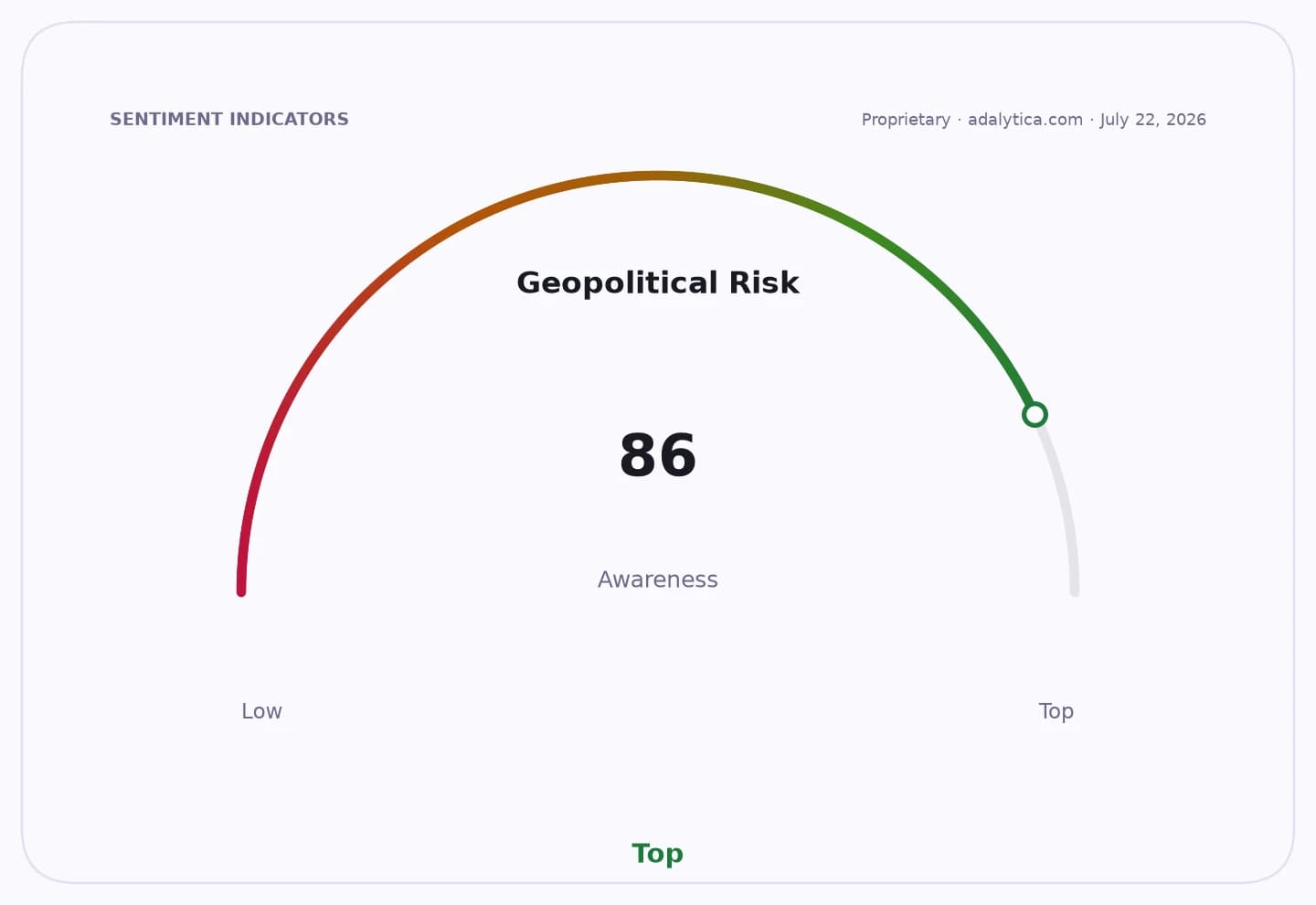
The immediate market significance is not just the rhetoric, but the way it feeds a fragile backdrop for trade, defense spending and regional capital flows. China and Russia have already conducted live-fire drills near Japan’s exclusive economic zone, while Tokyo is pressing ahead with a tougher defense posture and louder talk about nuclear deterrence. That combination raises the odds of policy escalation, trade friction and supply-chain disruption across one of the world’s most important manufacturing corridors.
Sentiment IndicatorsⓘProprietary · adalytica.com · July 22, 2026
This is a snapshot — live sentiment, awareness and momentum for 130+ markets update continuously in the dashboard.Open AlphaPulse
Investors should pay attention because tensions between Beijing and Tokyo do not stay confined to foreign ministries. They affect exporters, defense contractors, semiconductors, shipping routes and commodities tied to industrial production. China has also been accused of curbing rare earth magnet exports to Japan even as shipments to other markets rise, a sign that strategic trade leverage is already being used as a pressure tool. That matters for companies exposed to advanced manufacturing, autos and electronics, where even small interruptions can ripple through margins and inventories.
The market backdrop suggests the conflict risk is becoming more visible even as positioning remains volatile. Adalytica’s US–China Relations Sentiment gauge shows “Extreme Fear,” while its Global Stability Sentiment is also in “Extreme Fear,” reflecting a sharp deterioration in geopolitical confidence over the past month. That kind of backdrop tends to favor hard assets, defense names and supply-chain redundancy plays over cyclical exporters dependent on smooth Asia trade.
The ETF moves tell the same story. China-focused FXI has swung sharply lower from its earlier highs, with the fund recently trading well below its 200-day moving average, while Japan’s EWJ has been more resilient but has also backed off its highs. That divergence suggests investors are starting to price country risk differently, rather than treating Asia exposure as one broad trade. In other words, the market is beginning to discriminate between beneficiaries of regional rearmament and the companies most exposed to retaliation, export controls or diplomatic shock.
Our thesis is straightforward: the market is underestimating how quickly a China-Japan security dispute can migrate into investment decisions. If Beijing keeps dismissing Tokyo’s concerns and Japan keeps hardening its defense stance, the winners are likely to be defense suppliers, cybersecurity firms, domestic industrial substitutes and selective commodity and logistics plays. The losers are firms reliant on open cross-border trade, just-in-time supply chains and stable access to strategic materials.
For investors, this is not a reason to panic — it is a reason to position early. The asymmetric opportunity lies in owning the picks-and-shovels of regional deterrence and supply-chain duplication before consensus fully catches up. The next catalyst will come from any further military exercise, export restriction or policy announcement that pushes the dispute from rhetoric into pricing.
| Entity | Gains | Losses |
|---|---|---|
| Defense contractors | ▲Higher procurement demand | ▼Lower peacetime budgets |
| Rare earth substitute suppliers | ▲Strategic sourcing demand | ▼China-linked exporters |
| Japan domestic industry | ▲Onshoring tailwind | ▼Cross-border supply chains |
| China-focused equities (FXI) | ▲Diplomatic calm | ▼Geopolitical escalation |