China’s latest round of minimum wage adjustments underscores a broader effort to support household incomes even as growth remains uneven and employers face rising labor costs in parts of the country.
China minimum wages rise above RMB 2,000
By August 2026, all 31 provincial-level regions had pushed monthly minimum wages above RMB 2,000, with Shanghai at the top at RMB 2,740 and Beijing leading hourly pay at RMB 27.7. The wage floors now span a wide range, from Shenzhen’s RMB 2,700 and Guangzhou’s RMB 2,680 to lower-tier county and western-region standards that remain below the coastal hubs but still reflect a steady climb in mandated pay.
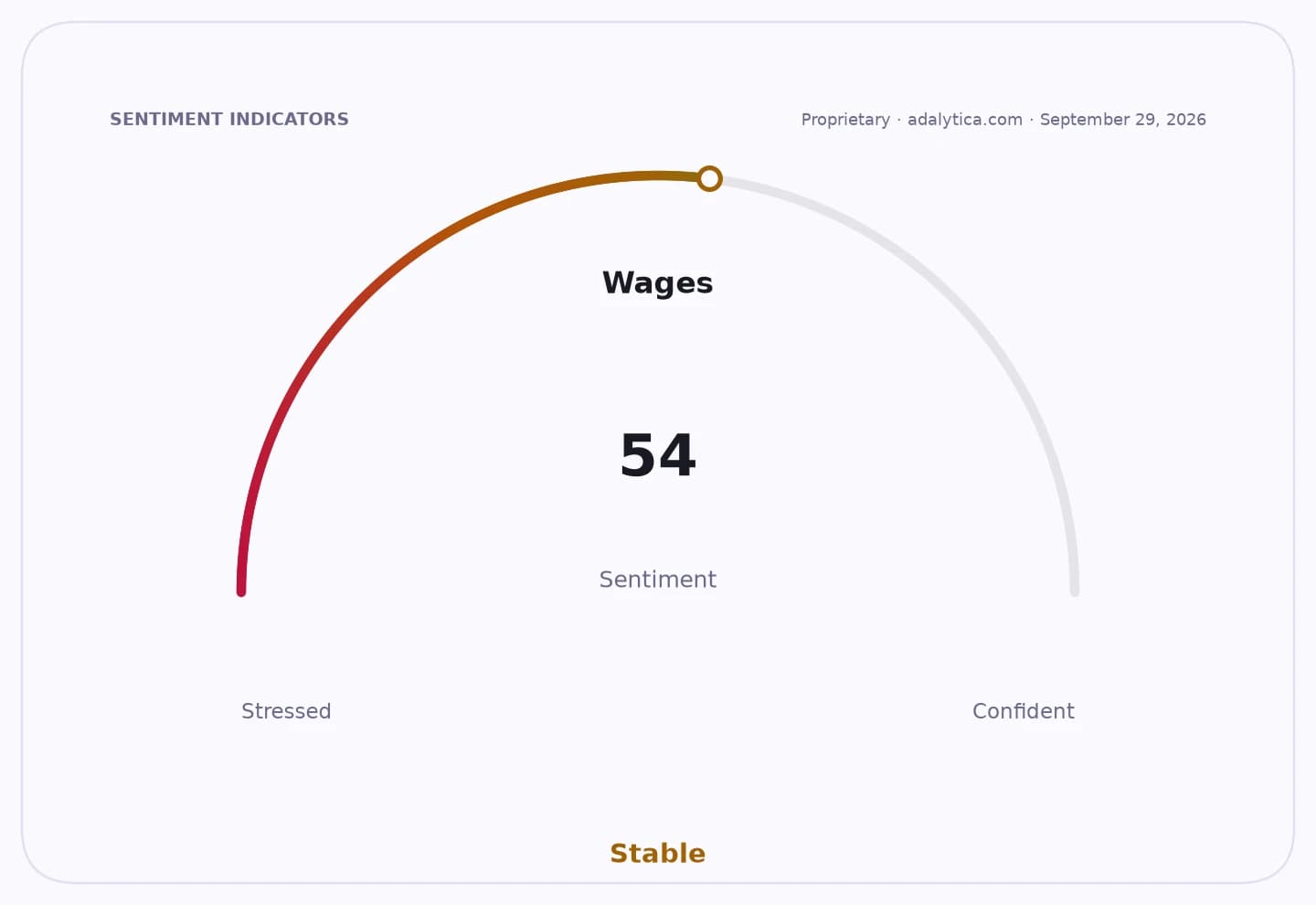
Sentiment IndicatorsⓘProprietary · adalytica.com · September 29, 2026
This is a snapshot — live sentiment, awareness and momentum for 130+ markets update continuously in the dashboard.Open AlphaPulse
The significance is less about the headline figures than the direction of travel. Minimum wage increases feed directly into labor costs for smaller firms, service businesses and labor-intensive manufacturers, while also lifting the base line for millions of lower-paid workers. In a period of patchy domestic demand and pressure on employment, the policy aims to bolster consumption at the margin without the blunt stimulus of a broad cash transfer.
China’s system gives provincial governments discretion to set wage floors based on local living costs, consumer prices, social insurance burdens, average wages and employment conditions. That flexibility helps explain the wide gap between Shanghai and poorer inland areas, but it also means wage adjustments are increasingly tied to local fiscal and labor-market conditions rather than a single national benchmark. The fact that Guangdong, Shanxi, Xinjiang and Yunnan were among the latest regions to revise standards suggests authorities are still calibrating the balance between worker protection and business affordability.
For investors, the implications are sector-specific rather than market-wide. The impact should be most visible for companies with high domestic labor intensity, including retail, logistics, hospitality, food services and some consumer manufacturing. Higher wage floors can pressure margins if pricing power is weak, but they can also support discretionary spending over time by improving take-home pay at the bottom end of the income distribution. That makes the policy mildly supportive for consumption-oriented names, even if the near-term effect on earnings is mixed.
The update also matters for asset markets because it reinforces the view that Beijing is leaning on gradual income support rather than a dramatic fiscal reset. That is consistent with the broader policy mix investors have seen in China: measured wage and social-policy adjustments, targeted local implementation and continued caution about overloading employers. For the FXI, MCHI and KWEB China equity ETFs, the move is not a direct trading catalyst, but it adds to the backdrop for consumer sentiment, labor costs and margins at a time when Chinese equities remain sensitive to domestic growth signals.
One important caveat is that China’s stated minimum wages are not always the same as workers’ actual take-home pay. In many regions, employee social insurance and housing fund contributions are counted within the minimum wage calculation, which can leave net pay below the posted floor. Shanghai is one of the few areas that explicitly excludes those deductions, making its headline number more protective in practice. That distinction matters for households and for companies evaluating compliance costs.
The broader narrative is clear: China is letting wages edge higher region by region to stabilize living standards and support consumption, but it is doing so in a way that keeps pressure manageable for employers. For investors, that means watching not only the wage floor itself, but whether higher labor costs start to show up in margins, pricing and hiring decisions across consumer-facing industries.
| Entity | Gains | Losses |
|---|---|---|
| Low-wage workers | ▲Higher pay floors | ▼No guaranteed real income boost |
| Consumer sectors | ▲Better household spending | ▼Higher payroll costs |
| Labor-intensive firms | ▲Policy stability | ▼Margin pressure |
| Inland provinces | ▲Gradual wage convergence | ▼Less room for cheap labor advantage |