China’s latest leadership purge matters less for the names removed than for the message it sends: Xi Jinping is tightening political control at the expense of institutional predictability, and that raises the risk premium on everything from policy execution to capital allocation.
China purge lifts political risk premium
The immediate economic significance is not that one more official has fallen, but that the campaign reinforces a governing style that prioritizes loyalty and discipline over technocratic continuity. For investors, that typically means slower policy transmission, less transparency around decision-making and a wider gap between stated economic goals and actual implementation. In a system already struggling with weak domestic demand, property stress and fragile confidence, a purge of senior figures is another reminder that political risk in China is not episodic — it is structural.
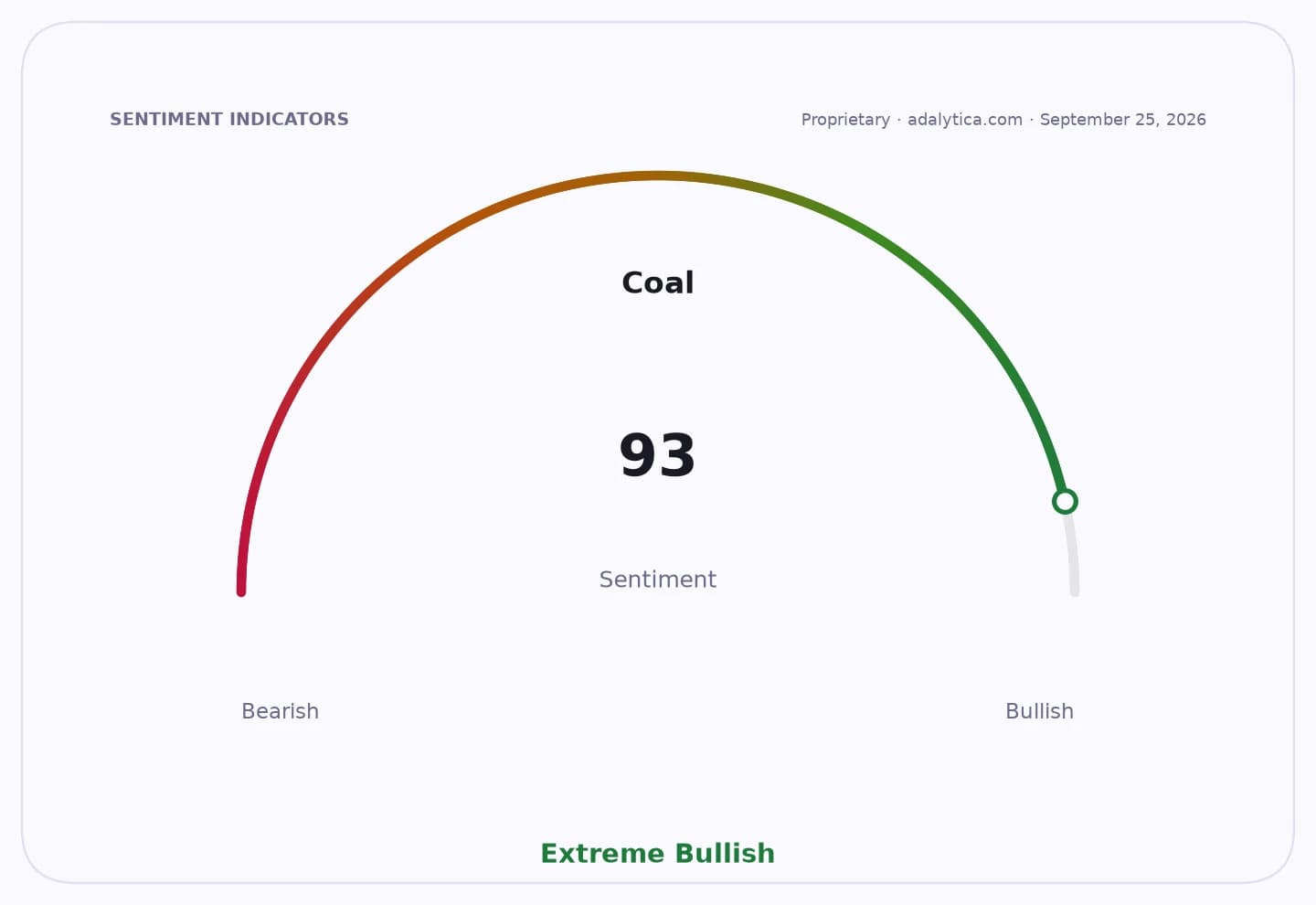
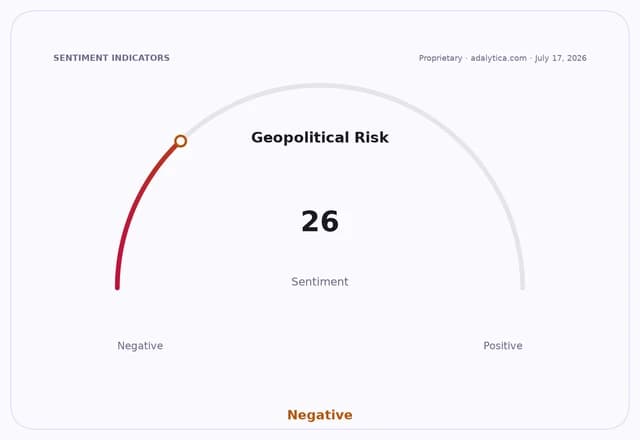
Sentiment IndicatorsⓘProprietary · adalytica.com · July 17, 2026
This is a snapshot — live sentiment, awareness and momentum for 130+ markets update continuously in the dashboard.Open AlphaPulse
Markets have been forced to price that uncertainty rather than any clear policy shift. The iShares China Large-Cap ETF, FXI, has recovered modestly to 34.53 from 33.77 a day earlier, but it remains well below its 200-day moving average near 37.22, a sign that the broader trend is still bearish despite the short-term bounce. The fund’s RSI has climbed to 90.4, an overbought reading, suggesting the move may be more tactical than foundational. The Invesco China Large-Cap ETF, MCHI, tells a similar story: it closed at 54.14, just under its 50-day moving average of 54.40 and still far below its 200-day line around 58.79, indicating China equities remain in a corrective phase rather than a sustained recovery.
The more levered expression of China optimism, the Direxion Daily FTSE China Bull 3X Shares, YINN, has also rebounded sharply to 27.72, but it is still a long way below its 200-day average near 38.94. That gap matters because it shows how quickly sentiment can turn on headline risk, and how little conviction remains behind rallies tied to stimulus hopes or easing rhetoric. The latest moves point to a market that is still trading China as a political-risk asset as much as a growth market.
US-China Relations vs FXIadalytica.com
Explore this data interactively — full history, time series and cross-market comparisons.Open AlphaPulse
That is why the purge resonates beyond domestic politics. A leadership shake-up can strengthen Xi’s control in the short run, but it also deepens concerns that cadre advancement depends more on ideological alignment than on economic competence. For companies, that can mean greater caution in boardrooms, more conservative capital spending and a heavier compliance burden. For foreign investors, it reinforces the argument for discounting Chinese assets relative to peers until there is clearer evidence that politics will support, rather than distort, economic management.
The backdrop is not helping. The benchmark 10-year U.S. Treasury yield has drifted to 4.55%, keeping global financial conditions relatively tight and preserving the appeal of safer developed-market assets. Against that, China needs stronger policy credibility to attract capital, not weaker institutional signals. Instead, the purge suggests the opposite: a system in which political survival outranks market confidence.
There is a bull case. Xi’s consolidation can be read as a bid to eliminate corruption, enforce discipline and push through industrial and strategic priorities more effectively. If the campaign improves execution on technology, supply chains and national security goals, Beijing may argue that the centralization of power ultimately supports long-term competitiveness.
But the bear case remains stronger for investors. Purges often create obedience, not efficiency. They can deter initiative, encourage risk aversion and make officials less willing to deliver bad news upward. That dynamic is especially damaging when China needs local governments, regulators and state firms to act decisively on debt, consumption and property-market repair.
The next catalysts will be whether the purge broadens into more senior civilian or economic posts, whether Beijing pairs political tightening with credible pro-growth measures, and whether foreign capital continues to treat China rallies as tradable bursts rather than durable regime shifts. For now, the message is clear: Xi’s latest purge is not just about personnel. It is about the kind of state China is becoming, and the valuation investors should assign to it.
| Entity | Gains | Losses |
|---|---|---|
| Xi Jinping and loyalists | ▲tighter control | ▼institutional predictability |
| Beijing’s security state | ▲authority and discipline | ▼policy flexibility |
| China equities bulls | ▲short-term tradeable rebounds | ▼sustained conviction |
| Foreign investors | ▲selective opportunities | ▼confidence in governance |