China is pulling ahead of the US in the race to commercialize humanoid robots, with its manufacturers accounting for 97% of global deliveries in the first half of this year and leveraging a supply chain advantage that could decide a market Morgan Stanley says may be worth more than $5 trillion by 2050.
China Robotics Makers Lead Humanoid Robot Deliveries
That matters because humanoid robots are moving from flashy demos into an industrial contest over manufacturing capacity, chips, sensors, software and data — the ingredients that will determine who captures the profits if robots become a mainstream labor tool. Investors are watching closely because the winners could span hardware makers, AI developers, chip suppliers and component vendors, while the losers may be companies forced to rely on foreign parts.
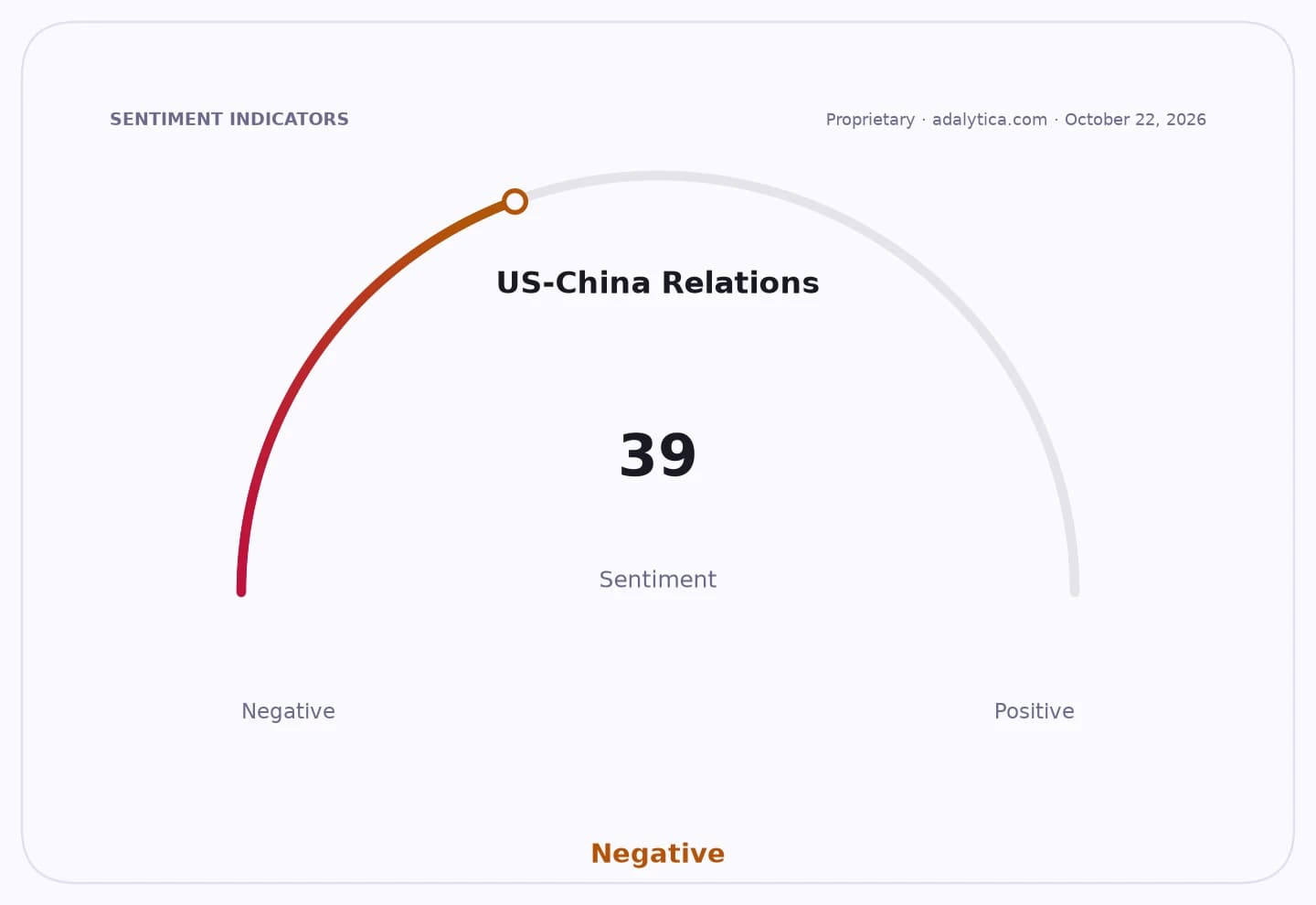
Sentiment IndicatorsⓘProprietary · adalytica.com · October 22, 2026
This is a snapshot — live sentiment, awareness and momentum for 130+ markets update continuously in the dashboard.Open AlphaPulse
The gap is not just about output. China’s edge comes from years of state backing, dense component ecosystems and a deep industrial labor pool, while US companies are leaning more heavily on AI models and advanced semiconductors to build the “brain” of the machine. That split has created two competing paths: China’s scale-first hardware model versus America’s software-and-chip-led approach.
The commercial stakes are already visible. LinkerBot, a Chinese supplier, says it provides more than 80% of advanced robotic hands used globally and counts Samsung, Meta and Siemens among customers. The company’s founder said the market still lacks dexterity — a reminder that impressive robot videos do not yet equal mass deployment — but that firms need real-world data to improve performance.
For Tesla, the manufacturing dependency is strategic. Morgan Stanley estimates Optimus production costs could nearly triple if Chinese parts were removed, underscoring how exposed US robot builders remain to China’s component dominance. China also controls 90% of permanent magnets used in robot joints, along with 40% of precision bearings, 40% of sensors and 30% of power electronics, according to the bank.
That supply-chain grip is one reason US robotics companies are pressing Washington for a national strategy. Jeff Burnstein, who leads the Association for Advancing Automation, said China has treated robotics and AI as a national priority for more than a decade, while the US has not. Agility Robotics has called for domestic supply-chain development and incentives for early adopters.
The fight is also turning into an AI talent race. US companies including Nvidia and OpenAI are pushing into physical AI and humanoid systems, while Elon Musk has said robots could outproduce humans within a few years. On the Chinese side, firms such as PsiBot are building cognition models for robots and attracting investors including Chery Automobile and Lens Technology.
Pricing could accelerate adoption. Bank of America forecasts component costs for a humanoid robot made in China could fall by about half to below $17,000 by the end of the decade, with deliveries rising from 20,000 last year to 10 million by 2035. If that happens, robots could move from novelty to a meaningful industrial input across factories, warehouses and service work.
The investor question is whether the US can close the gap before China locks in the ecosystem. Without policy support, researchers say the distance is likely to widen — and the spoils of a market that could eventually run into the trillions may accrue first to the companies that control factories, parts and training data.
| Entity | Gains | Losses |
|---|---|---|
| China robotics makers | ▲Scale, pricing power | ▼Exposure to export scrutiny |
| US robot builders | ▲Advanced chips, AI models | ▼Higher component costs |
| Component suppliers in China | ▲Global demand, volume growth | ▼Potential trade barriers |
| Tesla and peers | ▲AI-led innovation upside | ▼Dependence on Chinese parts |