China’s top military brass moved to reinforce its partnership with Russia on Tuesday, a reminder that the geopolitical split between Beijing and the West remains a powerful long-term tailwind for defense spending, sanctions risk and the global security trade.
China-Russia military ties support defense stocks
Geopolitical Risk
Zhang Shengmin, vice chair of China’s Central Military Commission, told Russian Defence Minister Andrei Belousov that Beijing was willing to “enhance strategic communication” and deepen mutual trust in the military field, China’s defence ministry said. The meeting matters because it points to a more formalized China-Russia security axis at a time when both countries are under sustained pressure from the U.S. and its allies, and when the market is already pricing in a sturdier global defense cycle.
Sentiment Indicators
For investors, the message is not just diplomatic theater. More coordination between Moscow and Beijing raises the odds of a more fragmented security order, with higher defense budgets, more procurement urgency and a longer runway for aerospace and missile suppliers. The cleanest beneficiaries are the large U.S. primes, which remain central to allied rearmament, missile defense, space systems and munitions replenishment.
That helps explain why Lockheed Martin, Northrop Grumman and RTX have stayed in focus despite recent volatility. Lockheed has been trading well above its 50-day and 200-day moving averages even after a sharp pullback, while Northrop and RTX have also held above their long-term trend lines, underscoring continued institutional interest in the defense trade. RTX, in particular, has rebounded from earlier weakness as investors rotate toward companies tied to air defense, sensors and counter-drone systems.
Geopolitical Risk vs LMTadalytica.com
Explore this data interactively — full history, time series and cross-market comparisons.
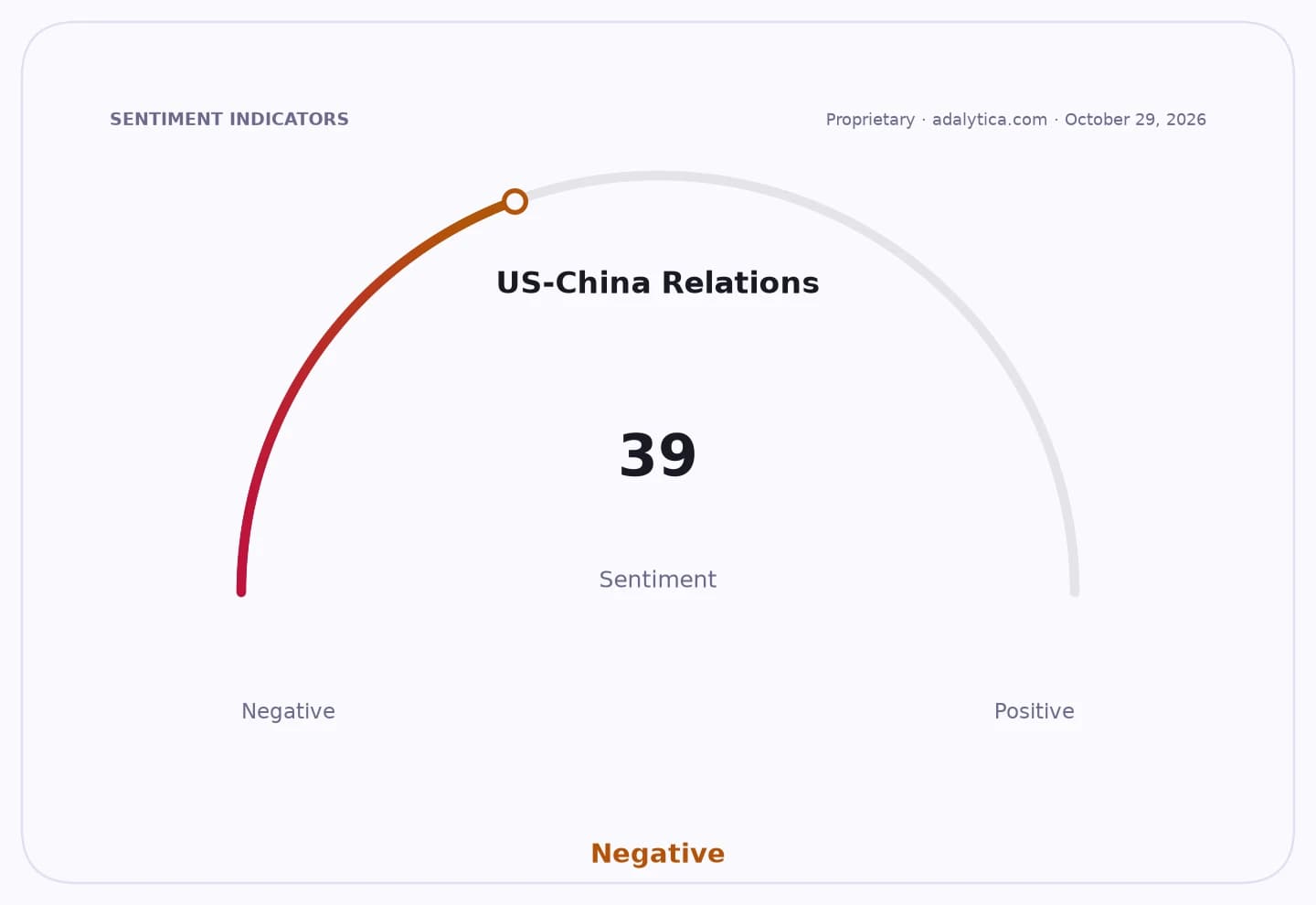
Adalytica’s Global Stability Sentiment gauge sits at an “Extreme Greed” reading of 93, while its U.S.-China Relations Sentiment gauge is at 75, suggesting markets are still treating geopolitical friction as an investable theme rather than a passing headline. That supports the case for owning defense on dips, especially names with exposure to munitions, missile warning, integrated air and missile defense, and space-based surveillance.
The bigger narrative is that China and Russia are not simply maintaining cordial ties; they are building a strategic counterweight that keeps the West on a higher alert setting. That does not just affect diplomacy. It sustains demand for readiness, inventory, and deterrence — the exact mix that has powered the defense supercycle.
For investors, the takeaway is straightforward: any deepening Beijing-Moscow military alignment reinforces the case for long-duration exposure to defense, with the best risk-reward still in companies that sell the picks-and-shovels of deterrence rather than headline-sensitive combat platforms.
| Entity | Gains | Losses |
|---|---|---|
| Lockheed Martin | ▲Missile and air-defense demand | ▼De-escalation trades |
| Northrop Grumman | ▲Space and nuclear deterrence spending | ▼Lower threat perception |
| RTX | ▲Sensors and integrated defense orders | ▼Budget-cut rotation |
| U.S. allies | ▲Urgency to rearm | ▼Procurement delays |