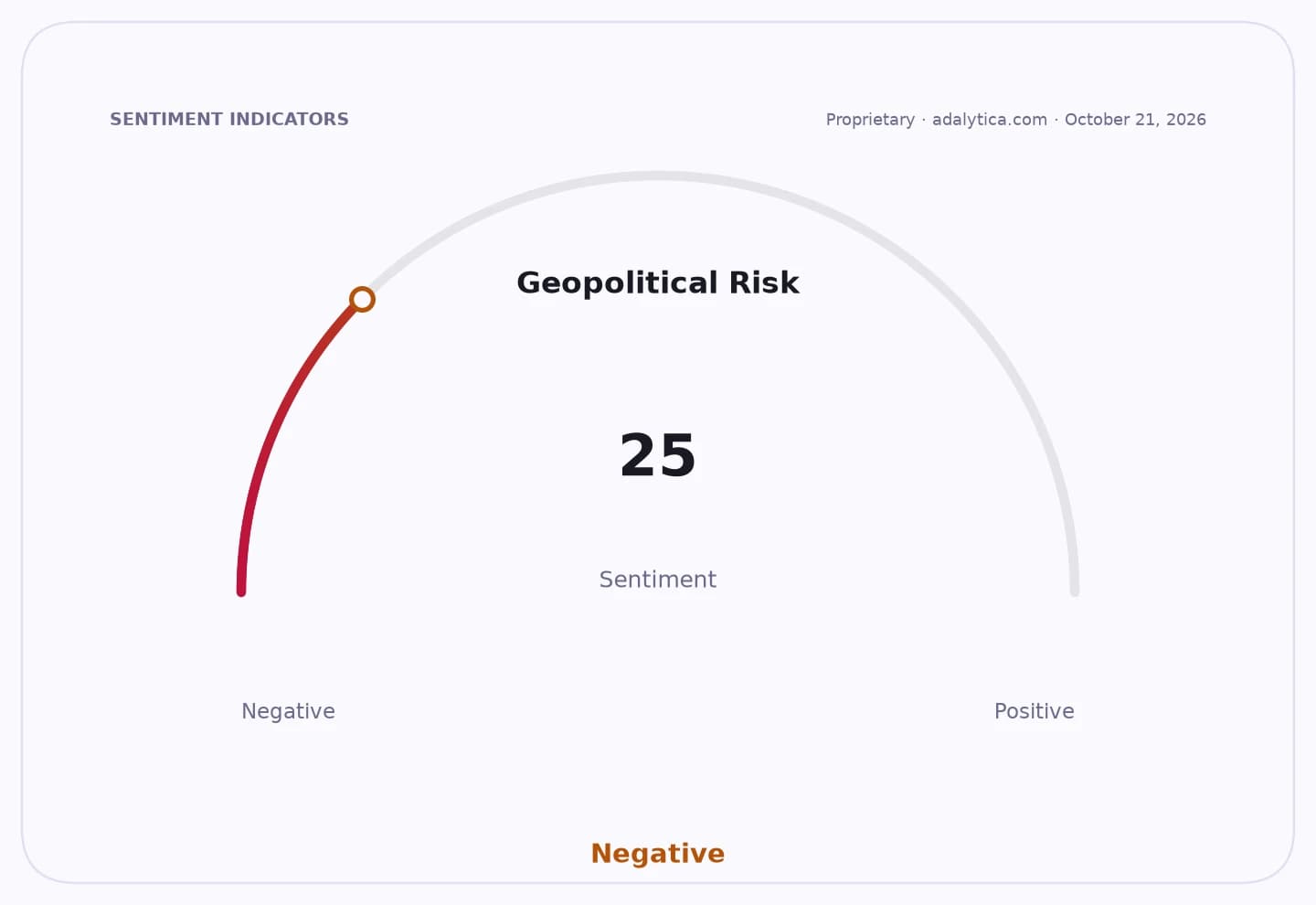
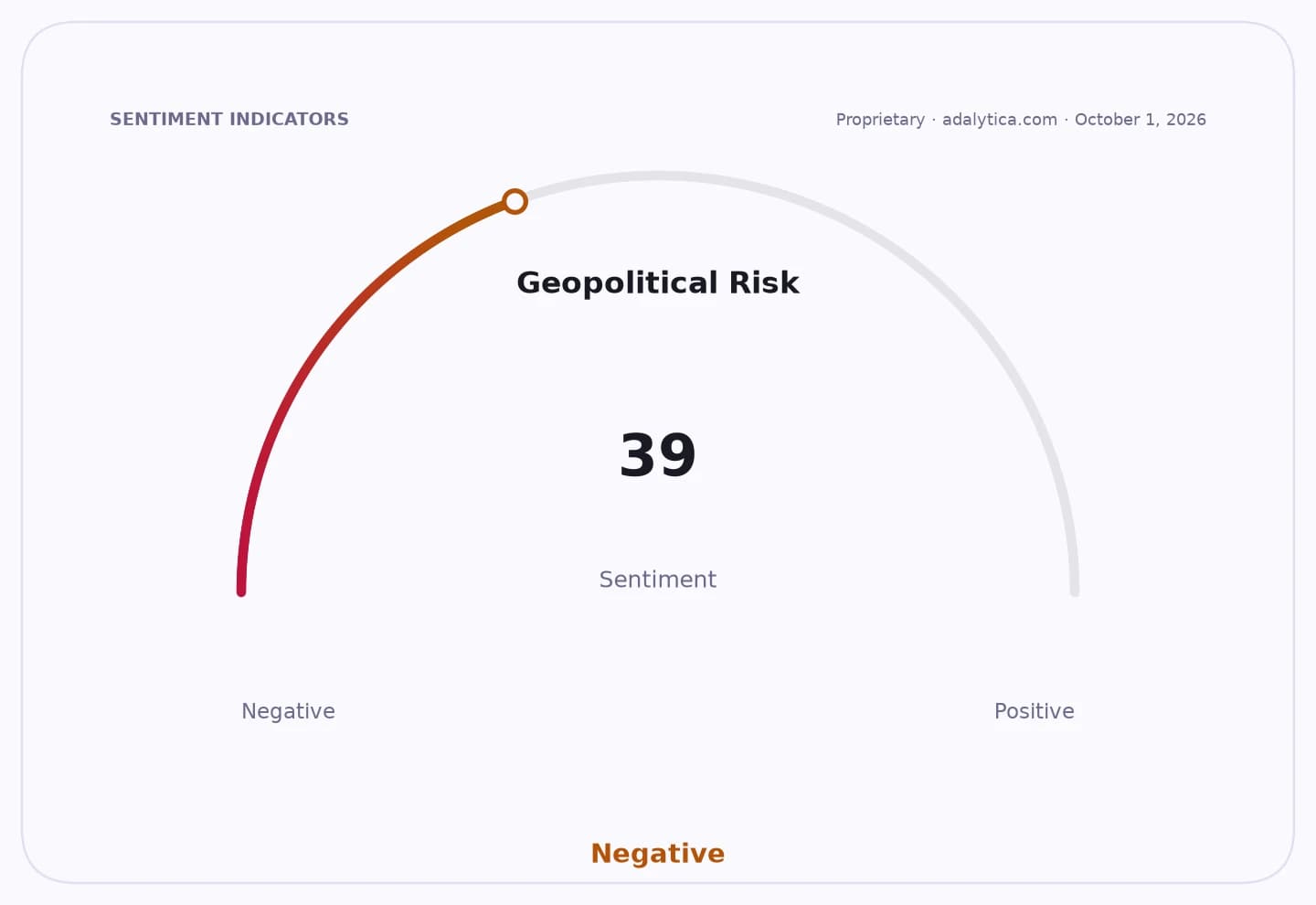
The Pentagon’s reported push to build a covert spy network aimed at China matters because it shows Washington is treating economic competition as a battlefield, not just trade policy.
Pentagon Spy Report Lifts Defense Stocks Watch
If the Washington Post report is accurate, the Defense Department is preparing a deeper, more secretive intelligence effort that would use agents posing as business professionals to collect economic and technology information on China and other rivals. That would be a major escalation in how the U.S. pursues its contest with Beijing, moving beyond tariffs and export controls toward a more aggressive blend of espionage, industrial policy and national security strategy.
Sentiment Indicators
For investors, the important point is not whether this exact program becomes operational — the Pentagon has denied the report — but what it says about the direction of policy. The U.S. is already tightening scrutiny around advanced semiconductors, artificial intelligence, biotechnology and critical minerals. The reported plan suggests that pressure on China’s technology ecosystem could become more persistent and more sophisticated, with more intelligence gathered on supply chains, investment flows and strategic chokepoints.
That is a favorable backdrop for defense contractors that benefit when geopolitical risk rises and Washington prioritizes surveillance, intelligence and electronic warfare. Lockheed Martin, Northrop Grumman and RTX all trade as direct proxies for a world in which great-power rivalry stays elevated. Their businesses are already tied to higher defense spending, classified programs and modernization budgets. The latest trading data show investors remain willing to pay up for that exposure, with Lockheed Martin closing at $629.75 on Oct. 28, Northrop at $552.77 and RTX at $195.84.
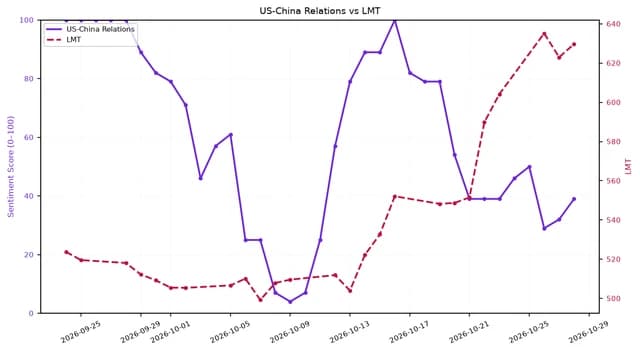
The market is also telling a simpler story: geopolitical tension still carries a premium. Lockheed shares have rallied back above both the 50-day and 200-day moving averages, while its relative strength index was a frothy 85.9 on the latest data, a sign of strong momentum. Northrop has also climbed back above its 50-day average, while RTX has turned higher as well after a sharp summer swoon. In other words, investors are already positioning for a long cycle of elevated security spending and strategic competition.
The broader economic logic is easy to see. The U.S. has increasingly treated chips, minerals and technical know-how as national assets. The report says Pentagon officials have discussed using retired CIA officers and a covert “nonofficial cover” model to gather information under commercial guise. That would fit a policy environment in which the boundaries between commerce, intelligence and defense keep blurring. It also helps explain why Washington is leaning so hard on investment restrictions, export controls and targeted investment in rare earths and minerals.
There are real risks to the plan, if it exists. Former officials cited legal uncertainty, operational challenges and the difficulty of hiding U.S. military ties in an era of biometric surveillance and digital footprints. The Pentagon’s denial and the absence of clear congressional notification suggest the idea may be politically toxic as well as legally murky. That means investors should not assume a new procurement boom from this alone.
Still, the message for long-term holders is clear: U.S.-China rivalry is not cooling, and the defense sector remains one of the most direct ways to own that trend. For diversified investors, these stocks are worth watching, but the better lesson is that geopolitical compounding often lasts longer than headlines. If Washington keeps widening the economic war footing, defense names with deep intelligence and surveillance capabilities could stay in favor for years, not weeks.
| Entity | Gains | Losses |
|---|---|---|
| Lockheed Martin, Northrop Grumman, RTX | ▲Higher defense premium | ▼Noisy headline risk |
| U.S. security apparatus | ▲More intelligence reach | ▼Legal and oversight scrutiny |
| China’s tech and industrial targets | ▲Nothing obvious | ▼More surveillance and pressure |
| Long-term defense investors | ▲Geopolitical hedge | ▼Near-term valuation volatility |