China and the United States have reopened military contacts after a two-year freeze, a small but economically meaningful sign that the world’s two largest powers are trying to reduce the risk of a miscalculation that could jolt supply chains, energy markets and defense spending.
China U.S. Military Contacts Resume After Two-Year Freeze

The breakthrough came in Victoria, British Columbia, where the commander of China’s Eastern Theater Command, Gen. Yang Zhibin, met his U.S. Pacific counterpart at an Indo-Pacific chiefs-of-staff conference on Aug. 31, according to the South China Morning Post. It was the first such contact since Beijing cut military links in 2022, and only the second since then after a meeting in Hawaii in September 2024.
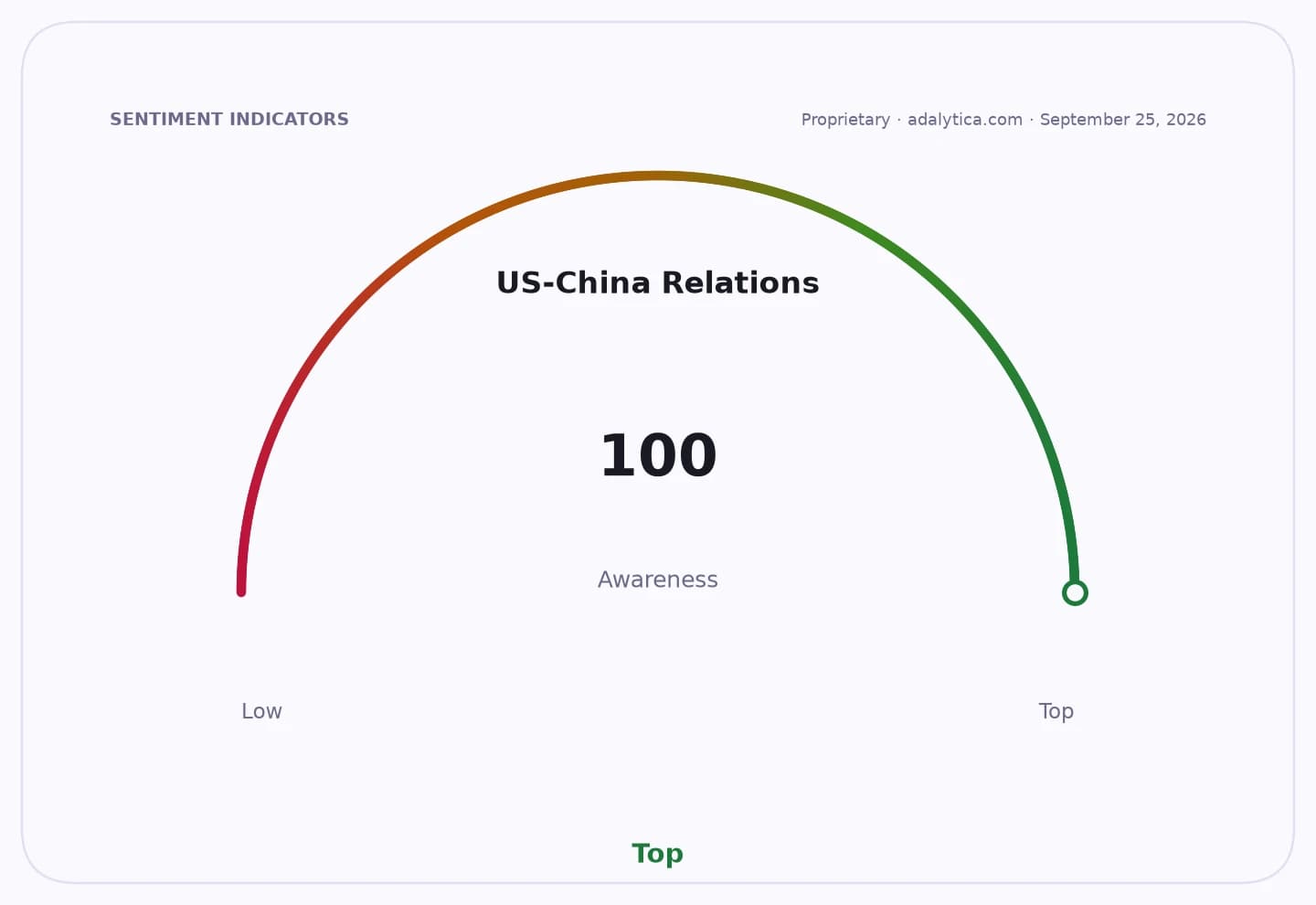
Sentiment IndicatorsⓘProprietary · adalytica.com · September 5, 2026
This is a snapshot — live sentiment, awareness and momentum for 130+ markets update continuously in the dashboard.Open AlphaPulse
The importance is not the symbolism alone. Direct military channels matter most when tensions over Taiwan, the South China Sea and the broader Indo-Pacific are elevated, because they reduce the odds that an incident at sea or in the air escalates into a broader confrontation. For investors, that means a modest but real repricing of geopolitical tail risk: fewer emergency scenarios, less pressure on shipping and insurance costs, and a slightly better backdrop for cross-border trade and industrial planning.
The conference itself underscored how high the stakes remain. Thirty-two military representatives from 29 countries took part over three days, with both sides emphasizing the need for open communication to prevent “miscalculations” and promote “safe and professional” behavior between forces. That language is diplomatic, but the market implication is straightforward: Washington and Beijing are trying to manage rivalry without allowing it to spill into a crisis.
US-China Relations — 30-day sentimentadalytica.com
Explore this data interactively — full history, time series and cross-market comparisons.Open AlphaPulse
That matters because the investment playbook for U.S.-China relations remains built around the same secular winners. A thaw in contact does not change the strategic competition, but it can reduce the likelihood of abrupt policy shocks that hit semiconductors, defense procurement, shipping and energy. The tension premium embedded in sectors tied to the Pacific theater may narrow at the margin, while companies exposed to global trade get a bit more breathing room.
The market has already shown how sensitive it is to geopolitical swings. China-focused assets, including the FXI ETF, have been recovering from a volatile stretch, while broader U.S. equities continue to trade near record territory. Technical readings on FXI show the fund holding above its 50-day moving average, with momentum improving but still below the longer-term 200-day average, a setup that suggests investors are willing to add China exposure without fully pricing in a durable détente. U.S. stocks, meanwhile, remain resilient, showing that risk appetite has not been derailed by the geopolitical backdrop.
Oil is the other obvious market channel. The USO ETF has surged sharply this year and remains elevated, reflecting a market that still prices geopolitical and supply risk across the Middle East and beyond. Any reduction in great-power friction in the Indo-Pacific helps remove one more source of upside pressure on energy and freight, even if it does not change the broader oil balance on its own.
My view is that the market underestimates how much value sits in avoiding the wrong headline. Investors do not need a grand U.S.-China reset to benefit; they need fewer surprises, fewer military incidents and less policy whiplash. That favors the large-cap platforms and infrastructure names that can compound through noise, as well as defense contractors that remain supported by the fact that rivalry is still rivalry, just more managed.
The real catalyst to watch is whether the 2024 Hawaii contact becomes routine rather than exceptional. If military-to-military communication continues, it lowers the odds of an accidental escalation around Taiwan and supports a more stable risk premium across Asia-linked assets. If it breaks down again, the market will quickly remember how fast premiums can reprice.
For investors, the takeaway is to stay positioned for a world of managed competition, not peace. That means owning the beneficiaries of geopolitical containment — defense, cybersecurity, energy security and supply-chain resilience — while using any improvement in U.S.-China dialogue to accumulate quality China exposure selectively, rather than chase an outright détente.
| Entity | Gains | Losses |
|---|---|---|
| U.S. and China militaries | ▲Lower miscalculation risk | ▼Less leverage from brinkmanship |
| Defense contractors | ▲Ongoing strategic demand | ▼Brief de-risking in tension premium |
| China equities, including FXI | ▲Better risk sentiment | ▼Still capped by strategic rivalry |
| Oil and shipping markets | ▲Less crisis-driven volatility | ▼Smaller geopolitical risk premium |