Consumer confidence is edging higher even as business confidence weakens, a split that matters because it suggests households are still willing to spend while companies grow more cautious on hiring and investment.
Consumer-business confidence split clouds growth outlook

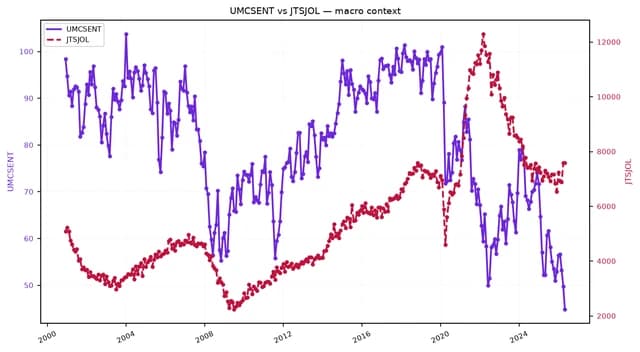
The latest University of Michigan reading on consumer sentiment is forecast to fall to 43.18 in June from 44.8 in May, extending a collapse from 53.3 in March and leaving confidence near recessionary territory. Yet the labor market has not cracked: the unemployment rate slipped to 4.2% in June from 4.3%, and job openings, while still far below the post-pandemic peak, held at 7.594 million in May, up from 7.585 million in April and ahead of the 7.6569 million forecast for June.
That divergence is economically important because the U.S. expansion has increasingly depended on consumers, not companies. If households keep spending, growth can limp along even with softer corporate sentiment. But if businesses respond to weaker confidence by slowing capital expenditure, trimming payroll plans or delaying replenishment, the lag eventually shows up in earnings, wage growth and broader demand.
For investors, the split is a warning that the market may be pricing too neat a landing. SPY has rebounded to 748.28, back above its 50-day and 200-day moving averages, but the move comes after a sharp spring selloff and with momentum still uneven. The index’s relative strength reading has recovered from deeply oversold levels, yet the broader backdrop remains one of fragile conviction rather than durable risk appetite.
The consumer side still looks resilient on the surface. Adalytica’s Consumer Spending Sentiment gauge remains in “Extreme Greed” at 86, even after a decline over the past month. That suggests households have not yet turned defensive in a way that would typically precede a spending retrenchment. But the confidence backdrop is deteriorating: Adalytica’s Consumer Confidence Recession Sentiment remains firmly in “Fear,” even after a small one-day rebound, pointing to anxiety about income security and the economic outlook.
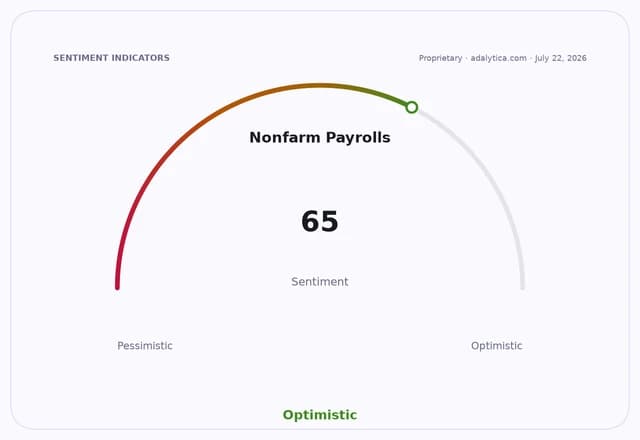
Businesses are telling a different story. The broader message from payroll and confidence indicators is one of caution, not collapse. Adalytica’s Nonfarm Payrolls Sentiment sits in neutral territory, while its awareness score is in “Extreme Fear,” a sign that labor-market uncertainty is rising even if outright job losses are not yet the dominant narrative. In practical terms, that usually means slower hiring, more selective investment and tighter cost controls before it means a full downturn.
The macro risk is that consumer resilience is doing the heavy lifting while corporate caution builds beneath it. That can sustain growth for a time, but it also leaves the economy vulnerable if spending cools even modestly. With confidence near multi-year lows and the labor market no longer improving quickly, the margin for error is thin.
For markets, the key question is whether this divergence resolves through a re-acceleration in business activity or through a belated cooling in consumer demand. If companies regain confidence, equities could justify current levels and cyclicals may outperform. If not, the present mix of steady jobs and weak sentiment points to slower growth, softer margins and more defensive positioning in the months ahead.
| Entity | Gains | Losses |
|---|---|---|
| Consumers | ▲Near-term spending power | ▼Confidence and caution |
| Businesses | ▲Stable demand if spending holds | ▼Hiring and investment appetite |
| Equities/SPY | ▲Rebound if growth persists | ▼Valuations if growth slows |
| Defensive assets | ▲Less immediate need | ▼Safe-haven appeal if sentiment worsens |




