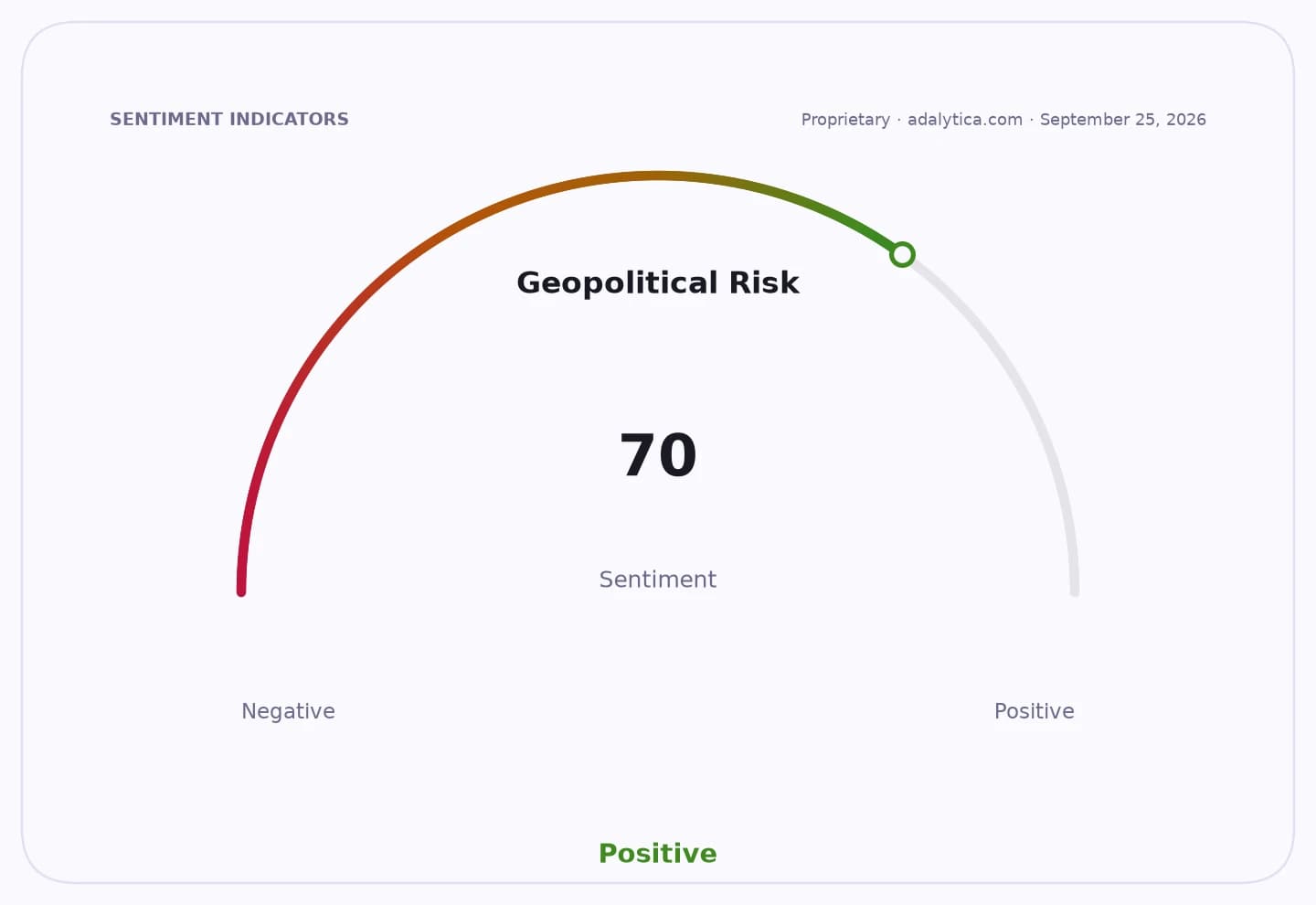
Household consumption is proving more resilient than inflation had suggested, with families spending an extra 314 euros a year even as prices continue to rise. That is economically important because it points to demand that remains intact despite higher living costs, and it complicates the policy debate over how quickly governments and central banks can normalize without choking off growth.
Consumer Spending Holds Up as Inflation Persists

The message for markets is that consumers are still absorbing price increases rather than pulling back sharply. In macro terms, that supports near-term activity in retail, travel and discretionary services, while also suggesting inflation may be proving stickier than many hoped if firms can keep passing through higher costs. The combination is particularly relevant as policymakers try to balance support for growth with pressure to tighten public finances.
Sentiment IndicatorsⓘProprietary · adalytica.com · August 11, 2026
This is a snapshot — live sentiment, awareness and momentum for 130+ markets update continuously in the dashboard.Open AlphaPulse
The backdrop remains one of elevated inflation. The U.S. consumer price index, which is often used as a benchmark for broader price trends, stood at 332.568 in June 2026 after a 40.06% increase from the prior reading in the data set, while the forecast for July points to another 0.89% monthly gain. Energy costs are still part of the picture too: West Texas Intermediate crude was recently trading around $81.96 a barrel, a level that keeps fuel and transport costs from easing much.
That matters because household spending is ultimately the bridge between inflation and corporate earnings. If consumers keep opening their wallets, companies in discretionary segments can defend revenue and margins better than in a demand downturn. That is reflected in exchange-traded funds tied to consumer and communications stocks, both of which have held up better than during the spring selloff and are now trading above their 50-day and 200-day moving averages. XLY closed at 119.67 on Aug. 10, above both its 50-day and 200-day averages, while XLC finished at 111.83, also above both levels.
Still, the strength in spending is not an unqualified positive. Investors need to weigh the bull case — resilient demand, better earnings visibility and less risk of an abrupt recession — against the bear case, which is that consumers are being forced to spend more just to buy the same basket of goods and services. In that scenario, nominal spending can rise even as real purchasing power stays under pressure, leaving households more exposed if wages soften or energy prices climb again.
The market also has to consider policy spillovers. Japan’s plan to keep tax relief temporary before restoring the consumption tax rate underscores how governments are trying to support demand without worsening debt dynamics. At the same time, U.S. trade and inflation expectations gauges from Adalytica.com show heightened attention to price pressures and the dollar, reinforcing the view that investors are still treating inflation as a live macro risk rather than a solved problem.
For now, the key takeaway is that consumers are still spending through inflation, and that keeps growth alive even as it leaves policymakers with fewer comfortable options. If price pressures cool, the result could be a soft landing for earnings and valuations. If they do not, the extra 314 euros a year may prove less a sign of prosperity than a sign that households are paying more for less.
| Entity | Gains | Losses |
|---|---|---|
| Consumer-facing companies | ▲Higher nominal sales | ▼Demand sensitivity if prices rise further |
| Households | ▲Continued access to goods and services | ▼Lower real purchasing power |
| Equities tied to discretionary spending | ▲Better revenue visibility | ▼Valuation risk if inflation re-accelerates |
| Policymakers | ▲Evidence of economic resilience | ▼Harder inflation and fiscal trade-offs |