International corn and sugar prices are climbing even as rice and soybean oil ease, a split move that points to a tighter, more uneven global food market and keeps pressure on inflation-sensitive consumers and food companies.
Corn and Wheat Prices Rise as Rice Eases

The broader significance is that staple-crop prices are still being driven by supply shocks rather than a clean, broad-based demand recovery. In commodities, that matters because food prices feed directly into consumer inflation and central-bank policy, while also shaping margins for grocers, packaged-food makers and livestock producers. The latest move fits a market where Black Sea disruption, drought damage in Europe and lingering logistics risks continue to distort grain availability, even as some edible oils and rice prices retreat.
Sentiment IndicatorsⓘProprietary · adalytica.com · August 22, 2026
This is a snapshot — live sentiment, awareness and momentum for 130+ markets update continuously in the dashboard.Open AlphaPulse
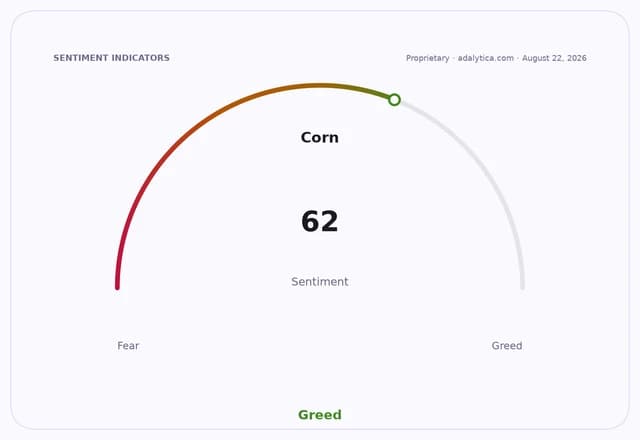
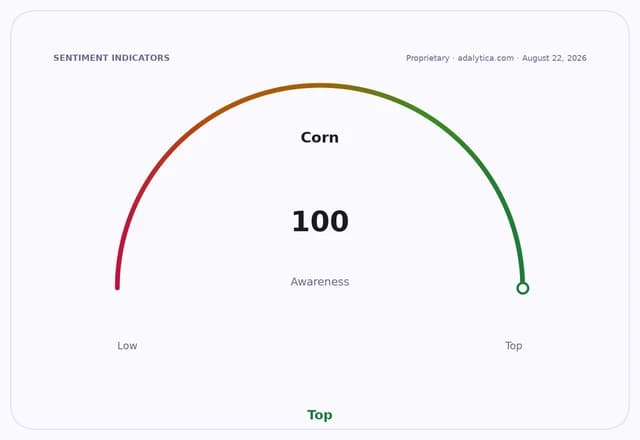
Corn was the clearest winner. The CORN fund rose to 19.01 on August 21 from 18.76 the prior session, extending a sharp rebound after a mid-June low near 16.47. Technical readings show the move has regained momentum: the fund is trading above both its 50-day and 200-day moving averages, while RSI remains elevated at 71.4, a sign of strong near-term buying interest. Adalytica’s Corn Fear & Greed Index also flashed “Extreme Greed” on awareness, suggesting the market is highly focused on the crop’s outlook.
Wheat has been even more constructive for bulls. The WEAT fund finished at 25.41, near its recent highs and above its 50-day and 200-day moving averages. That matters because wheat remains the most macro-sensitive grain in the basket, with supply concerns amplified by the war in Ukraine and weather stress in parts of Europe. Reuters and Bloomberg reporting has repeatedly shown how attacks on Black Sea export routes and drought in key producing regions have tightened international supplies and lifted prices for bread, feed and processed foods.
The inflation implication is straightforward: when corn and wheat rise together, food manufacturers usually face a lagged but persistent input-cost squeeze. Companies such as Mondelez, Campbell and Flowers Foods have already flagged higher input costs and the need for pricing actions to protect margins. That makes the current move relevant not only for crop traders, but also for equities tied to food production, packaging and livestock feed.
Soybeans tell a different part of the story. SOYB edged up to 26.24, but soybean oil was among the softer parts of the complex, underscoring that this is not a uniform agricultural rally. Rice also eased, suggesting ample pockets of supply remain and that recent gains are concentrated in crops with the most obvious weather and geopolitics risk.
For investors, the key issue is whether the rise in corn and wheat proves temporary or turns into a broader second-wave food inflation trade. If Black Sea exports remain constrained and weather conditions stay adverse, agricultural inflation could remain sticky even as headline consumer prices cool elsewhere. If not, the divergence across grains may keep the market range-bound rather than trigger a full-blown commodity spike.
| Entity | Gains | Losses |
|---|---|---|
| Corn bulls | ▲Higher prices, stronger momentum | ▼Feed users, importers |
| Wheat producers | ▲Better selling prices | ▼Bakers, food makers |
| Consumers | ▲— | ▼Higher food costs |
| Food companies | ▲— | ▼Margin pressure |