Fitch’s affirmation of Türkiye’s BB- rating with a stable outlook is a reminder that in today’s financing market, creditworthiness is no longer just about default risk — it is about whether investors believe the borrower will stay disciplined when capital gets more expensive and global liquidity turns fickle.
Credit Discipline Favored as Rates Stay High

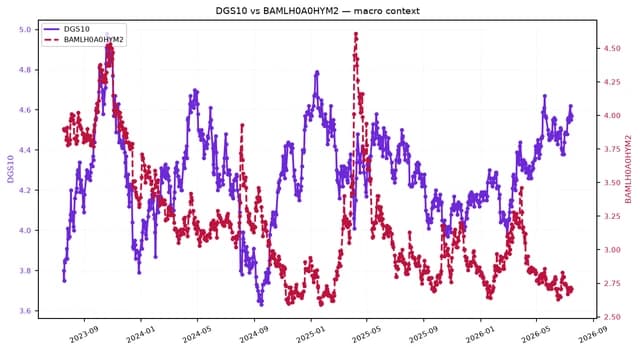
That matters because the cost of trust is rising. The U.S. 10-year Treasury is hovering around 4.56%, while high-yield credit spreads remain tight at about 2.72 percentage points, a combination that tells you markets are still willing to lend — but only to borrowers they think will keep faith with creditors. In a world of higher-for-longer rates, “good faith” has become an economic asset: it lowers funding costs, widens the buyer base for debt, and buys time when growth slows.
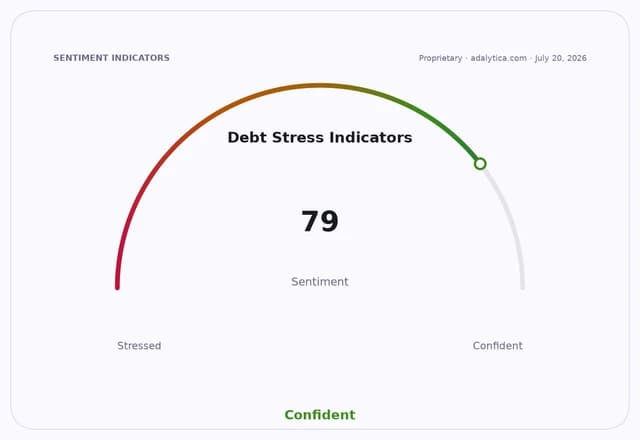
Sentiment IndicatorsⓘProprietary · adalytica.com · July 20, 2026
This is a snapshot — live sentiment, awareness and momentum for 130+ markets update continuously in the dashboard.Open AlphaPulse
The broader message is especially important for financial stocks. U.S. unemployment sits near 4.2%, suggesting the consumer backdrop is not deteriorating in a disorderly way, but household stress signals are flashing warning signs. Adalytica’s Household Debt Stress Sentiment is at 79, labeled Greed, even as awareness remains in Extreme Fear territory, a split that suggests credit optimism can turn quickly if delinquencies climb. That tension is exactly why lenders with disciplined underwriting and strong data advantages tend to outperform when credit cycles mature.
Capital One and Synchrony are both trading well above their spring lows, with Capital One at $208.03 and Synchrony at $73.62, but the tape is still telling a more selective story than the headline index. Capital One remains below its 200-day moving average near $206.38, while Synchrony is roughly flat to its 200-day average at $73.79. Those are not euphoric setups; they are rebuilding phases. The market is rewarding institutions that can prove credit quality, while punishing those that look exposed to consumer fragility or funding volatility.
The investor takeaway is straightforward: this is not a time to chase every lender, but to own the franchises that can price risk, verify behavior and monetize trust. Credit bureaus, scorekeepers and data-rich lenders remain the toll roads of modern finance because everyone else has to pass through them. That includes companies like Capital One, Synchrony and credit infrastructure names such as FICO, which benefit when lenders become more selective and borrowers have to prove themselves more often.
Türkiye’s stable rating outlook underscores the same point on the sovereign side. In an era of expensive capital, markets are paying a premium to borrowers that can keep policy credible, preserve reserve buffers and avoid surprises. For investors, that means the best opportunities sit with balance sheets that can defend confidence — and the biggest risks sit with issuers that still rely on it being cheap.
| Entity | Gains | Losses |
|---|---|---|
| High-discipline lenders | ▲Lower funding risk | ▼Less room for sloppy growth |
| Credit infrastructure firms | ▲More demand for scoring and verification | ▼Borrower disintermediation |
| Türkiye | ▲Stable access to capital markets | ▼No upgrade momentum |
| Weak-credit borrowers | ▲Short-term refinancing pressure | ▼Higher spreads and scrutiny |




