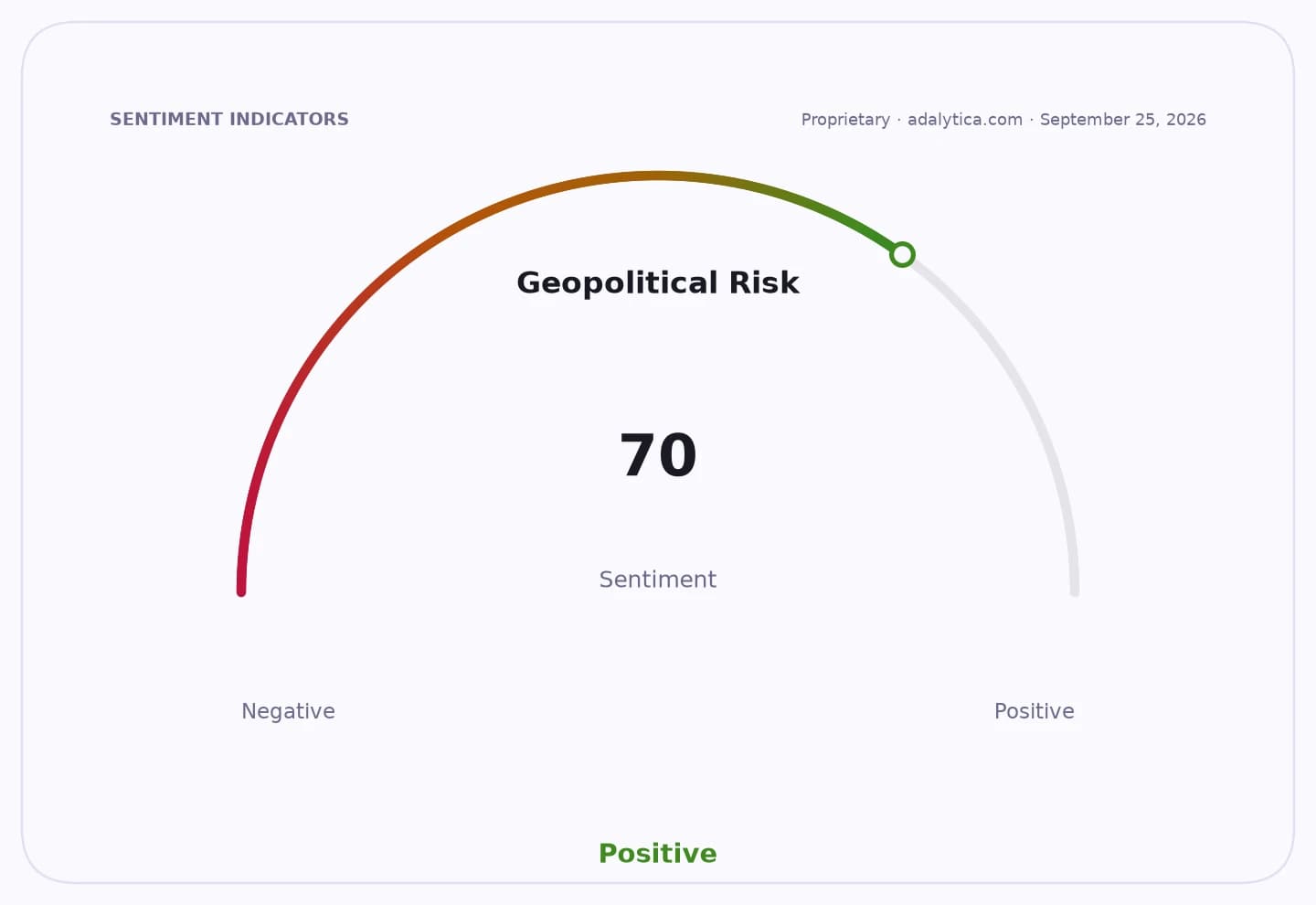
The Czech Republic’s rising public debt is becoming more than a budgetary statistic: it is a growing drag on fiscal flexibility, a warning sign for future borrowing costs and a potential headwind for domestic assets if the government cannot slow the pace of debt accumulation.
Czech debt rises as fiscal flexibility shrinks

At 14,120 euros of debt per capita, the burden underscores how quickly liabilities can compound even in an economy that has generally been viewed as more disciplined than some peers. The problem for policymakers is not just the absolute level, but the trajectory. A steadily larger debt stock means a bigger share of future tax revenue will be diverted to interest and refinancing, leaving less room for public investment, support for households or countercyclical spending if growth weakens.
Sentiment IndicatorsⓘProprietary · adalytica.com · July 18, 2026
This is a snapshot — live sentiment, awareness and momentum for 130+ markets update continuously in the dashboard.Open AlphaPulse
That matters economically because the Czech state is operating in an environment where borrowing is no longer cheap by historical standards. Ten-year US Treasury yields are around 4.56%, well above the ultra-low rates of the pandemic era, while the Federal Reserve’s policy rate sits at 3.63%. Even though Czech funding costs are set by local conditions, the global backdrop still matters: higher international rates tend to keep sovereign financing expensive, especially for smaller, open economies that rely on investor confidence. In other words, a rising debt ratio is more painful now than it was when global money was essentially free.
For investors, the key issue is whether the debt trend stays manageable or starts to pressure Czech sovereign spreads, the koruna and domestic risk assets. Markets generally tolerate higher debt when growth is solid and the fiscal path is credible. They become more cautious when borrowing rises without a convincing plan to stabilize it. That is why the debt-per-capita figure matters less as a headline number than as a signal that the state’s policy choices will increasingly be scrutinized.
The broader European backdrop adds to the significance. Investors have been rotating between riskier and safer assets as growth expectations and policy rates move around. Exchange-traded funds tracking Czech and European equities have held up, but the macro message is mixed: EWC, which tracks Canada, has pushed to record highs with its 50-day and 200-day moving averages rising, while Europe’s EZU has also recovered. That resilience suggests markets are not pricing in a broad funding crisis. But it also means country-specific fiscal slippage can quickly stand out against a still-favorable global equities backdrop.
The narrative, then, is straightforward: the Czech Republic is not facing an immediate debt emergency, but it is moving into a phase where every additional koruna of borrowing carries more economic cost. If growth slows or rates stay elevated, the debt burden will become harder to absorb, forcing tougher choices on spending, taxes or both. For investors, the next catalysts are the government’s budget path, any shift in borrowing projections and whether markets begin to demand a higher premium for holding Czech risk.
| Entity | Gains | Losses |
|---|---|---|
| Bond investors | ▲higher yield potential | ▼fiscal slippage risk |
| Czech government | ▲near-term funding access | ▼rising interest burden |
| Taxpayers | ▲none | ▼future budget squeeze |
| Local economy | ▲short-term stimulus if spent | ▼less fiscal room later |