Investors on the German stock market have already braced for more pain, and that pessimism is helping the DAX avoid a sharper selloff for now.
DAX Pessimism Limits Selling, Not Recovery
That is the key message from a Handelsblatt survey: the market’s weakness is no longer shocking investors, which limits the damage, but a fast rebound is still not on the table. For long-term investors, that combination matters because it usually says more about nerves and positioning than about the underlying economy alone.
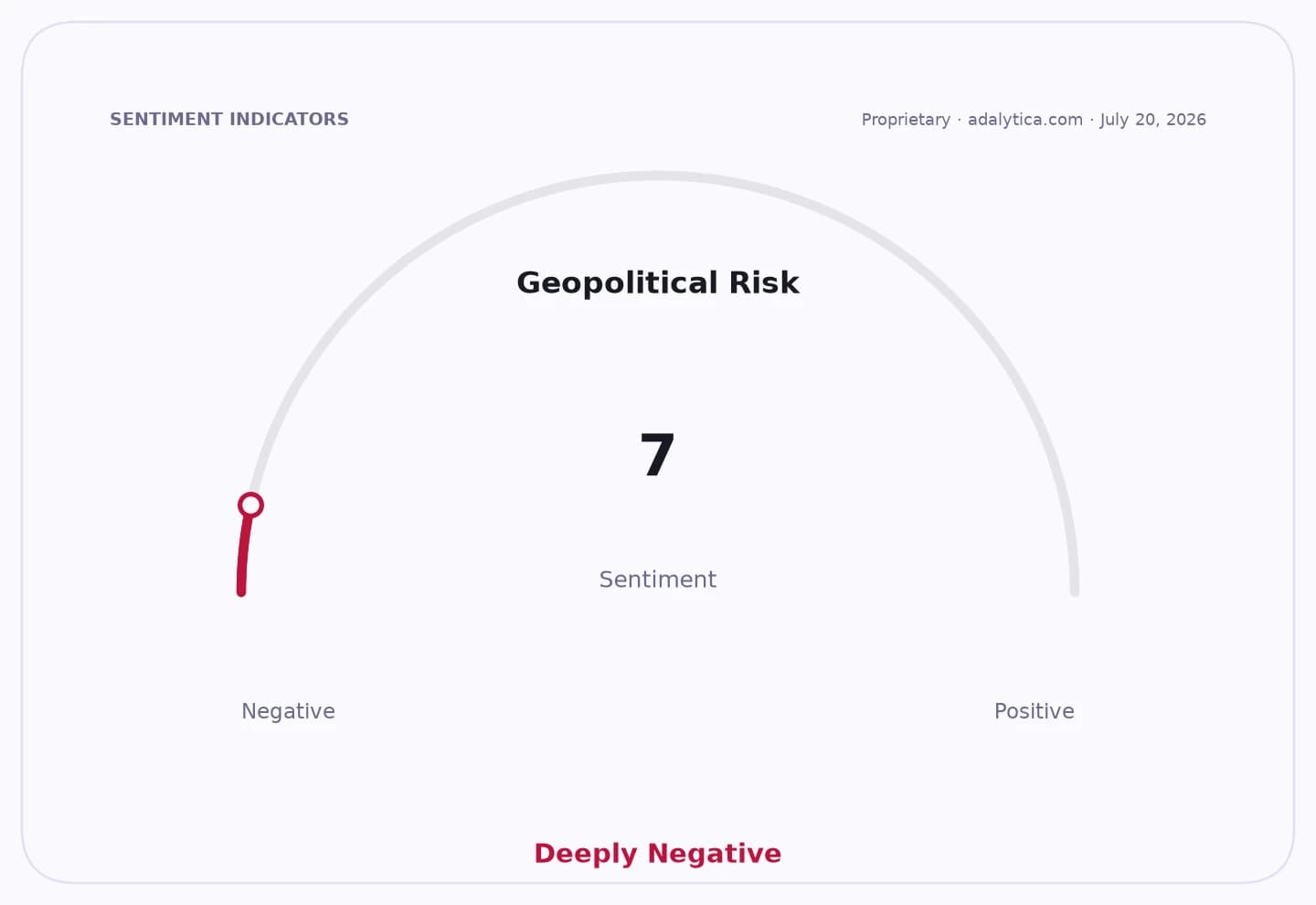
Sentiment IndicatorsⓘProprietary · adalytica.com · July 20, 2026
This is a snapshot — live sentiment, awareness and momentum for 130+ markets update continuously in the dashboard.Open AlphaPulse
The DAX has been grinding rather than breaking, and that is often what a cautious market looks like before it chooses a direction. The index was recently trading around 24,802, just above its 50-day moving average and comfortably above its 200-day average, which suggests the longer-term trend has not fully cracked even as momentum has faded. Conventional technical indicators show the market has cooled from earlier overbought levels, with the RSI easing back to 46, a sign that the immediate froth has washed out.
That matters economically because German equities sit at the crossroads of Europe’s growth story. Germany is heavily exposed to industrial demand, global trade, energy costs and geopolitical risk, so a flat DAX can be an early warning that companies and households are still being forced to navigate uncertainty rather than a clean expansion. When investors are prepared for falling prices, they tend to sell less aggressively on bad headlines, but they also need proof before they buy back in.
The survey backdrop fits that pattern. Sentiment has improved only slightly, not decisively, and the market is still wrestling with the same issues that have dominated for months: Middle East tensions, export sensitivity, and the question of whether Europe’s largest economy can generate enough earnings growth to justify a stronger rerating. That is why a quick recovery remains elusive even after pockets of resilience, including gains in Siemens Energy and some smaller names.
For investors, the lesson is not to chase every bounce. It is to separate noise from lasting value. A market that has already discounted a lot of bad news can create opportunities in companies with real moats, strong free cash flow and exposure to long-term themes such as electrification, industrial automation and energy infrastructure. That is especially true for patient investors building diversified portfolios over years, not weeks.
The flip side is that the losers are clear too. Exporters, cyclicals and leveraged businesses remain vulnerable if the economic backdrop stays choppy or geopolitical stress intensifies. Until earnings confirm a broader recovery, the DAX may continue to move in a narrow, uneasy range.
For now, Germany’s market is telling investors something useful: fear has already been priced in, but conviction has not returned. That makes this a moment to watch closely, not a moment to rush.
| Entity | Gains | Losses |
|---|---|---|
| Long-term buyers | ▲Lower entry prices | ▼Near-term upside uncertainty |
| Defensive large caps | ▲Relative stability | ▼Limited momentum |
| Exporters/cyclicals | ▲Brief relief from oversold levels | ▼Slower earnings recovery |
| Shorts/cautious traders | ▲Continued volatility | ▼Risk of relief rallies |




