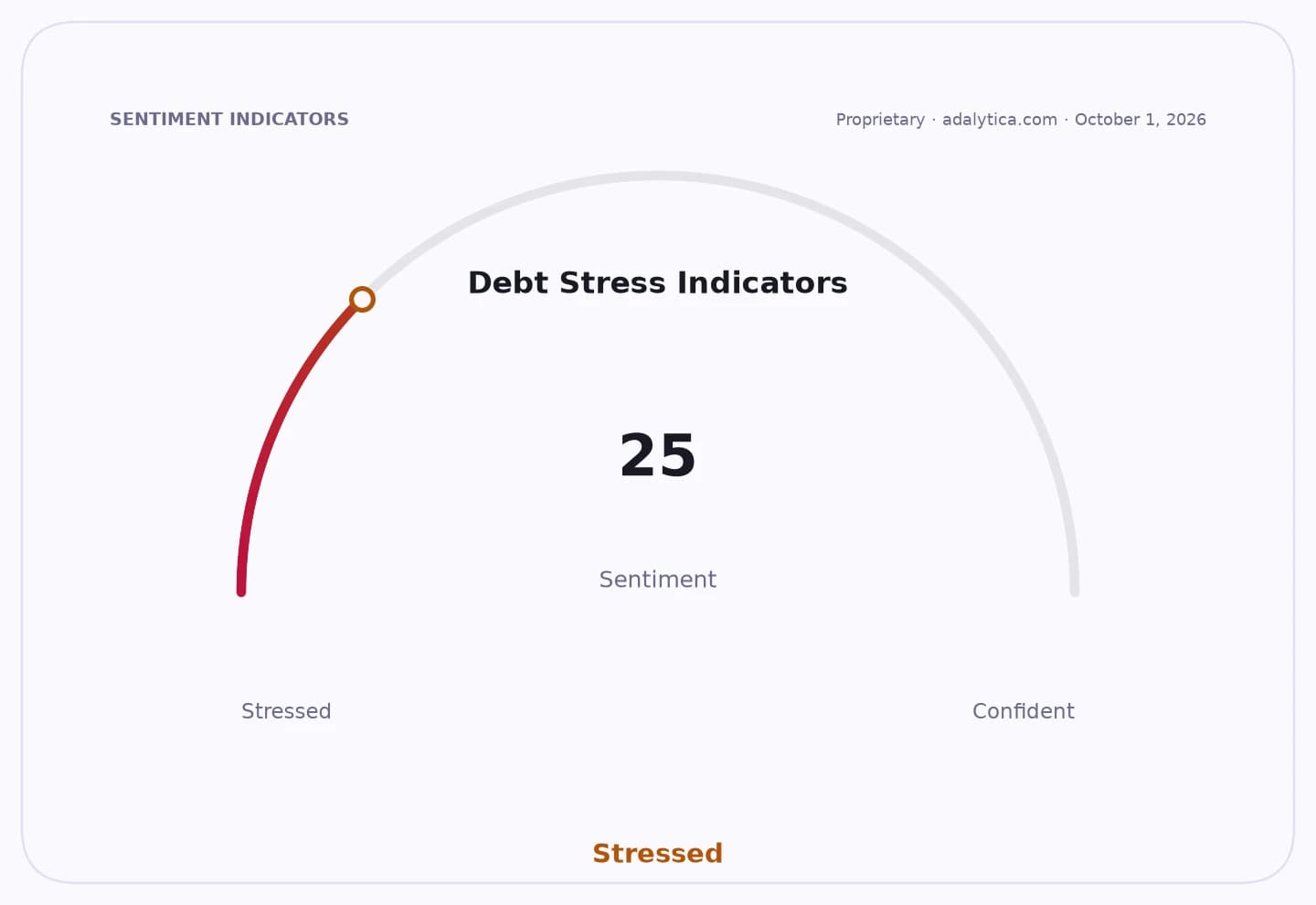
Debt-to-income ratio is becoming the make-or-break metric for borrowers as higher rates keep monthly payments elevated and lenders grow more selective.
Debt-to-income ratios pressure consumer lenders
That matters because DTI is not an abstract credit score statistic; it is a direct test of how much of a household’s gross income is already spoken for by debt. When borrowing costs rise, the same loan eats up more cash flow, pushing DTI higher and narrowing the pool of applicants who can qualify for mortgages, auto loans and other consumer credit. In a tightening credit environment, that can slow loan growth, curb spending and pressure the lenders most exposed to prime and near-prime borrowers.
The backdrop is clear. The 10-year Treasury yield is sitting around 5.3%, Fed funds are near 3.75% and unemployment is still relatively low at about 4.0%, but those benign labor-market conditions are not enough to offset the squeeze from expensive debt. Lenders generally want DTI around 40% to 43%, and borrowers above that range may still get approved only if they have stable income, strong repayment history and low default risk. In other words, the market is rewarding cash flow discipline over balance-sheet optimism.
That is why the story matters for investors. Consumer lenders live and die on underwriting quality, and the market is already differentiating sharply between names with resilient credit profiles and those tied to stretched borrowers. Capital One Financial, Synchrony Financial and Ally Financial have all seen their shares retreat from earlier highs, with technical indicators such as the 50-day moving average and RSI readings showing weakened momentum in recent trading. That weakness reflects more than market noise: it is a signal that investors are reassessing how much credit risk can be absorbed if rates stay elevated and households remain under pressure.
The broader investment thesis is that the next phase of this cycle will reward lenders and financials that can underwrite to real repayment capacity, not just to a FICO score. DTI is effectively the front line of credit quality when refinancing becomes harder and monthly obligations stay sticky. Banks and specialty lenders with tighter standards may lose volume in the near term, but they are better positioned to protect margins and avoid future losses. That makes DTI a crucial filter not only for borrowers, but for anyone trying to identify which consumer-credit stocks can compound through a higher-rate world.
For investors, the takeaway is straightforward: favor lenders with conservative underwriting, strong capital, and low charge-off risk, and be wary of businesses leaning on stretched consumers to fuel growth. In this market, the companies that respect debt-to-income reality are the ones most likely to outperform when credit finally turns.
| Entity | Gains | Losses |
|---|---|---|
| Conservative lenders | ▲Better credit quality | ▼Slower loan growth |
| Stretched borrowers | ▲None | ▼Lower approval odds |
| Capital One, Synchrony, Ally | ▲Disciplined underwriting advantage | ▼Near-term sentiment pressure |
| Banks with high DTI exposure | ▲None | ▼Higher default risk |