Employers are being pushed to treat people with disabilities less as a social obligation and more as a usable labor pool, a shift that could widen access to jobs while easing recruitment pressure in a tight but uneven labor market.
Disability hiring shifts toward labor pool strategy
That change matters economically because the hiring gap is no longer just about goodwill. It is about whether firms can fill roles, control labor costs and retain workers as competition for staff remains intense across services, education, retail and other labor-heavy industries. In the US, payrolls remain near 159.1 million and job openings were still about 7.1 million in August, leaving employers with incentives to expand sourcing beyond the usual candidate pool. At the same time, unemployment at 4.1% suggests the market is not in distress, but it is competitive enough that underused labor pools carry real value.
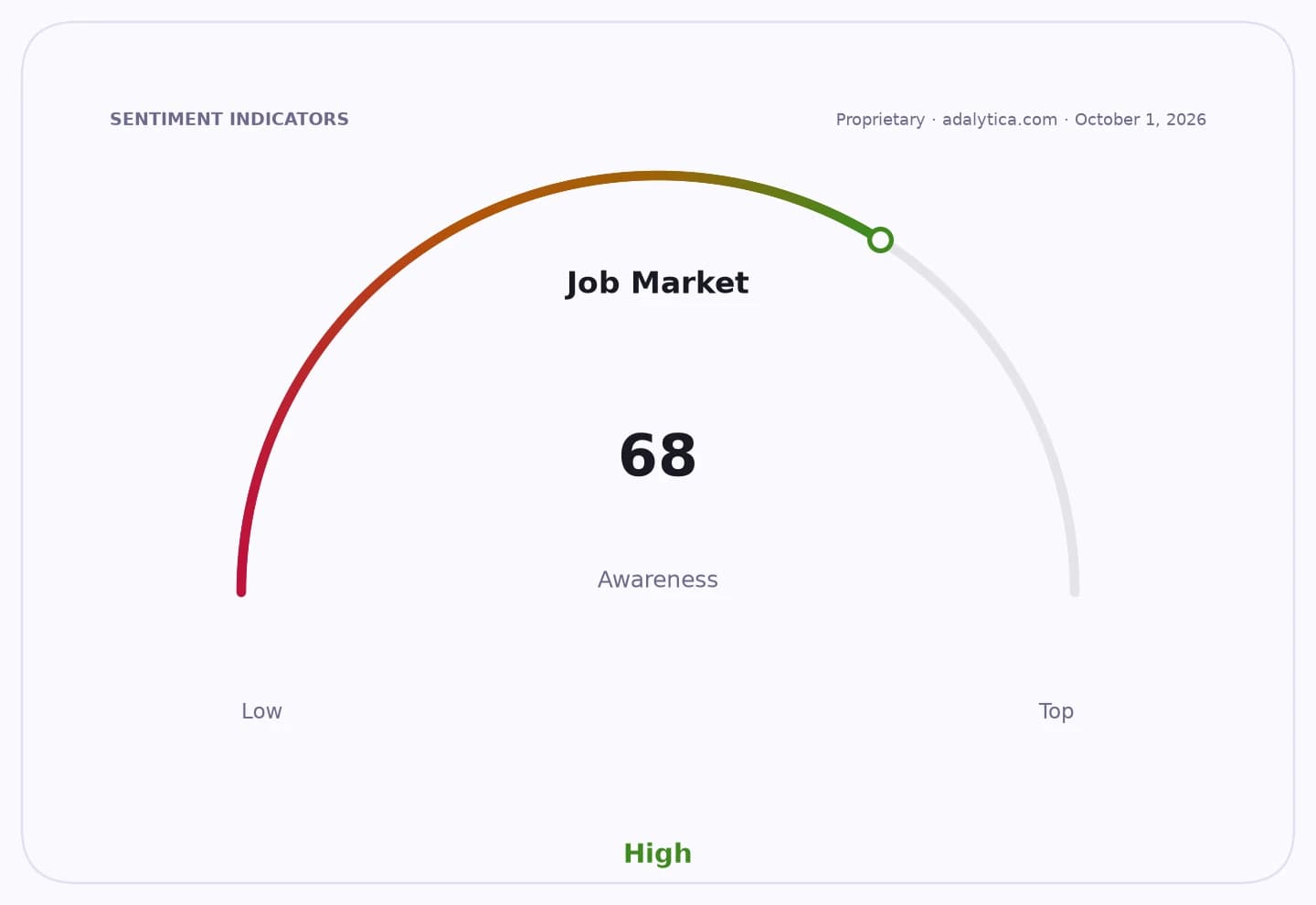
Sentiment IndicatorsⓘProprietary · adalytica.com · October 1, 2026
This is a snapshot — live sentiment, awareness and momentum for 130+ markets update continuously in the dashboard.Open AlphaPulse
The clearest message from disability advocates and employers is that access alone is not enough. Thach Tran Bach Long, a psychologist and trainer in Ho Chi Minh City who is visually impaired and an albino, said he had to build a record of free classes, extra certifications and visible work before employers took him seriously. His experience reflects a broader reality: disabled candidates are often asked to prove productivity before they are given accommodations, even when those accommodations are relatively small and inexpensive.
That is why organizations working on disability employment are trying to change the hiring model itself. Nguyen Van Ngoan, who runs a jobs and vocational training center in Ho Chi Minh City, said the goal is to move from a simple “company has a job, worker applies” approach to one where employers help prepare talent in advance. The logic is straightforward. If businesses specify what they need earlier, training institutions can tailor instruction, and candidates can enter the labor market with fewer mismatches. For employers, that reduces onboarding friction and lowers the risk that disability inclusion becomes a one-off hire rather than a durable staffing pipeline.
The economics are more compelling than the rhetoric. Dinh Thi Phuong, who runs a handmade products company, said placing disabled workers can take months and requires close mentoring, but once integrated they can add stable output. That makes disability hiring less like a philanthropic program and more like a long-duration workforce investment. For employers under pressure to manage turnover, the payoff may come through improved loyalty, lower churn and better brand positioning, rather than immediate productivity gains on day one.
Investors should watch the shift because it touches sectors that rely heavily on labor, training and compliance. Recruitment firms, payroll providers and HR software companies stand to benefit if disability employment becomes more structured and data-driven. ADP, for example, has emphasized tools for talent management, benefits administration and compliance, while Manpower has noted measured employer behavior in workforce markets. If inclusion moves from policy aspiration to operating requirement, demand could rise for staffing, onboarding and workforce-administration services that make accommodations easier to scale.
The bull case is that employers discover a neglected talent base at a time when many are still struggling to hire, especially for roles that do not require highly specialized skills. The bear case is that progress remains slow because many firms still see accommodations as a cost rather than a productivity tool, and because disabled applicants continue to face screening bias and fragmented support.
For now, the larger narrative is that disability inclusion is moving from charity language toward labor-market efficiency. If employers, training centers and policymakers can align on “the right person, the right job and the right conditions,” the result could be more than better outcomes for disabled workers — it could also become a modest but meaningful supply-side fix for employers.
| Entity | Gains | Losses |
|---|---|---|
| Disabled job seekers | ▲More hiring pathways | ▼Lower bias and fewer barriers |
| Employers | ▲Broader talent pool | ▼Higher onboarding effort |
| HR and staffing firms | ▲More placement demand | ▼Less reliance on standard sourcing |
| Charity-style buyers | ▲Less central role | ▼Old paternalistic model |