Gold prices in Egypt have climbed to fresh highs, with the pound value of a gold pound touching about 48,000 pounds, reflecting a powerful mix of global bullion strength, dollar weakness and stubborn local demand.
Egypt Gold Hits Record as Demand Stays Firm
The move matters because gold is not just a consumer item in Egypt; it is a store of value, a hedge against inflation and, for many households, a shadow currency. When local prices accelerate this quickly, it signals pressure in the broader economy, especially in an environment where purchasing power has been eroded and households and traders are increasingly using bullion to preserve wealth.
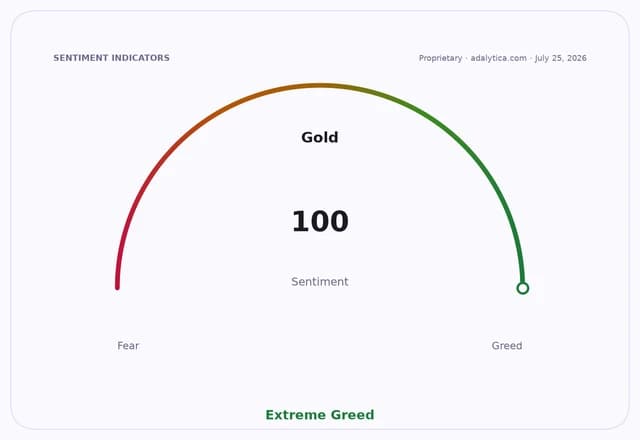
Sentiment IndicatorsⓘProprietary · adalytica.com · July 25, 2026
This is a snapshot — live sentiment, awareness and momentum for 130+ markets update continuously in the dashboard.Open AlphaPulse
The rally is being reinforced by global market conditions. Gold-backed ETF GLD has stayed elevated even after a pullback, closing at $371.90 on July 24, far above its 50-day average of $390.11 earlier in the year and well above its 200-day average of $411.80, while still showing a relatively firm RSI reading of 41.3 after more extreme overbought levels earlier in the cycle. Smaller gold fund IAU was little changed at $76.23, also holding above long-term support. The move in the miners has been even more pronounced: Newmont shares, tracked by GOLD, remain far above where they traded a year ago even after a sharp correction, underscoring how much of this year’s gold trade has already been priced into equities.
For Egypt, the immediate driver is the local translation of that global strength into pounds. The latest market note said 21-karat gold reached 6,000 pounds, while the gold pound touched 48,000 pounds, after a week marked by volatility and a sharp drop in SJC gold prices on July 22. That kind of intraday and day-to-day swing points to a market that is highly sensitive to imported price moves, exchange-rate expectations and local liquidity conditions. It also suggests buyers are still willing to step in on dips, limiting any sustained correction.

The macro backdrop is not helping. U.S. 10-year Treasury yields have moved up to around 4.749%, which would normally pressure non-yielding assets such as gold, but the metal has held up anyway. That implies investors are still paying more attention to currency risk, policy uncertainty and geopolitical hedging than to the traditional yield argument. Adalytica’s Gold Fear & Greed Index is at 100, or “Extreme Greed,” while its U.S. dollar trade signals show “Fear,” a combination that is consistent with strong demand for hard assets and weaker confidence in the greenback.
That matters to investors in several ways. For bullion holders and gold miners, it confirms the market is still in a momentum phase, though the technical backdrop warns the trade is extended and vulnerable to sharp reversals. For jewelry retailers and consumers in Egypt, higher prices risk choking off discretionary demand and widening the gap between official market quotes and what buyers can afford. For savers and importers, the rally reinforces gold’s role as a hedge against local currency stress, but it also raises the cost of entering the market now.
The bull case is that persistent inflation, dollar softness and elevated risk sentiment keep gold supported, particularly in markets where households treat bullion as an emergency reserve. The bear case is that rising U.S. yields, a stronger dollar or a more orderly macro backdrop could cool the trade quickly, especially after such a steep run in local prices. For now, though, the message from Egypt is clear: gold remains one of the few assets still carrying credibility, and that credibility is showing up in the price.
What to watch next is whether the 48,000-pound level becomes a new floor for the gold pound in Egypt or another brief spike in a volatile market. A sustained break higher would point to continued hoarding and currency anxiety; a pullback would suggest demand is becoming price-sensitive at record levels.
| Entity | Gains | Losses |
|---|---|---|
| Gold holders | ▲Wealth preservation | ▼Higher entry cost |
| Egyptian consumers | ▲Inflation hedge | ▼Weaker affordability |
| Bullion dealers | ▲Strong turnover | ▼Wider volatility |
| Dollar assets | ▲Relative appeal | ▼Safe-haven flows |




