A historic Super El Nino is exposing a hard limit in one of the market’s hottest themes: AI can speed up weather forecasts and lower their cost, but it still struggles when climate conditions move beyond the data it was trained on.
El Nino and AI Weather Models
That matters because the stakes are not academic. The World Meteorological Organization says the current El Nino could peak in December and last until at least February 2027, with sea-surface temperatures in the key Nino 3.4 region potentially running 3.7C above the long-term average next month, the hottest reading since modern observations began in the 1950s if it materializes. When weather systems become that extreme, the failure of prediction models can quickly turn into crop losses, supply shocks, wildfire risk and higher claims for insurers.
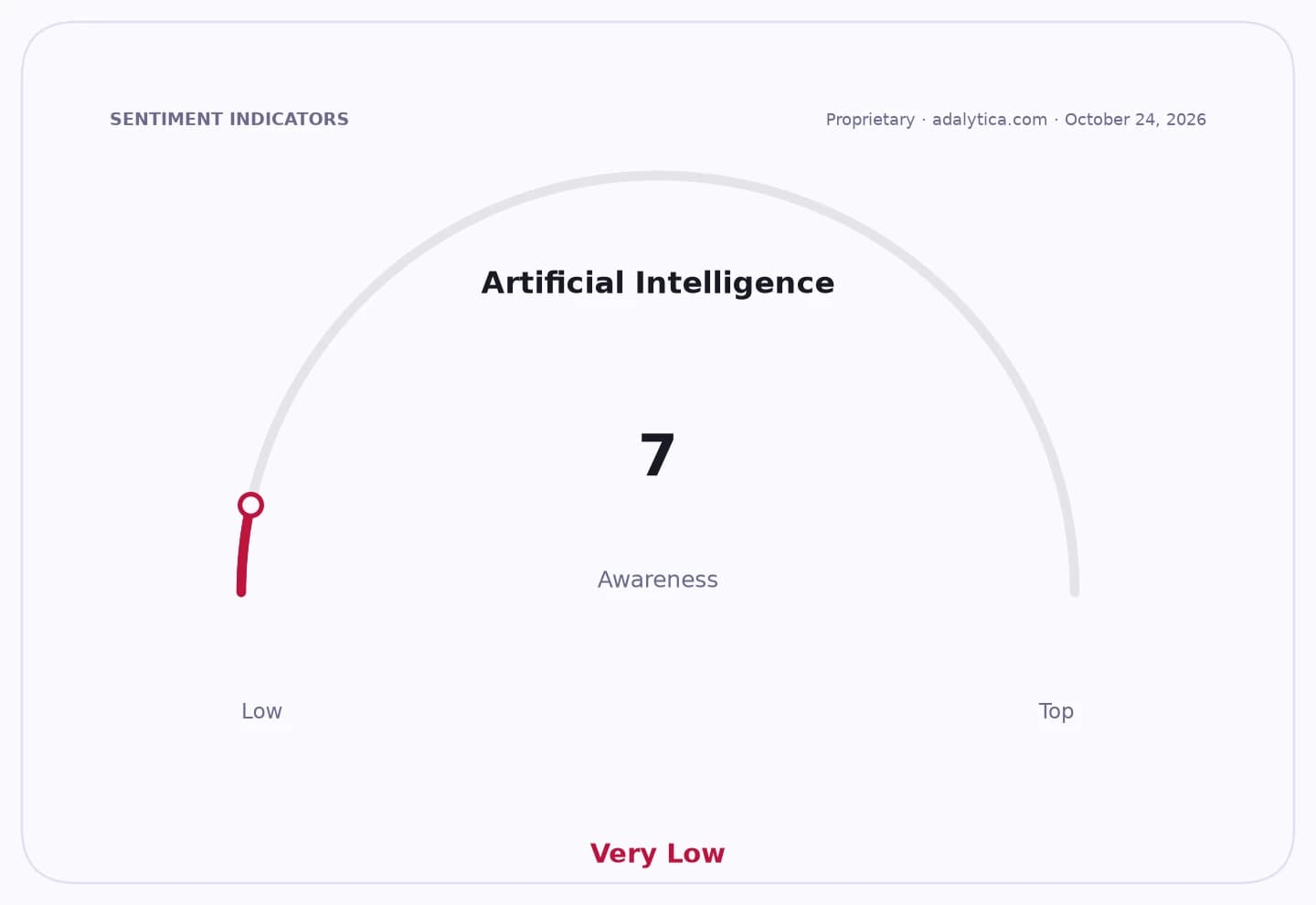
Sentiment IndicatorsⓘProprietary · adalytica.com · October 24, 2026
This is a snapshot — live sentiment, awareness and momentum for 130+ markets update continuously in the dashboard.Open AlphaPulse
The investment case is shifting from “AI will predict everything” to “AI will need infrastructure, data and human oversight to be useful in the real world.” Weather models powered by machine learning are attractive because they are cheaper to run than traditional supercomputing systems and can process patterns quickly. The World Food Programme is already blending AI with conventional forecasting to flag food insecurity, while groups such as TomorrowNow are pushing forecast advice directly to farmers for less than $1 per person per year.
But the same event that makes AI weather tools more valuable also exposes their weakness. Scientists cited in the report say AI models trained on cooler historical conditions may miss the interaction between El Nino and a warmer planet, and sometimes generate outputs that conflict with physical laws. The Met Office’s Adam Scaife said an AI model failed to predict the severe Northern European winter that followed the November 2009 El Nino, even though a physics-based model got it right.
For investors, that creates a sharper divide between winners and losers. The winners are the firms selling picks-and-shovels to climate adaptation: weather data platforms, satellite and sensor providers, precision agriculture firms, wildfire detection systems and insurers with the best catastrophe modeling. The losers are businesses that rely on stable weather assumptions — crop producers, food processors, utilities exposed to drought and heat, and insurers that underwrite flood, fire and storm risk without better models.
The market is already hinting at that split. Deere’s shares have remained above both its 50-day and 200-day moving averages, while Chubb has climbed sharply and trades well above those same technical levels, reflecting investor interest in agricultural resilience and catastrophe protection. Conagra, by contrast, has been rangebound and remains below its 200-day average, underscoring how vulnerable food companies are when input costs and crop conditions swing abruptly. Those are the kinds of second-order beneficiaries and casualties that a Super El Nino can create.
The broader message is that AI is becoming indispensable in climate forecasting, but not yet omniscient. That is exactly why the most attractive trade may not be the AI model itself, but the ecosystem that monetizes uncertainty: the hardware, data pipelines, farm equipment, insurance analytics and climate resilience tools that are needed when the atmosphere refuses to behave like the past. If El Nino proves as severe as warned, the next leg of the trade will go to companies that help the economy adapt when forecasts fail.
| Entity | Gains | Losses |
|---|---|---|
| Deere (DE) | ▲Precision ag demand | ▼Weather-driven crop stress |
| Chubb (CB) | ▲Cat modeling demand | ▼Bigger catastrophe claims |
| Conagra (CAG) | ▲Demand for resilient sourcing | ▼Crop and input volatility |
| Farmers/WFP users | ▲Earlier warning tools | ▼Model failures, losses |