The next El Niño cycle could push global inflation up by about 0.3 percentage point, JPMorgan has warned, a seemingly small shock that could matter disproportionately for central banks, food importers and commodity markets already sensitive to supply disruptions.
El Niño Could Lift Inflation and Crop Prices

The bank’s estimate underscores how climate patterns can quickly feed into prices through crops, shipping and energy demand. A strong El Niño typically brings hotter and drier conditions to key producing regions and heavier rains and floods to others, disrupting planting, yields and logistics. That can tighten grain and soft commodity supplies, lift food inflation and add to the volatility that policymakers have been trying to contain after the post-pandemic inflation surge.
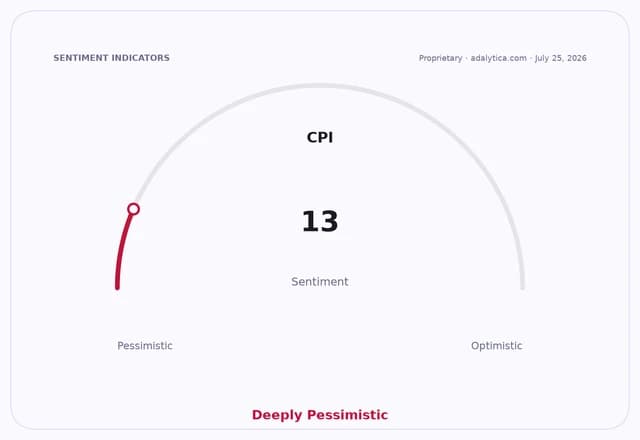
Sentiment IndicatorsⓘProprietary · adalytica.com · July 25, 2026
This is a snapshot — live sentiment, awareness and momentum for 130+ markets update continuously in the dashboard.Open AlphaPulse

The timing matters. Forecasts point to El Niño strengthening from mid-2026 into early 2027, with an elevated chance of strong to very strong intensity. For economies where food carries a large weight in consumer baskets, even modest supply shocks can ripple through headline inflation, income expectations and interest-rate decisions. JPMorgan’s estimate implies the impact would be broad enough to be macro-relevant, but not so large as to trigger a full inflation regime shift on its own.
Markets are already signaling that investors are treating the climate threat as a tradable macro theme. Agricultural funds have firmed, with DBA, WEAT and CORN all trading above their 50-day moving averages and posting elevated RSI readings, suggesting momentum has built as traders price in tighter crop conditions. Wheat and corn, in particular, have attracted renewed buying interest after recent weather-driven swings, while crude oil has also been volatile as energy markets absorb multiple demand and supply forces. Higher food prices would also be uncomfortable for consumers at a time when broad inflation has only recently eased from its 2026 highs.
The implications extend beyond commodities. Food producers may benefit if raw material costs rise faster than they can pass them on, while livestock and packaged-food companies face margin pressure. Import-dependent emerging markets are most exposed because they have less room to absorb higher staple prices and often weaker currencies, which can amplify imported inflation. That is why the U.S. dollar’s recent weakness matters too: a softer dollar can cushion some commodity import costs, but it also complicates inflation readings and policy responses across regions.
For investors, the key question is not whether El Niño will lift prices, but how quickly the effect shows up and whether it coincides with already tight inventories or policy fragility. If the weather pattern intensifies as forecast, grains, softs and select food-related equities could keep outperforming, while rate-sensitive assets may struggle if inflation expectations edge higher. The bear case is that the shock proves uneven or short-lived, limiting the pass-through to consumer prices. The bull case for commodities is that weather disruption lands on top of already stretched supply chains and low crop buffers, creating a sharper price impulse than JPMorgan’s headline estimate suggests.
The market will watch crop conditions, export restrictions and monthly food inflation data for evidence that the El Niño story is moving from forecast to price reality. If it does, the inflation debate in 2026 and 2027 may be shaped as much by weather as by rates.
| Entity | Gains | Losses |
|---|---|---|
| Grain and soft commodity bulls | ▲Higher crop prices | ▼Weather uncertainty |
| Food importers and consumers | ▲Currency relief if dollar weakens | ▼Higher staple costs |
| Agricultural producers | ▲Better farm-gate pricing | ▼Yield losses from drought/floods |
| Central banks | ▲Clearer inflation channel | ▼Less room to cut rates |