A former Obama adviser’s claim that Donald Trump is preparing to challenge the midterms is sharpening investor focus on U.S. election risk just as sentiment around White House policy direction weakens and broader market gauges flash caution.
Election Risk Raises Market Caution
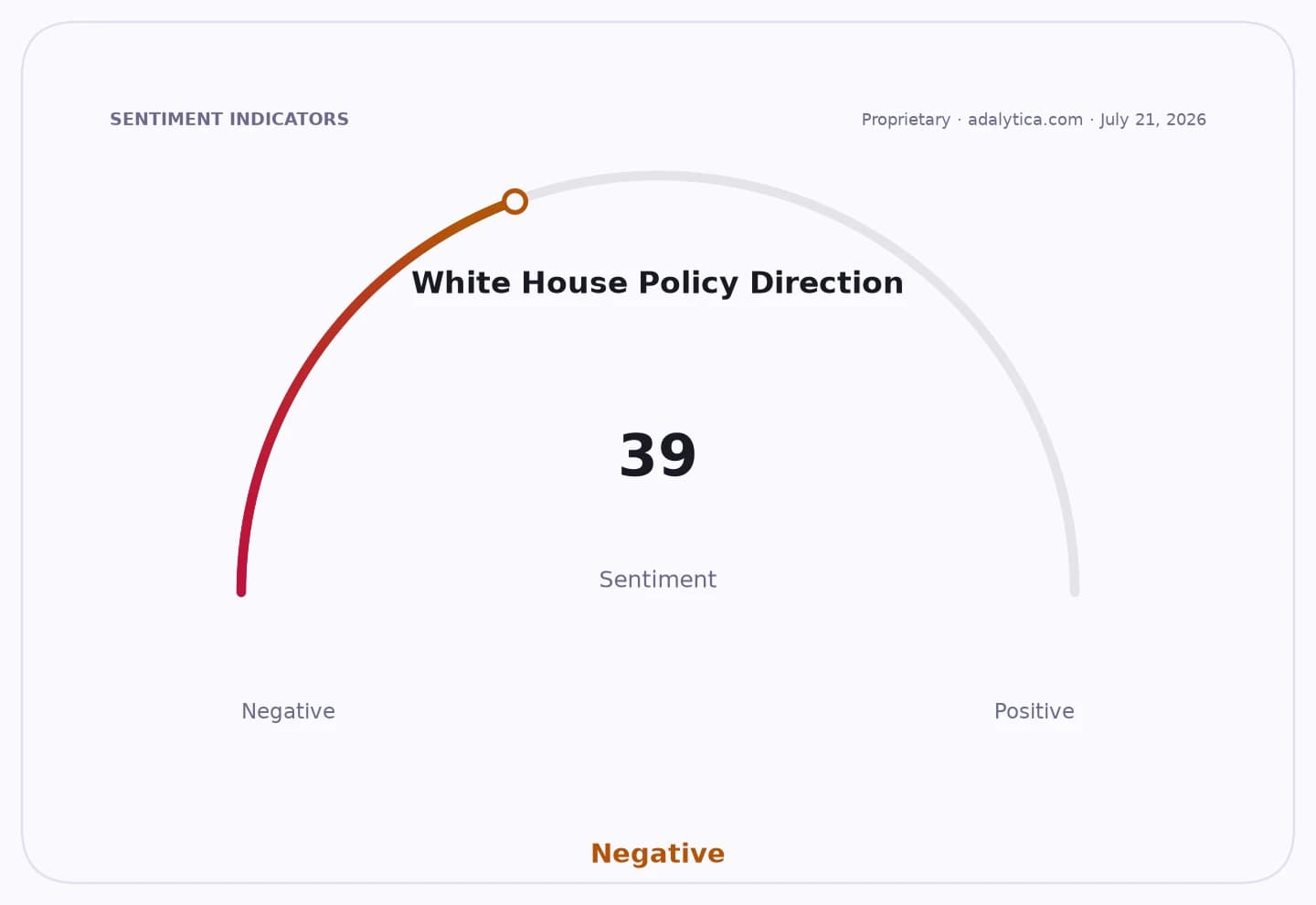
The timing matters because contested elections can quickly spill into fiscal policy, regulation and market positioning. Investors have been rotating into safety as Adalytica’s U.S. White House policy direction sentiment fell to 39 from 86 in mid-June, while its change over the past week dropped 31 points and its 30-day decline reached 38 points, indicating a rapid cooling in confidence around the administration’s policy path.
Sentiment IndicatorsⓘProprietary · adalytica.com · July 21, 2026
This is a snapshot — live sentiment, awareness and momentum for 130+ markets update continuously in the dashboard.Open AlphaPulse
The warning also lands in a market already showing signs of stress. Adalytica’s S&P 500 trade signals snapshot shows sentiment at 17, or “Fear,” down 24 points on the day and 60 points over 30 days, while global stability sentiment sits at 7, labeled “Extreme Fear,” underscoring how political uncertainty is feeding into risk aversion.
For investors, the key issue is not the claim itself but what it suggests about the next several months: more legal fights, more headline volatility and a higher probability that campaigns, voting rules and court challenges become a market variable. That could keep pressure on equities, boost demand for defensives and add volatility to sectors sensitive to Washington, including banks, health care, defense and energy.
Presidential Approval — 30-day sentimentadalytica.com
Explore this data interactively — full history, time series and cross-market comparisons.Open AlphaPulse
The approval backdrop is also turning choppier. Adalytica’s U.S. presidential approval sentiment is still elevated at 79, labeled “Greed,” but it slipped 4 points in a day and 18 points over a week, hinting that enthusiasm is cooling even as attention rises around the election fight.
The immediate catalyst for markets will be whether the allegation turns into a broader legal or political challenge with measurable effects on campaign rules, turnout confidence or congressional control. Until then, investors are likely to treat the story as another reason to stay cautious on U.S. risk assets and watch for any spillover into policy expectations.
| Entity | Gains | Losses |
|---|---|---|
| Trump-aligned Republicans | ▲stronger base mobilization | ▼higher legal and political scrutiny |
| Democrats | ▲fundraising and turnout advantage | ▼risk of protracted election disputes |
| Defensive stocks | ▲haven demand | ▼lower risk appetite for cyclicals |
| S&P 500 bulls | ▲little immediate upside | ▼volatility from election uncertainty |