Emerging-market stocks bounced from a two-month low on Tuesday as a pullback in oil and a softer U.S. dollar eased pressure on importers and helped restore appetite for risk across developing-economy assets.
Emerging Markets Rebound as Dollar and Oil Ease
The recovery matters because the selloff that dragged EM equities to their weakest level in two months was driven less by company-specific weakness than by a tightening of global financial conditions: firmer energy prices, a stronger dollar and elevated U.S. yields were squeezing currencies, raising funding costs and threatening capital flows. When those pressures ease, the bid quickly returns to markets that depend on stable external financing and lower import bills.
Sentiment IndicatorsⓘProprietary · adalytica.com · July 21, 2026
This is a snapshot — live sentiment, awareness and momentum for 130+ markets update continuously in the dashboard.Open AlphaPulse
The MSCI Emerging Markets gauge, tracked here by the iShares MSCI Emerging Markets ETF, stabilised after slipping to the equivalent of a two-month low earlier in the month. VWO, the broader EM fund, has held above its 200-day moving average, but the recent drop in price and weakening RSI readings show the rebound is still fragile rather than a clean trend reversal. EEM, another major EM benchmark, also remains above its 200-day average, yet its MACD has turned negative, underscoring that investors have not fully repaired their risk appetite.
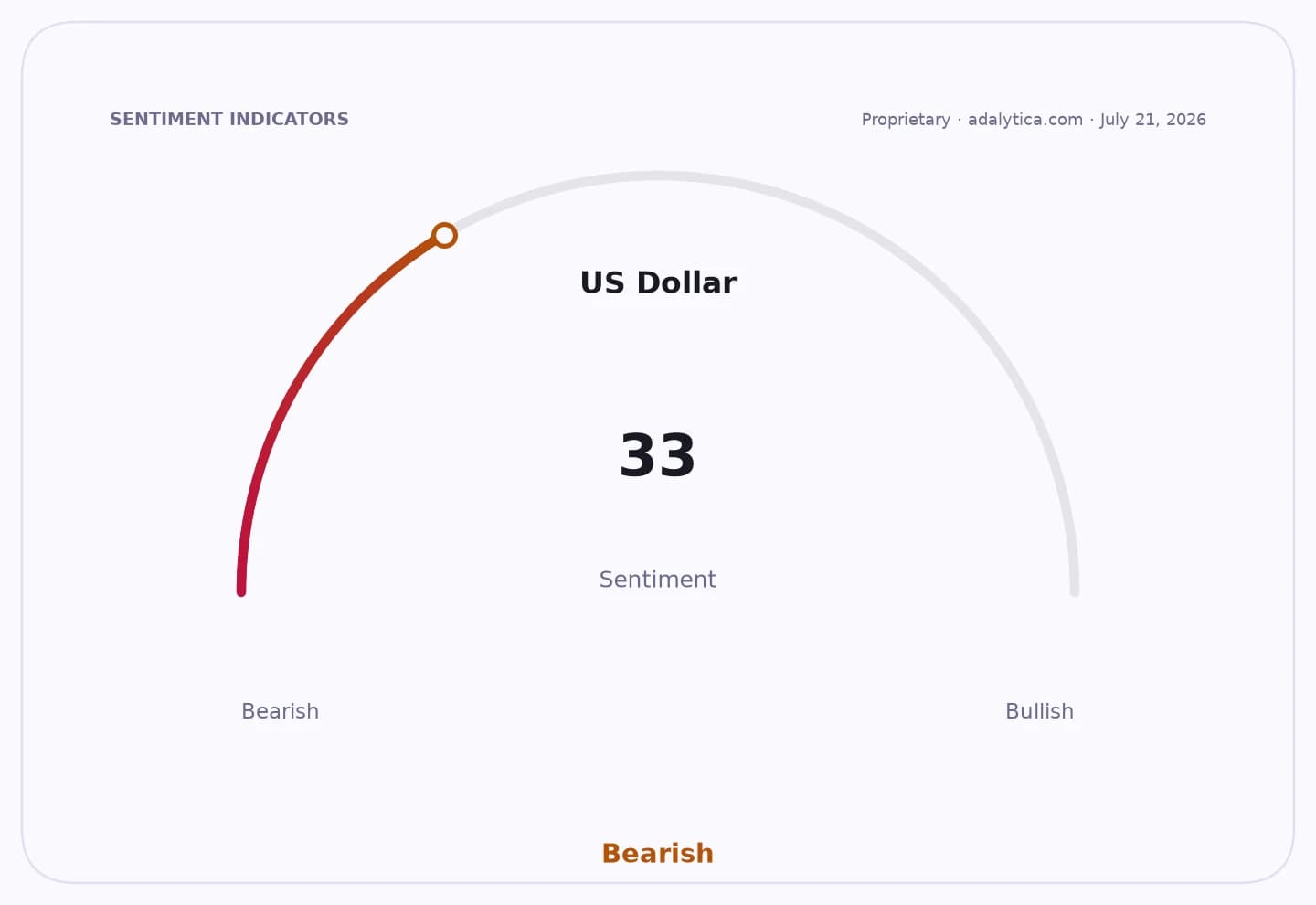
The immediate market catalyst is the easing in oil and the decline in the dollar. Brent and WTI had surged earlier this year, adding to inflation pressure in importing economies and worsening current-account balances in countries from India to Turkey. A softer crude price removes some of that strain, while a weaker dollar tends to support local currencies, reduces the burden of dollar-denominated debt and can prompt foreign inflows into bond and equity markets. Adalytica’s U.S. dollar trade signal has cooled to neutral, with a sharp one-day drop in sentiment, reinforcing the market’s shift away from aggressive dollar longs.
US Dollar — 30-day sentimentadalytica.com
Explore this data interactively — full history, time series and cross-market comparisons.Open AlphaPulse
That combination is especially important for emerging markets because much of the asset class trades as a macro beta on global liquidity. Lower oil generally helps oil importers by improving trade balances and easing inflation, while exporters such as Brazil and parts of the Gulf face a different mix: softer energy prices can reduce fiscal windfalls even as stronger currencies make external financing more manageable. Brazil’s EWZ ETF has recently steadied after a sharp spring correction, while VWO’s broad-based move suggests the rebound is not confined to one country but is being driven by a wider shift in macro conditions.
Investor positioning also appears to have become less defensive. The latest technical readings on EEM and VWO suggest the market was oversold near the recent lows, with RSI falling into the low 30s before recovering modestly. That supports the case for a tactical bounce, particularly if U.S. Treasury yields continue to ease and oil remains contained. At the same time, the 10-year Treasury yield near 4.5% keeps the hurdle high for a sustained EM re-rating, because high real rates in the U.S. still compete with risk assets and can cap foreign inflows.
The bull case is that the recent move marks the start of a broader catch-up trade in emerging markets, especially if China’s policy support stabilises sentiment there and global inflation pressures keep fading. The bear case is that the rebound is just a relief rally inside a still-hostile macro regime: if oil reverses higher, the dollar firms again or U.S. yields stay elevated, EM currencies and equities could easily give back gains.
For investors, the message is that emerging markets are still being steered more by global macro than by local fundamentals. The near-term direction of oil, the dollar and U.S. rates is likely to determine whether this rebound becomes a durable recovery or another short-lived bounce.
| Entity | Gains | Losses |
|---|---|---|
| EM equity buyers | ▲Cheaper entry points | ▼Missed the dip if rally extends |
| Oil importers | ▲Lower input costs | ▼Exporters’ terms soften |
| EM currencies | ▲Relief from dollar pressure | ▼Volatile if U.S. yields rise again |
| Dollar bulls | ▲Near-term momentum fade | ▼Weaker carry and returns |