The European Union is moving from rhetoric to action on China, building a broader set of trade and investment tools that could make it harder for Beijing to use Europe as a pressure valve for surplus exports. That matters because Europe is not just another export market: it is one of China’s biggest demand centers, and any sustained tightening from Brussels would hit Chinese manufacturers already facing weaker pricing power and more aggressive barriers in the US.
EU Expands China Trade Tools as FXI Holds 36.17
The immediate economic significance is that Brussels is trying to close the gap between its pro-trade instincts and the reality of a Chinese industrial machine that has kept pumping out goods, including AI-related and other innovation-led exports, even as Washington hardens its stance. The EU’s new anti-Beijing instruments give policymakers more leverage to investigate subsidies, restrict access to public procurement, and retaliate against market-distorting practices without waiting for a full-blown tariff war. For Beijing, that raises the risk that surplus capacity in sectors ranging from electric vehicles to clean-tech components will face a second major gatekeeper after the US.
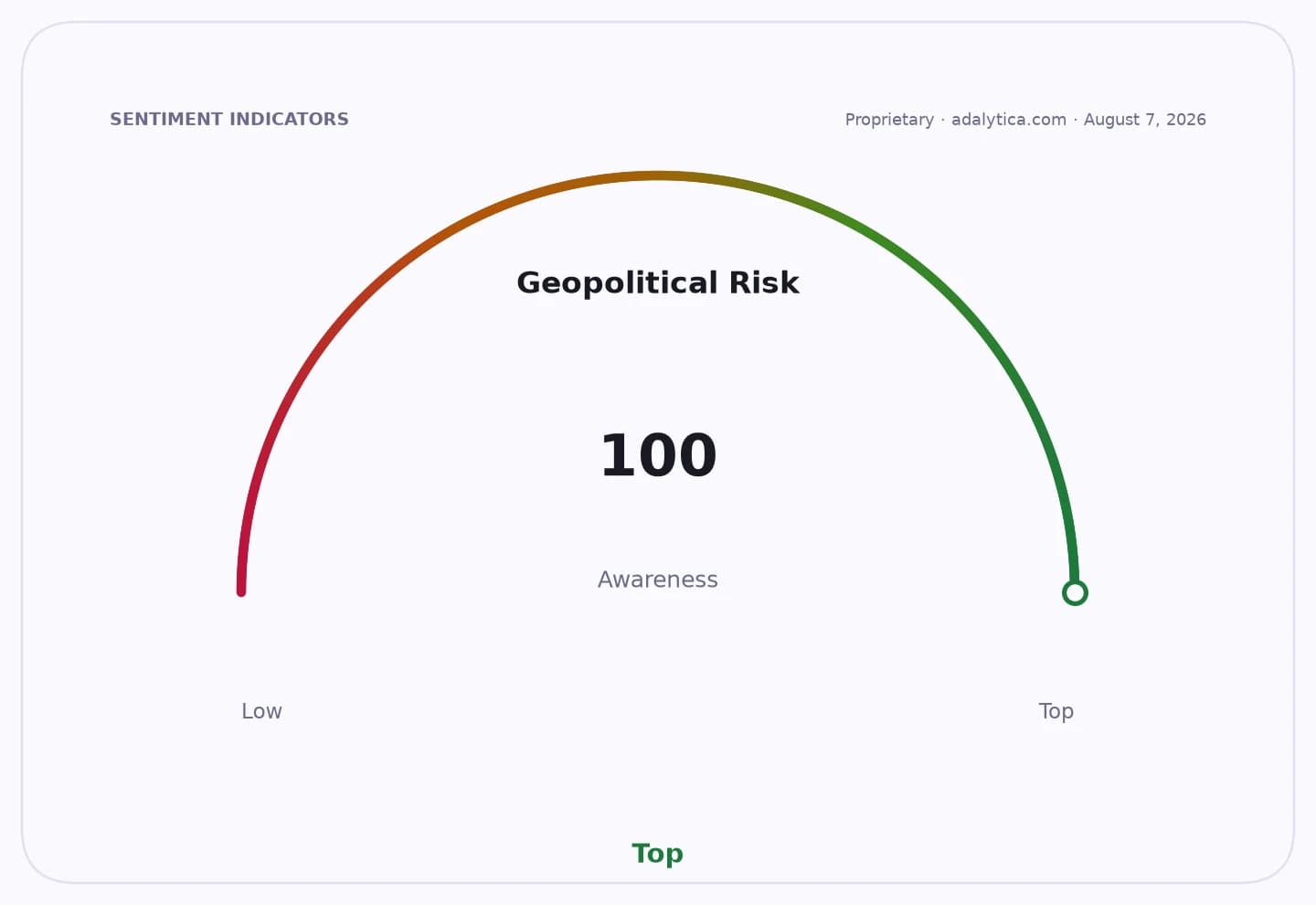
Sentiment IndicatorsⓘProprietary · adalytica.com · August 7, 2026
This is a snapshot — live sentiment, awareness and momentum for 130+ markets update continuously in the dashboard.Open AlphaPulse

That risk is already showing up in market behavior. The iShares China Large-Cap ETF, FXI, has recovered to 36.17 after a volatile summer that included a spike to 40.87 and a slide to 35.73, a pattern consistent with investors oscillating between hope for policy support and fear of renewed trade friction. The ETF is now trading just above its 50-day moving average at 34.28 and only slightly below its 200-day average at 36.88, suggesting the market is treating Chinese equities as range-bound rather than decisively re-rated. Momentum indicators are constructive but not decisive: the 14-day RSI sits at 66.2, while MACD remains above its signal line, reflecting short-term strength without resolving the larger policy overhang.
The backdrop is one of intensifying fragmentation rather than a clean decoupling. China’s trade data have shown resilience, with July exports rising sharply on the back of innovation-led shipments, while trade with the European Union has remained important enough to keep Brussels engaged even as it grows more wary. From the EU’s perspective, the issue is not simply China selling more goods; it is whether Beijing’s industrial policy, state support and export push distort competition inside Europe and force local producers to absorb the adjustment costs.
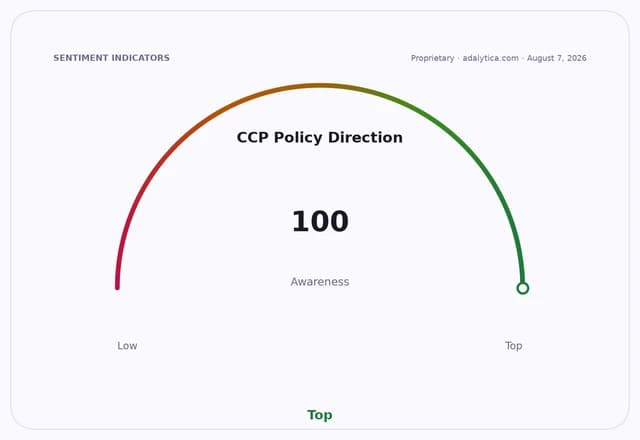
CCP Policy Direction vs FXIadalytica.com
Explore this data interactively — full history, time series and cross-market comparisons.Open AlphaPulse
For investors, the key question is who bears the margin squeeze. Chinese exporters can still lean on scale, cost advantages and demand from emerging markets, but the risk premium on Europe-facing revenue is rising. European manufacturers and policymakers, by contrast, may gain from more forceful defence of domestic industry, though consumers could eventually face higher prices and fewer low-cost imports. In China equities, the bull case is that policy support and external demand keep earnings afloat; the bear case is that Brussels joins Washington in making it harder for Chinese firms to convert export momentum into durable valuation gains.
Adalytica’s China CCP Policy Direction Sentiment gauge is flashing extreme greed, while US-China relations sentiment remains in extreme fear, underscoring how sharply the geopolitical backdrop has polarized. That combination argues for continued volatility in China-related assets: if the EU follows through with tighter enforcement, the next leg will likely be driven less by growth data and more by retaliation risk, margin pressure and the ability of Chinese companies to reroute sales into less contested markets.
| Entity | Gains | Losses |
|---|---|---|
| EU manufacturers | ▲Stronger trade defence | ▼Chinese import competition |
| Chinese exporters | ▲Access to large EU market | ▼Pricing power and margins |
| European consumers | ▲Potentially fairer competition | ▼Lower-cost imports |
| China equity investors | ▲Policy stimulus hopes | ▼Escalating trade risk |




