Europe’s push to wean itself off Russian energy has accelerated its clean-power buildout, but it has also left the bloc more exposed to China for the hardware that makes that transition possible.
EU clean power buildout increases China hardware dependence
Geopolitical Risk
That dependency now sits at the center of a strategic trade-off for Brussels and investors alike: faster decarbonization and lower equipment costs on one side, and weaker industrial sovereignty, security risks and a new layer of geopolitical leverage on the other. The tension is becoming more acute as the European Union expands grids, electric-vehicle infrastructure and renewable generation to meet rising power demand.
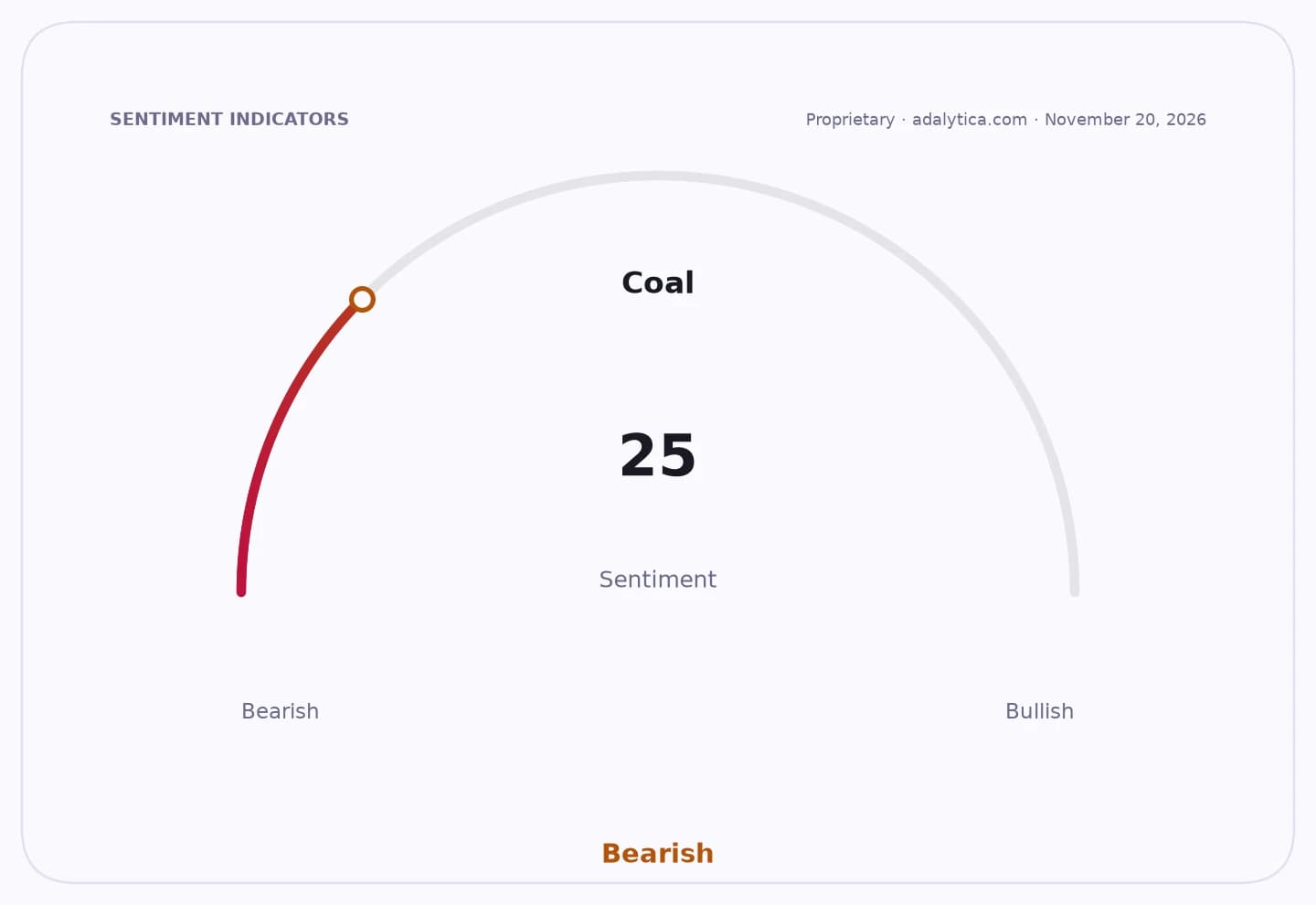
Sentiment Indicators
Since Europe cut Russian gas purchases after 2022, the bloc has leaned more heavily on imported US liquefied natural gas, helping diversify supply but at a higher energy cost. At the same time, the EU is now generating more electricity from wind and solar than from fossil fuels for the first time in 2025, underscoring how far the energy system has shifted. But the machinery behind that shift is increasingly Chinese.
Capital Economics and the International Energy Agency say Chinese companies controlled almost 80% of global solar-module manufacturing capacity and 77% of electric-vehicle battery capacity in 2024. China also accounts for at least 80% of global output of solar equipment and lithium-ion batteries, giving its suppliers scale and pricing power that Europe has struggled to match.
That cost gap is the key reason the dependency has deepened. Producing electric vehicles in China is about 35% cheaper than making fully European equivalents, while wind-turbine equipment costs 30% to 45% less, according to the figures cited. For utilities, developers and policymakers racing to build capacity, cheaper imports help keep the energy transition moving. For European manufacturers, they threaten market share, investment and eventually the continent’s industrial base.
The investor implications are broad. European renewable equipment makers face margin pressure and the risk of losing scale, while developers and grid operators may benefit from lower capital costs in the near term. The clean-energy buildout itself is also likely to remain supported, because higher equipment prices could slow deployment and make policy targets harder to hit. That is one reason economists warn that Brussels’ push to favor local procurement could backfire by lifting costs and delaying projects.
The policy response is still taking shape. The EU is considering requirements to use European-made products in public procurement of solar panels, wind turbines and batteries, and is also weighing rules that would force companies to source critical components from at least four suppliers. Those moves are designed to reduce dependence on any one country and narrow a trade deficit that the bloc says reaches €1 billion a day.
Security concerns are reinforcing the shift. Brussels has already barred Chinese inverters from projects financed with European money, citing fears they could be exploited to trigger large-scale blackouts. The warning reflects a broader concern that the continent’s energy transition could be vulnerable not just to price shocks, but to supply-chain disruption or coercive trade measures.
That risk was illustrated in 2025, when some European auto plants halted production after Beijing restricted exports of rare earths. For markets, the lesson is that Europe’s clean-energy transition is no longer just a climate story. It is a supply-chain, industrial-policy and geopolitical story as well, and the winners are likely to be the firms with diversified sourcing, local manufacturing and pricing power rather than those relying on a single low-cost supplier base.
The EU can accelerate renewable adoption, but unless it rebuilds domestic capacity in batteries, inverters and turbines, its energy independence will remain incomplete. The next test is whether Brussels can support local industry without slowing the very transition it is trying to secure.
| Entity | Gains | Losses |
|---|---|---|
| Chinese clean-tech suppliers | ▲Higher export demand | ▼Risk of EU restrictions |
| EU renewable developers | ▲Lower equipment costs | ▼Supply-chain dependence |
| European manufacturers | ▲Policy support potential | ▼Market share and margins |
| Brussels/EU policymakers | ▲Faster decarbonization leverage | ▼Industrial and security exposure |