Europe’s 21st sanctions package against Russia matters less as a headline than as a pressure point: by widening restrictions on banks and individuals, Brussels is trying to tighten the financial vise on the Kremlin while forcing a higher economic price on everyone still doing business in and around Russia.
EU Sanctions Deepen Compliance Costs Across Finance
That matters because sanctions are no longer just a diplomatic gesture. They are a second-order macro shock that can reroute trade finance, complicate cross-border payments, raise compliance costs and deepen the split between Western capital markets and the Russian financial system. When envoys agree on a package that reportedly targets 90 Russian banks and 215 individuals, the message to lenders, corporates and investors is clear: the sanctions regime is becoming broader, more persistent and more operationally painful.
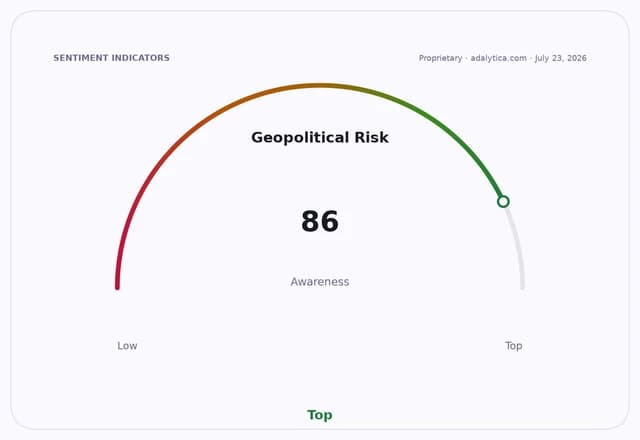
Sentiment IndicatorsⓘProprietary · adalytica.com · July 23, 2026
This is a snapshot — live sentiment, awareness and momentum for 130+ markets update continuously in the dashboard.Open AlphaPulse
For investors, the immediate read-through is not only for Russian names, which are already largely isolated, but for the entire web of counterparties that still face exposure through energy, commodities, shipping, payments and sanctions screening. Every new round increases the probability of frozen transactions, delayed settlements and higher legal risk for banks with any remaining regional business links. That is why the market underestimates sanctions as a recurring earnings headwind for global lenders, trade-finance providers and intermediaries that must keep adding controls rather than revenue.
The broader policy backdrop also matters. The EU push comes even as some member states balk at the economic cost, underscoring how difficult it has become to keep a unified Western front without damaging domestic business interests. At the same time, Washington is weighing new sanctions of its own, which raises the odds of a more synchronized transatlantic squeeze. If that happens, the pressure on Russian finance will intensify, but so will the compliance burden on Western banks and multinationals.
That is where the investable opportunity sits. The winners are not the obvious “sanctions beneficiaries” in a simplistic sense; they are the companies that sell the tools of enforcement and resilience. Defense, cyber, payments infrastructure, compliance software, and non-Russia commodity logistics all gain as governments turn economic warfare into a standing feature of geopolitics. The losers are institutions with residual exposure to sanctioned jurisdictions, thin risk controls, or business models dependent on frictionless global settlement.
Even the market tape reflects this kind of regime shift. Shares of BCS have climbed above both the 50-day and 200-day moving averages, while RSI readings and MACD signals point to a stock that has recovered sharply from earlier stress. That does not mean the sanctions story is priced in; it suggests instead that investors are hunting for survivors and service providers in a world where geopolitical risk is becoming structural. Our thesis is simple: as the sanctions net widens, capital will keep rotating toward the picks-and-shovels of financial control, defense and secure infrastructure.
For investors, the takeaway is to stay long the businesses that profit from a more fragmented world and to be selective — or outright cautious — on firms exposed to sanctions creep, cross-border settlement risk and regulatory escalation. The market still treats sanctions as episodic. They are becoming permanent.
| Entity | Gains | Losses |
|---|---|---|
| Defense and air-defense suppliers | ▲Higher procurement demand | ▼Budget squeeze from delayed spending elsewhere |
| Compliance and sanctions software firms | ▲More enforcement spending | ▼Little if sanctions weaken |
| Western banks with clean balance sheets | ▲Safer competitive position | ▼Higher compliance costs |
| Russia-linked lenders and counterparties | ▲None | ▼Funding access, transaction flow |