EUR/JPY is settling near 184.00, but the bigger story for investors is that the euro-yen cross is holding a lofty level even as momentum cools and foreign-exchange volatility stays unusually elevated. That combination suggests the pair is not breaking down, but it is also not yet ready to launch a fresh leg higher.
EUR/JPY Holds Near 184 as Momentum Cools

For long-term investors, that matters because currency trends can quietly reshape returns across Japanese exporters, European multinationals and global portfolios. A cross near 184 still reflects a strong euro versus a weak yen, a backdrop that tends to favor European companies selling into Japan while squeezing Japanese buyers of imported goods and foreign assets.
Sentiment IndicatorsⓘProprietary · adalytica.com · August 12, 2026
This is a snapshot — live sentiment, awareness and momentum for 130+ markets update continuously in the dashboard.Open AlphaPulse
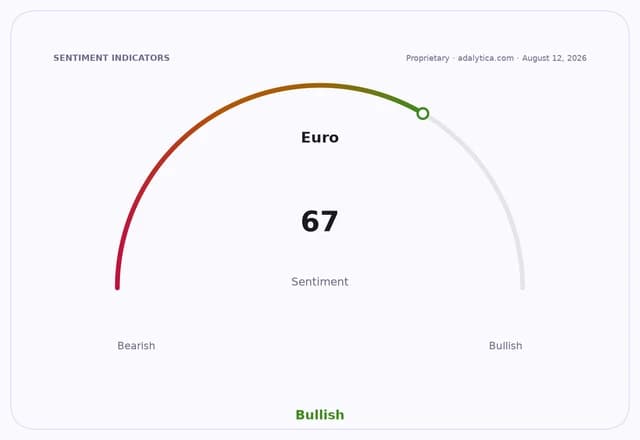
The latest technical picture points to a market that has paused after a powerful run. EUR/JPY is trading just below its recent highs and sits a touch under its 50-day moving average, while RSI readings around 39 suggest it has cooled from overbought conditions. MACD remains negative, another sign that short-term momentum has faded even though the pair is still far above its 200-day moving average. In plain English: the uptrend has not been broken, but it is no longer accelerating.
That matters because currency moves are never just chart patterns. They feed into inflation, trade balances and corporate earnings. A stronger euro can help European investors buying foreign assets, but it also makes eurozone exports less competitive. A weaker yen, meanwhile, can keep Japan’s exporters in a sweet spot while raising the cost of imported energy and food, a persistent issue for households and policymakers.

The market backdrop also helps explain the neutral tone. Adalytica’s FX volatility signals are flashing extreme greed, while both euro and dollar trade signals remain neutral. That kind of setup often means traders are positioned for continued swings rather than a clean directional break. In other words, this is a market where volatility itself is becoming the trade.
FXE, the euro trust, is holding around $106.50 and remains above both its 50-day and 200-day moving averages, reinforcing the view that the euro is still broadly supported. FXY, the yen trust, has also steadied near $57.60, but it remains below its 200-day average, a reminder that the yen has not yet staged a convincing recovery.
For investors, the key question is not whether EUR/JPY can wiggle a few points either way. It is whether the pair can stay elevated long enough to continue influencing profits, margins and inflation expectations across Europe and Japan. If it does, the winners are likely to be European exporters with pricing power and Japanese companies that earn overseas revenue. The losers are importers, households facing higher foreign-currency costs and policymakers hoping for a cleaner end to FX-driven inflation.
For now, EUR/JPY around 184 looks less like a turning point than a consolidation phase after a historic run. Investors with a long horizon should keep it on the watchlist, because the next big move in the pair could have real implications for global equities, inflation and central-bank policy.
| Entity | Gains | Losses |
|---|---|---|
| European exporters | ▲Stronger foreign-currency earnings | ▼Lower price competitiveness |
| Japanese exporters | ▲Overseas revenue translated higher | ▼Import-cost pressures |
| Eurozone households | ▲Little immediate gain | ▼Stronger euro can weigh on exports/jobs |
| FX volatility traders | ▲Bigger price swings | ▼Directional certainty fades |




