The U.S. dollar is trading at its strongest level since the first half of 2025, with EUR/USD near 1.10 as investors wager the Federal Reserve can keep tightening while the euro zone offers no comparable policy support.
EUR/USD Near 1.10 as Dollar Strengthens

That matters because the dollar’s advance is tightening global financial conditions, pressuring importers and emerging-market borrowers, and reshaping return calculations for investors with overseas exposure. A stronger greenback also raises the odds that euro-denominated assets underperform in dollar terms even when local markets are steady.
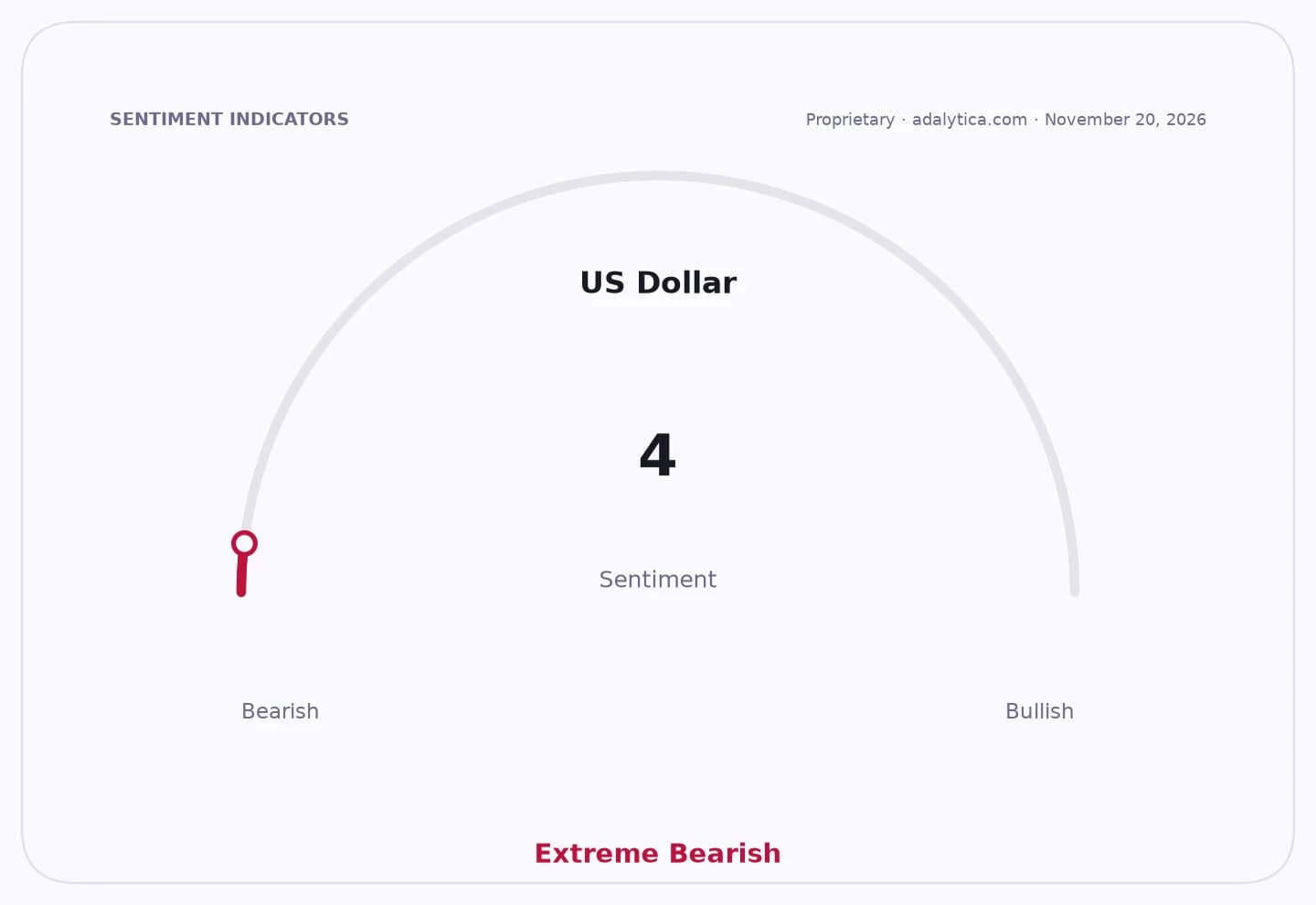
Sentiment Indicators
US Dollar
The latest catalyst is the resilience of the U.S. labor market. Initial jobless claims came in at 203,000, still a historically low level and consistent with the view that the Fed has room to keep rates elevated or raise them further if inflation stays sticky. Traders have responded by buying dollars, pushing the exchange rate to about 1.10 per euro, a level not seen since the first months of 2025.
Against that backdrop, the euro is losing support not because of a fresh euro-zone shock, but because the U.S. remains the main economy where policy can still tighten. Adalytica’s U.S. dollar trade signal shows “Extreme Fear” in sentiment alongside elevated awareness, reflecting how crowded the long-dollar trade has become.
FX Vol Index
The move is also amplifying weakness in other currencies. The Australian dollar fell after a shock labor report showed the economy lost 43,500 jobs in October versus forecasts for a gain of 25,200, while youth unemployment topped 11%. That adds to the dollar’s appeal versus major peers, even as China kept rates unchanged, underscoring the policy divergence that continues to favor U.S. assets.
For EUR/USD traders, the key question is whether the pair can hold the 1.10 area or break lower if upcoming U.S. data keep rate-cut expectations distant. The dollar index is holding above its 50-day and 200-day moving averages, while the euro pair remains below both, suggesting the broader trend still favors the dollar unless the Fed tone shifts or U.S. growth cools sharply.
| Entity | Gains | Losses |
|---|---|---|
| U.S. dollar | ▲Higher yields, safe-haven demand | ▼Crowded positioning |
| Euro | ▲Relative policy support if Fed pauses | ▼Weaker EUR/USD, import costs |
| U.S. exporters | ▲Cheaper foreign-currency revenues translate higher | ▼Overseas sales face FX headwind |
| European importers | ▲None | ▼Higher dollar-priced input costs |