The euro steadied against the dollar on Tuesday after a sharp drop the previous day, with traders weighing whether a brief wave of risk appetite and capital flows into U.S. assets can keep the greenback bid ahead of key German and American data.
Euro Steadies at $1.0905 as Dollar Holds Firm
The common currency was trading at $1.0905 in Frankfurt, holding close to early-session levels after slipping as low as below $1.09 on Monday for the first time since April 2025. The move followed news that Jensen Huang would return to the top of Nvidia, a development that briefly lifted U.S. equities and, unusually, supported the dollar rather than weakening it.
Sentiment Indicators
That reaction matters because it shows how fragile foreign-exchange pricing has become when U.S. technology stocks and dollar flows move together. In a typical “risk-on” session, the dollar tends to soften as investors reach for higher-yielding and higher-beta assets abroad. But Commerzbank’s Volkmar Baur said the price action looked more consistent with capital being redirected quickly into U.S. equities from overseas, a dynamic that can mechanically strengthen the dollar even when market sentiment is upbeat.
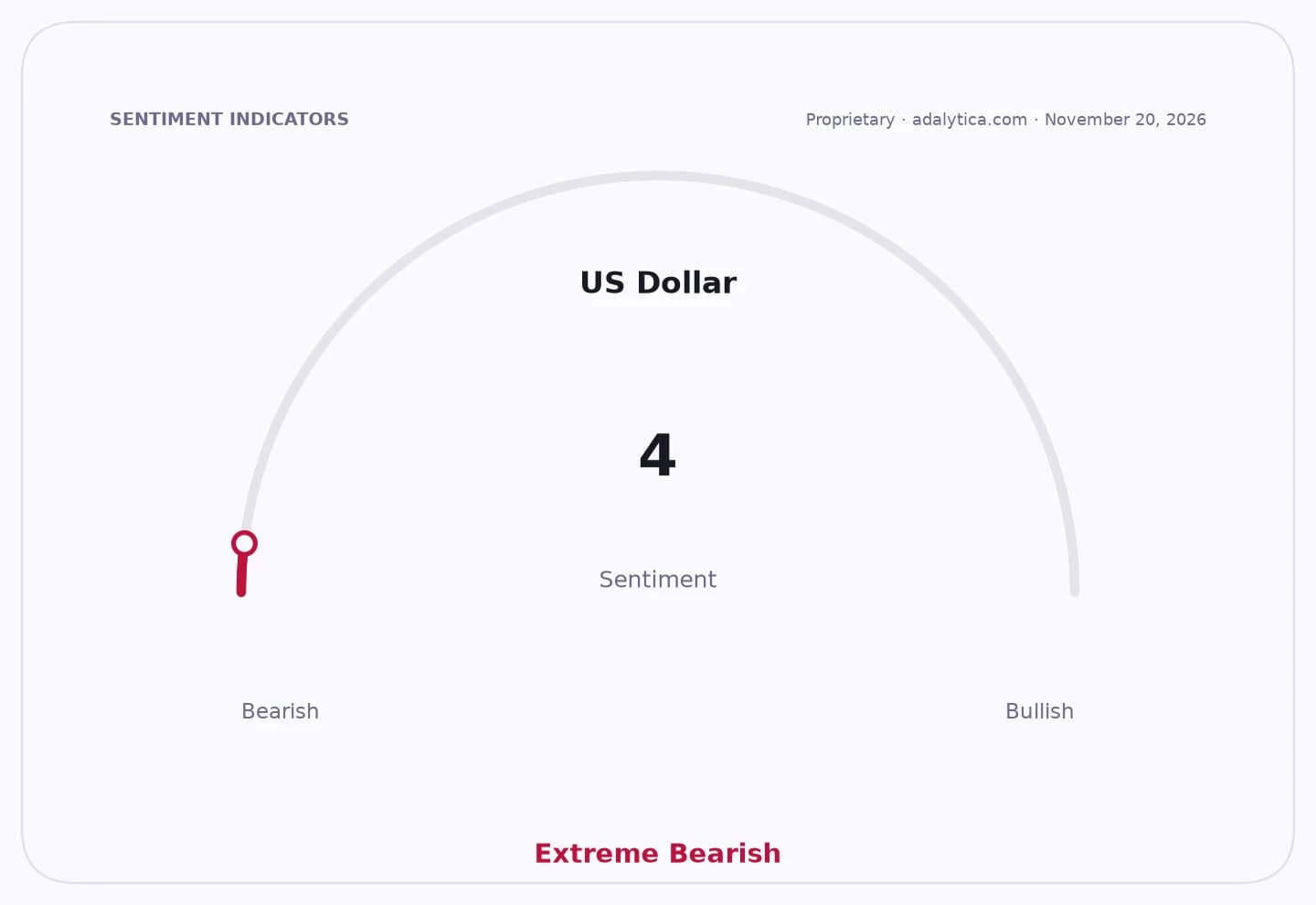
For investors, the immediate issue is whether the euro’s rebound is just a pause in a broader dollar advance. The dollar has been underpinned by renewed AI enthusiasm and expectations that the Federal Reserve will stay comparatively hawkish, keeping U.S. yields attractive versus the euro area. Adalytica’s U.S. dollar trade signals show sentiment still in “Fear” territory, but with the 7-day change improving sharply, suggesting the recent move has restored momentum to the greenback even if positioning remains unstable.
The euro’s next direction will be shaped less by this one-day swing than by incoming data. Markets are waiting for Germany’s Ifo business climate index, where economists expect a modest improvement after Monday’s surprise rise in German purchasing managers’ indices, helped by lower oil prices. Later in the day, U.S. consumer confidence figures will give another read on whether the American economy can continue to support strong dollar demand through growth and rate differentials.
If the Ifo survey confirms that German sentiment is stabilizing, it could give the euro a base. But if U.S. confidence holds up and risk flows continue to favor U.S. assets, the dollar may regain the upper hand quickly. For now, the market is treating the euro’s stabilization as a technical respite, not yet a change in trend.
| Entity | Gains | Losses |
|---|---|---|
| US dollar | ▲Supports U.S. assets | ▼Pressures euro and peers |
| Euro | ▲Stabilizes after drop | ▼Faces renewed downside risk |
| U.S. equities | ▲Attract foreign flows | ▼Can amplify dollar strength |
| European exporters | ▲Cheaper euro boosts competitiveness | ▼Import costs remain elevated |