Europe’s far-right surge is becoming more than an election story: it is emerging as a direct threat to NATO’s ability to fund rearmament, sustain aid to Ukraine and keep pressure on Russia.
Europe Far-Right Surge Pressures NATO Defense Spending

That matters because the alliance is trying to lock in a much more expensive defense posture just as voters are pushing back against higher taxes, tighter budgets and the trade-offs that come with sustained military spending. NATO states in Europe and Canada are on track to spend about $634 billion on core defense this year, an 11% increase from 2025, but the political runway for further gains is narrowing fast. Alliance officials are now openly worried that stronger nationalist and populist parties could slow or reverse the momentum needed to reach NATO’s goal of spending 5% of GDP on defense and security by 2035.
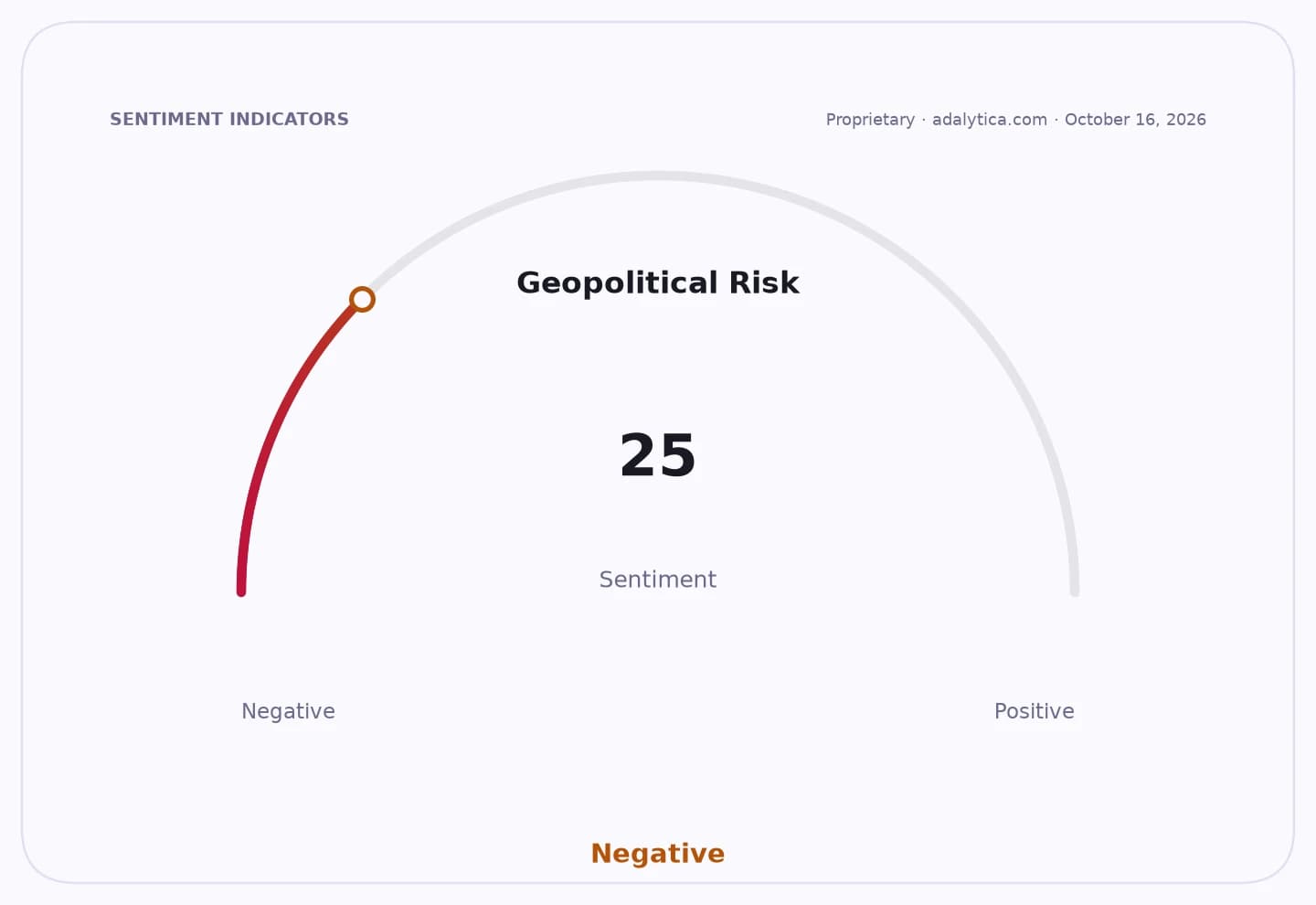
Sentiment IndicatorsⓘProprietary · adalytica.com · October 12, 2026
This is a snapshot — live sentiment, awareness and momentum for 130+ markets update continuously in the dashboard.Open AlphaPulse
The risk is not uniform, and that is what makes it so dangerous. In France, Marine Le Pen’s National Rally is pressing to cap support for Ukraine. In Italy, Roberto Vannacci and the League are pushing back on defense outlays just as Prime Minister Giorgia Meloni faces pressure to trim spending. In Poland, President Karol Nawrocki has tried to block access to nearly 44 billion euros in EU defense loans through the SAFE program. In Germany, the AfD is attacking military budget increases more broadly. These are not marginal voices anymore; they are setting the terms of debate in some of Europe’s most important military powers.
For investors, the key point is that defense spending is no longer just a budget line — it is a political variable. The market has spent the past two years rewarding names tied to European rearmament, ammunition, drones, air defense, cyber and industrial capacity. That trade still has legs, but the composition matters. If national governments hesitate, the winners shift from the most obvious prime contractors to the firms that can benefit from intermittent procurement, cross-border EU funding, maintenance, munitions replenishment and dual-use infrastructure that survives political cycles.
The backdrop is unfavorable for complacency. An ECFR survey across eight European countries found 46.2% of respondents opposed higher defense spending if it required tax increases, versus just 35.5% in favor. NATO internal polling shows public support for Ukraine aid slipping from 59% to 55% this year, with lethal military aid drawing the weakest support. That is exactly the kind of public mood far-right parties are exploiting as living costs remain elevated and governments compete with pensions, health care and social programs for fiscal space.
This is why the story matters beyond Europe’s domestic politics. A slowdown in French or Italian spending would ripple through NATO’s entire force-planning cycle, weaken Europe’s ability to deter Russia and complicate the alliance’s 2029 military-planning targets. It would also make the EU’s long-term defense financing debates harder, especially if budget negotiations drag into next year. As one NATO official put it, if larger countries stop moving forward, NATO stops moving forward.
The most investable conclusion is that Europe’s defense supercycle is entering a second, more politically fragile phase. I believe the market underestimates how much of the next leg will depend not on strategy documents, but on election calendars, budget votes and coalition arithmetic. That makes the opportunity asymmetric: stay exposed to the structural defense buildout, but favor companies and funds tied to the indispensable layers of the supply chain — munitions, air defense, electronic warfare, logistics, secure communications and industrial capacity — rather than relying only on headline enthusiasm for big-ticket procurement.
The headline risk is real, but so is the catalyst. If far-right parties continue to gain ground into 2027 elections in France, Italy, Poland and elsewhere, NATO’s spending ambitions will be tested in real time. For long-term investors, that argues for owning the bottlenecks of rearmament now, before the political friction forces the market to reprice Europe’s defense winners more selectively.
| Entity | Gains | Losses |
|---|---|---|
| Defense contractors | ▲Higher demand for core systems and munitions | ▼Delay risk from budget fights |
| Far-right parties | ▲Political leverage over budgets | ▼Credibility on security policy |
| Ukraine aid recipients | ▲Continued support if centrists hold | ▼Funding cuts if populists gain |
| European taxpayers/social programs | ▲Less pressure if spending is capped | ▼Higher taxes or reallocation if defense rises |