Europe’s labour market may be holding up, but inflation has left a lasting scar on household purchasing power, and the damage to real wages is becoming a bigger economic problem than the headline jobs data suggests.
Europe’s Real Wages Still Weigh on Demand
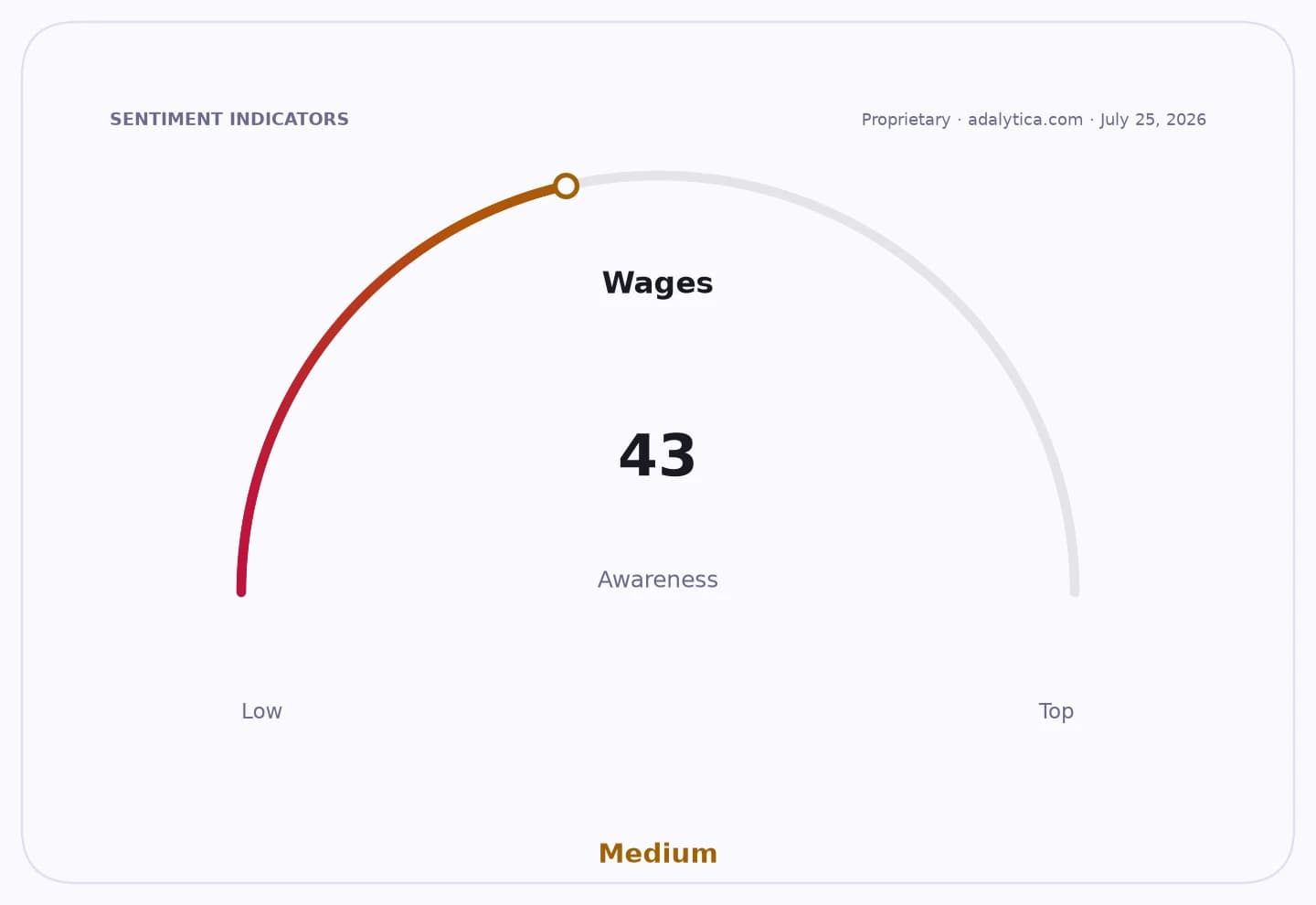
The key development is not just that pay is rising more slowly than prices in parts of the continent, but that in several large economies real earnings have still not reclaimed their 2021 level. That matters because wage gains that are swallowed by inflation do little to support consumption, the main engine of euro-zone growth. It also helps explain why consumer sentiment has remained fragile even as unemployment has stayed relatively low.
Sentiment IndicatorsⓘProprietary · adalytica.com · July 25, 2026
This is a snapshot — live sentiment, awareness and momentum for 130+ markets update continuously in the dashboard.Open AlphaPulse
The pattern is uneven but telling. In Italy, real wages are still about 6% below 2021 levels, while Spain is down roughly 2%, according to the figures cited in the seed material. France is only marginally above that benchmark, while Germany has largely stagnated. The broader message is that the post-pandemic inflation shock reset purchasing power across Europe, and the recovery in nominal pay has been too slow in many countries to fully offset it.
That is economically significant for a region where households typically respond quickly to changes in real income. When wages fail to keep pace with prices, consumers become more cautious on discretionary spending, and firms face a weaker demand backdrop just as financing costs remain elevated. For governments, the squeeze raises political pressure to intervene through tax relief, minimum wage adjustments or more generous collective bargaining settlements, even though those measures can feed back into inflation if they become too broad-based.
The latest U.S. inflation data in the context set underscores how persistent the broader inflation problem has been: core consumer prices remain elevated relative to the pre-pandemic era, and policymakers on both sides of the Atlantic are still trying to balance disinflation with growth. In Europe, where wage-setting is more fragmented and negotiated differently across countries, the pass-through from inflation to real incomes can be slower and more uneven than in the U.S. That leaves the euro-zone particularly vulnerable to a prolonged consumption downturn if nominal wage growth loses momentum.
For investors, the implications are straightforward. Weak real wages are a headwind for European retailers, consumer discretionary names and domestic cyclicals that rely on household demand. They are also relevant for banks and lenders exposed to consumer credit quality, because stretched households are more likely to cut spending or fall behind on payments if living costs stay high. By contrast, exporters and global earners are better insulated, since they depend less on domestic purchasing power.
The market backdrop reflects that split. The Canada ETF EWC has climbed above its 200-day moving average, while Germany’s EWG has recovered from a sharp spring selloff and Spain’s EWP has also strengthened. But the country-specific equity performance does not erase the underlying macro risk: equity investors may be pricing in improving growth, yet the wage data suggest that domestic demand in Europe remains vulnerable if inflation settles above the levels households need to restore lost purchasing power.
Adalytica’s long-term inflation expectations gauge and its inflation-target confidence snapshot both point to lingering uncertainty about whether price pressures have fully normalized. That matters because if households and firms continue to expect inflation to stay sticky, wage bargains may remain defensive rather than expansionary, limiting the pace at which real incomes recover.
The likely narrative for 2026 is therefore not one of a clean wage rebound, but of a slow and uneven repair. Countries with stronger labour markets may recover purchasing power earlier, while Italy and Spain remain more exposed to a longer hangover from the inflation shock. For investors, the main watchpoint is whether real wage growth can finally outpace inflation enough to revive spending — or whether Europe’s recovery continues to depend mostly on exports and policy support.
| Entity | Gains | Losses |
|---|---|---|
| Households | ▲higher nominal pay gains | ▼real purchasing power |
| Consumers of domestic goods | ▲eventual wage recovery | ▼immediate spending capacity |
| Exporters | ▲weaker domestic-currency pressure | ▼little direct harm |
| Retailers and cyclicals | ▲stronger demand if wages recover | ▼softer discretionary spending |