Corn prices jumped sharply on European exchanges this week as a weaker-than-expected harvest tightened supply and widened the transatlantic price gap, a reminder that weather-driven crop shocks can quickly ripple through feed markets, livestock margins and grain traders’ positioning.
European corn prices rise on weaker harvest
The clearest signal is on Euronext, where the November corn contract climbed from about 273 euros a ton on Friday to 303 euros by Wednesday, adding 26 euros in just two days and translating to roughly $339 a ton. That move has pushed the premium of European corn over U.S. corn to more than $140 a ton, a rare spread that is already changing buying patterns across the feed sector.
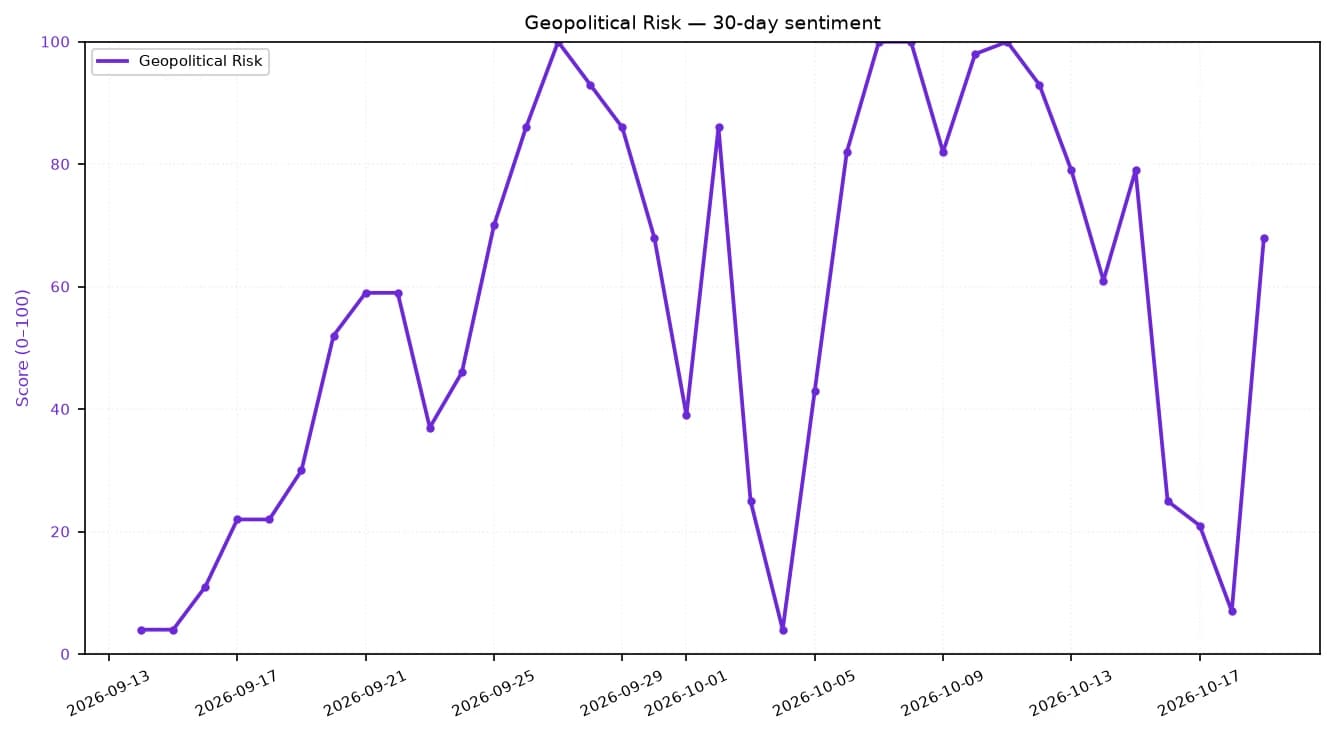
Sentiment IndicatorsⓘProprietary · adalytica.com · October 20, 2026
This is a snapshot — live sentiment, awareness and momentum for 130+ markets update continuously in the dashboard.Open AlphaPulse
For livestock producers and animal feed buyers, that gap matters more than the headline price alone. When corn becomes too expensive in Europe, buyers often switch to feed wheat if it is cheaper, and that is exactly what market participants are now weighing. In a region already coping with a weak euro and firm demand, the tighter corn balance sheet raises the cost of feeding cattle, poultry and pigs just as margins are under pressure from broader inflation and energy costs.
The move also highlights how uneven the global grain picture has become. U.S. corn remains under pressure, with the December Chicago contract recently slipping to around $189 to $190 a ton, while European prices are being supported by harvest disappointment. Wheat has been steadier, but the broader grain complex is being pulled by weather, crop progress and fund flows rather than any single demand story.
That is why this matters for investors: the market is not just repricing corn, it is repricing the entire agricultural input chain. Grain merchants, feed producers, livestock operators and food manufacturers all face different margin outcomes depending on where they source supply and how quickly they can pass costs through. The spread between European and U.S. corn is now the key trade to watch, not just the outright level.
Technically, U.S. corn has also lost momentum after earlier strength, with the corn ETF trading well below its 50-day moving average and the RSI signaling oversold conditions. By contrast, the European move reflects a more immediate supply squeeze than a broad-based demand boom, which makes it vulnerable to weather corrections but supportive for grain volatility in the near term.
For investors, the opportunity lies in the second-order effects. Stronger European grain prices can support storage, logistics and trading businesses while squeezing feed-sensitive sectors. They also reinforce the case for exposure to agricultural volatility rather than a simple directional bet on corn alone. Until harvest conditions improve, Europe’s corn market is likely to stay the hotter one — and the one most likely to keep pulling related prices higher.
| Entity | Gains | Losses |
|---|---|---|
| European grain traders | ▲Higher margins from volatility | ▼Greater hedging risk |
| Corn growers in Europe | ▲Better selling prices | ▼Smaller harvest volumes |
| Livestock and feed buyers | ▲Alternative feed wheat usage | ▼Higher input costs |
| U.S. corn exporters | ▲More price competitiveness | ▼Weak nearby pricing |