Higher gas costs are set to hit European households and businesses as the Iran war pushes wholesale prices sharply higher, raising the odds of broad tariff increases into the winter.
European gas prices rise on Iran war supply shock
That matters because gas is not just another utility line item. It is the marginal fuel that feeds heating bills, industrial input costs and electricity pricing across Europe, so a sustained jump ripples through consumer inflation and corporate margins far beyond Hannover, where Enercity Netz is already lifting network fees and Verivox expects gas tariffs to rise 10% to 20% at the turn of the year.
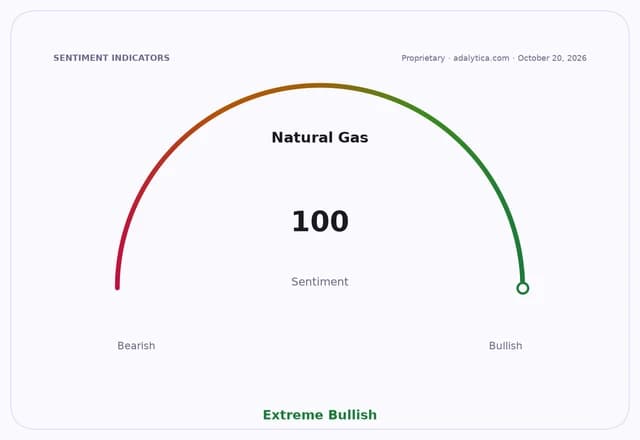
Sentiment IndicatorsⓘProprietary · adalytica.com · October 20, 2026
This is a snapshot — live sentiment, awareness and momentum for 130+ markets update continuously in the dashboard.Open AlphaPulse
The German data show the squeeze is arriving through two channels at once: regulated network charges and commodity costs. In Hannover, a household using 4,000 kilowatt hours of power will pay about 10.50 euros more in annual grid fees from 2027, while gas network charges in Lower Saxony are rising around 3%, or about 18 euros a year for a family using 20,000 kilowatt hours. The larger move, however, is wholesale gas, where Verivox says prices are up roughly 140% since February 2025 and have added about five euro cents per kilowatt hour net after the escalation in the Middle East.
Investors should read this as a new inflation shock rather than a local billing adjustment. Europe’s utility and industrial sectors remain exposed to every lurch in gas markets, and the latest spike comes just as fixed-price contracts become more valuable to consumers trying to lock in winter costs. The energy trade is already reflecting that tension: Adalytica’s natural gas signal is at “Extreme Greed,” while U.S. gas ETFs have stayed volatile and energy equities have outperformed more defensive parts of the market.
The beneficiaries are the obvious ones — gas producers, LNG exporters, pipeline and grid operators, and energy-heavy equities — but the hidden winners may be those with pricing power and low-cost fuel exposure. The losers are more numerous: households, chemical and manufacturing firms, and retailers that will have to absorb or pass on higher utility bills into a still-fragile consumer backdrop.
For now, the market appears to be underestimating how quickly a European gas repricing can feed through the real economy. If the Iran-linked supply disruption persists, the next round of winter tariff notices could become the latest reminder that energy inflation is still a live trade, not a history lesson. In that setup, investors should stay positioned for upside in gas-linked assets and energy infrastructure, while remaining cautious on businesses that cannot pass through higher input costs.
| Entity | Gains | Losses |
|---|---|---|
| Gas producers/LNG exporters | ▲Higher realized prices | ▼Volatile supply outlook |
| Grid operators/utilities | ▲Higher network revenues | ▼Regulatory scrutiny |
| Energy equities | ▲Inflation hedge appeal | ▼Broader market volatility |
| Households/manufacturers | ▲Fixed-price contracts | ▼Higher winter bills |