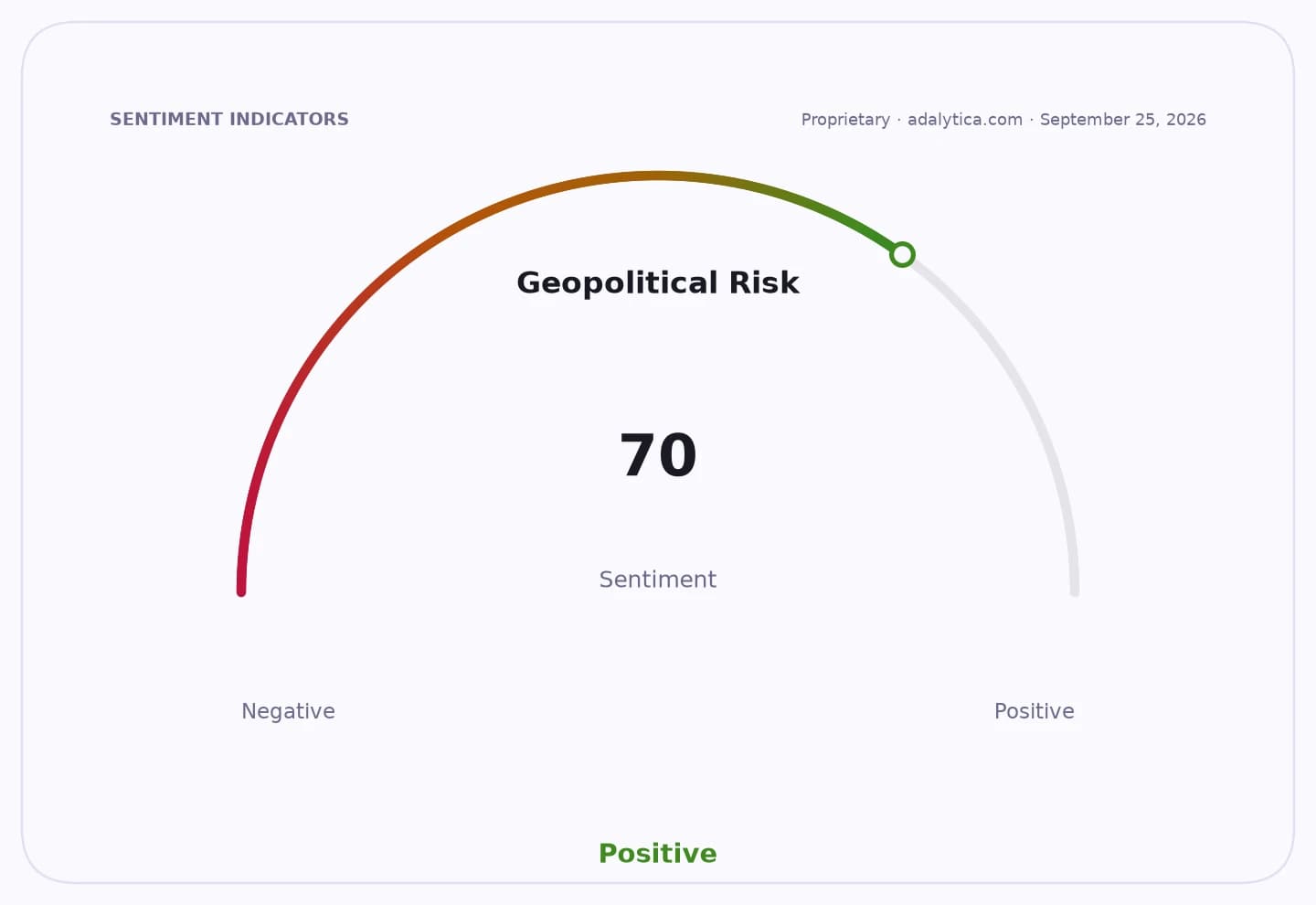
China’s protest to Japan over accusations that Beijing is inflating the “Chinese threat” comes at a moment when the regional risk premium is rising — and investors are already voting with their money. Japan’s ETF EWJ is pushing back toward its highs, Chinese equities in FXI remain well below their spring levels, and oil’s USO has swung violently as traders reassess what an escalation in Asia could mean for growth, currencies and defense spending.
EWJ at 93.88, FXI Lags Amid Japan-China Tensions
The economic significance is bigger than a diplomatic spat. When the world’s second- and third-largest economies harden their rhetoric, it can alter capital flows, defense budgets, trade assumptions and the pricing of imported energy. That matters for Japan’s exporters, China’s manufacturers and the broader Asia supply chain, where even a contained political confrontation can nudge companies to diversify sourcing, raise inventories or delay investment.
Sentiment IndicatorsⓘProprietary · adalytica.com · August 4, 2026
This is a snapshot — live sentiment, awareness and momentum for 130+ markets update continuously in the dashboard.Open AlphaPulse
The market backdrop says investors are not treating this as noise. EWJ is trading at 93.88, above its 50-day average of 92.59 and comfortably above its 200-day average of 86.46, while the RSI at 51.2 suggests the rally is no longer stretched. That points to a market that has absorbed a lot of geopolitical anxiety without breaking trend. FXI, by contrast, is at 36.12, still below its 200-day average of 36.93, a sign that China remains the laggard in any regional re-rating. The divergence matters: investors are rewarding the relative safety of Japan and punishing exposure to Chinese policy and geopolitical risk.
Energy is the other channel to watch. USO closed at 116.29 after a sharp pullback from the highs above 150 earlier this year, but it remains far above its 200-day average of 100.71. That keeps oil sensitive to any sign that Asia tensions could spill into shipping routes, sanctions, or a broader risk-off move that supports the dollar and lifts volatility across commodities. With Adalytica’s U.S. dollar trade signals flashing “Extreme Greed,” the market is already leaning into a defensive macro trade that typically weighs on emerging Asia and commodity importers while supporting hard-asset hedges.
The investable read-through is straightforward: the market underestimates how quickly geopolitical friction in Northeast Asia can become a capex story. Japan’s defense build-out, including drones and other military systems, favors contractors, electronics suppliers and industrial names tied to surveillance, robotics and missile defense. At the same time, companies exposed to China demand or cross-strait supply chains face a higher discount rate, because politics is increasingly shaping where capital is spent, where factories are built and where reserves are parked.
That is why the best opportunities are likely not in chasing the headline conflict itself, but in owning the infrastructure of strategic rearmament and economic insulation. EWJ looks like the cleaner expression of regional resilience, while FXI remains the more vulnerable trade until Beijing de-escalates and growth confidence returns. For investors, the message is to stay overweight Japan-linked industrial, defense and automation beneficiaries, and remain selective — if not defensive — on China exposure until the geopolitical premium starts to fade.
| Entity | Gains | Losses |
|---|---|---|
| Japan defense and industrial suppliers | ▲Higher military spending | ▼— |
| EWJ / Japanese equities | ▲Relative safe-haven demand | ▼— |
| China-listed equities / FXI | ▲— | ▼Geopolitical discount |
| USO / oil bulls | ▲Risk-premium support | ▼Growth scare volatility |