Brazil’s runoff has become more than a domestic political contest: investors are now pricing a possible shift in the country’s foreign policy, industrial strategy and capital flows, with the iShares MSCI Brazil ETF, EWZ, surging to $42.60 as markets bet that a Flávio Bolsonaro victory would pull Brasília closer to Washington and away from Lula’s more balanced stance toward China.
EWZ Rises on Brazil Runoff Policy Bets

That matters because Brazil is not just a commodity exporter anymore; it sits at the intersection of rare earths, energy, food, data centers, infrastructure and the Amazon, all of which are being pulled into the rivalry between the U.S. and China. A change in the presidency could alter where investment comes from, which sectors get favored, and how far Brazil is willing to lean into strategic autonomy versus alignment with the Trump agenda.
Sentiment IndicatorsⓘProprietary · adalytica.com · October 8, 2026
This is a snapshot — live sentiment, awareness and momentum for 130+ markets update continuously in the dashboard.Open AlphaPulse

The market move underscores how quickly politics can reprice a large emerging market when the policy mix looks set to change. EWZ has climbed well above its 50-day and 200-day moving averages, and its latest reading leaves the ETF trading near the top of its Bollinger Band, while RSI remains elevated at 73.8. That is not just momentum; it is a sign that global money is chasing the possibility of a friendlier investment regime, even before the vote is settled.
Lula still represents a development model built on state-led growth, social protection and industrial policy. Flávio, by contrast, is pitching privatization, deregulation, spending restraint and a more confrontational conservative coalition, with closer ideological ties to Trump-style nationalism. For investors, that distinction is crucial: one path implies more policy continuity and deeper ties with China, the other implies a more radical realignment that could reshape Brazil’s trade, infrastructure and defense priorities.
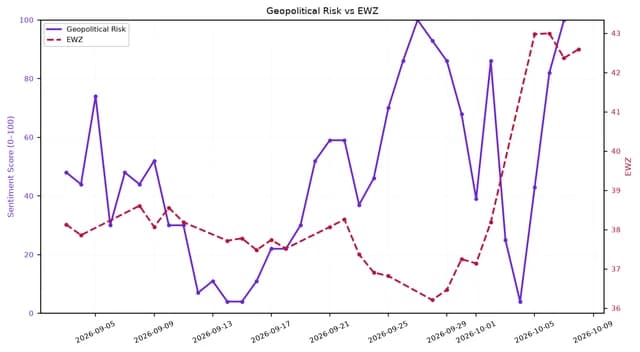
The real opportunity lies in the second-order effects. A Brazil that moves closer to Washington could see renewed foreign interest in strategic minerals, ports, power generation, logistics and digital infrastructure, while domestic financials and concession-heavy businesses may benefit from a market-friendly agenda. At the same time, exporters tied to China-facing commodity flows could face more policy volatility if Brasília starts hedging less and choosing sides more openly.
The market underestimates how much of this election is really about Brazil’s role in the next global supply chain map. If Flávio extends his lead, the trade between political probability and asset prices may still have room to run. If Lula claws back momentum, EWZ’s recent breakout could fade fast. Either way, the next catalyst is not just who wins the presidency, but which development model Brazil commits to for the next cycle. For investors, the setup argues for staying selective and positioning early around the beneficiaries of a more geopolitically strategic Brazil.
| Entity | Gains | Losses |
|---|---|---|
| EWZ / Brazil equities | ▲Policy re-rating | ▼Runoff uncertainty |
| Flávio Bolsonaro bloc | ▲Market-friendly narrative | ▼Institutional resistance |
| Lula coalition | ▲Continuity and state-led model | ▼Momentum in polls |
| U.S.-aligned sectors | ▲Capital inflows, deals | ▼China-dependent exporters |