Beth Hammack said the Federal Reserve should shift to a more restrictive stance “relatively quickly,” underscoring a growing concern inside the central bank that inflation is not fading on its own and may already be feeding into company pricing plans.
Fed's Hammack Calls for Quicker Restrictive Policy

The Cleveland Fed president’s remarks matter because they point to pressure for the Fed to keep policy tight, or tighten further, even as markets continue to debate how much restraint is already in place. Hammack said inflation pressures are now broad-based rather than confined to a single category, citing energy costs but also signs from her district that businesses intend to raise prices faster than their own input costs.
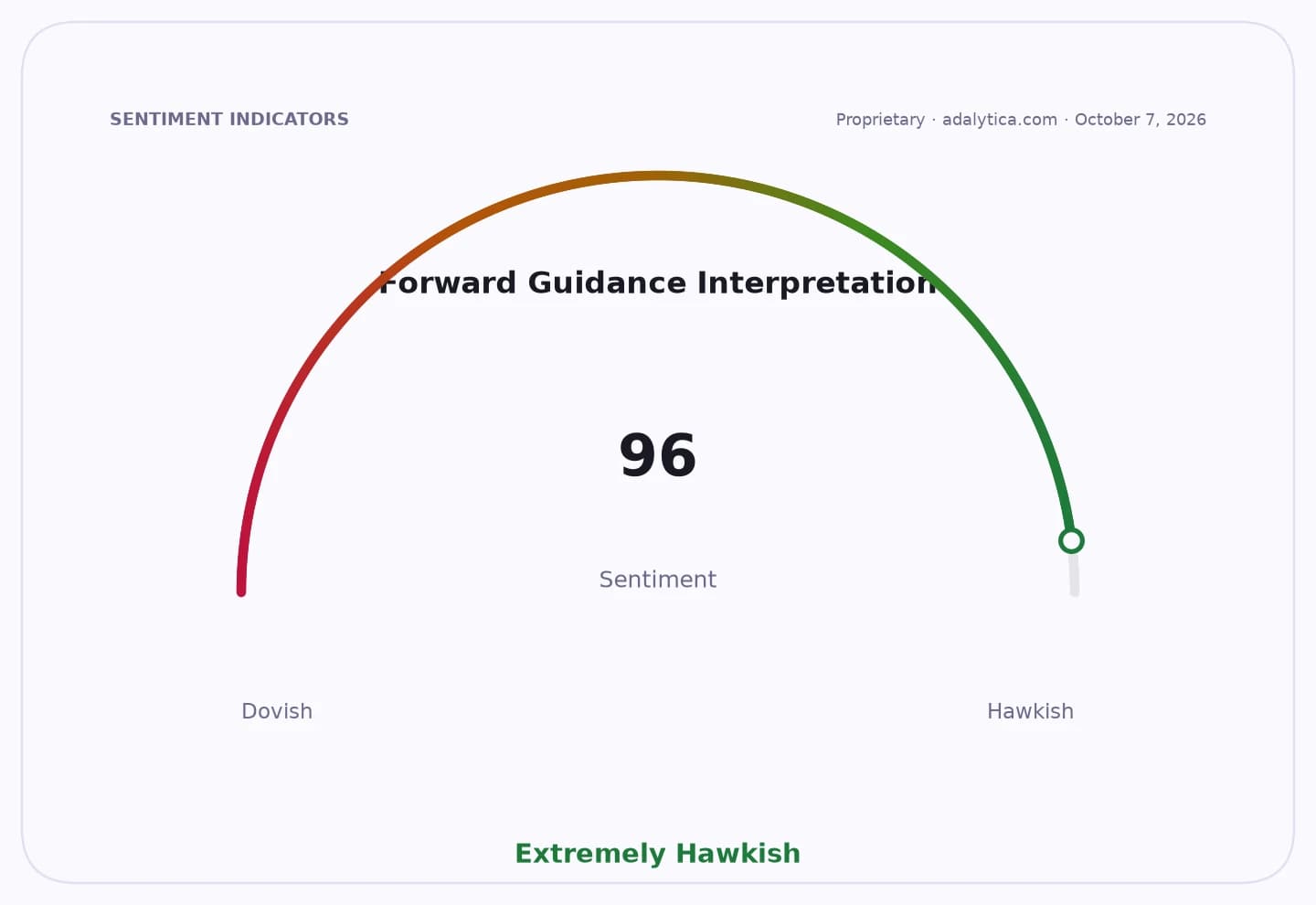
Sentiment IndicatorsⓘProprietary · adalytica.com · October 13, 2026
This is a snapshot — live sentiment, awareness and momentum for 130+ markets update continuously in the dashboard.Open AlphaPulse
That is economically significant because it suggests the inflation fight is not just about headline fuel prices or a handful of volatile goods. If firms begin to pre-emptively lift prices, the risk rises that inflation becomes sticky and expectations shift higher, forcing the Fed to choose between a longer period of elevated borrowing costs or a sharper response later. Hammack said a restrictive policy is needed to return inflation to the 2% target in a timely way, arguing that smaller adjustments made sooner are preferable to a larger correction if inflation proves more persistent.
Her comments also draw attention to a newer source of price pressure: the artificial intelligence investment boom. Hammack said demand linked to AI is pushing up prices for critical computing, electronics and high-tech components, raising costs not only for data centers but also for projects in aviation, power generation and construction that rely on similar inputs. That broadens the inflation story beyond consumer demand and suggests a supply-chain constraint in capital goods could keep parts of the economy under cost pressure even if goods inflation elsewhere cools.
FEDFUNDS vs CPIAUCSL — macro contextadalytica.com
Explore this data interactively — full history, time series and cross-market comparisons.Open AlphaPulse

For investors, the message is straightforward: the bar for early policy easing remains high, and the path of rates may stay restrictive for longer than markets hope. US Treasury bonds have already been trading with significant volatility, while equity valuations remain sensitive to any shift in the rate outlook. The 10-year Treasury yield was around 5.2%, a level that keeps real financing conditions tight for households and companies. Long-duration assets such as the iShares 20+ Year Treasury Bond ETF, TLT, have also shown strain, with the fund recently trading near 78, well below its 200-day average.
The market reaction in policy sentiment also reflects how quickly expectations can swing. Adalytica’s Federal Reserve forward-guidance gauge remained at an “extreme greed” reading of 86, while its hawkish-versus-dovish Fed sentiment measure sat near neutral at 39 after a sharp one-day drop, suggesting traders are still trying to price the balance between higher-for-longer rates and eventual easing.
The broader narrative is that inflation is reasserting itself in multiple channels at once: energy, consumer pricing, and now AI-related capital spending. That makes it harder for the Fed to declare victory, and it raises the odds that officials like Hammack will continue pressing for restraint before price pressures become more entrenched. The next catalyst is whether upcoming inflation and spending data confirm that this is a temporary burst or the start of a more durable reacceleration that keeps the Fed on hold well into next year.
| Entity | Gains | Losses |
|---|---|---|
| Fed hawks | ▲Stronger case for tight policy | ▼Risk of slower growth |
| Borrowers | ▲None | ▼Higher-for-longer rates |
| Treasury bonds | ▲Potential haven demand | ▼Yield pressure and price losses |
| AI hardware and data center users | ▲None | ▼Higher component and project costs |