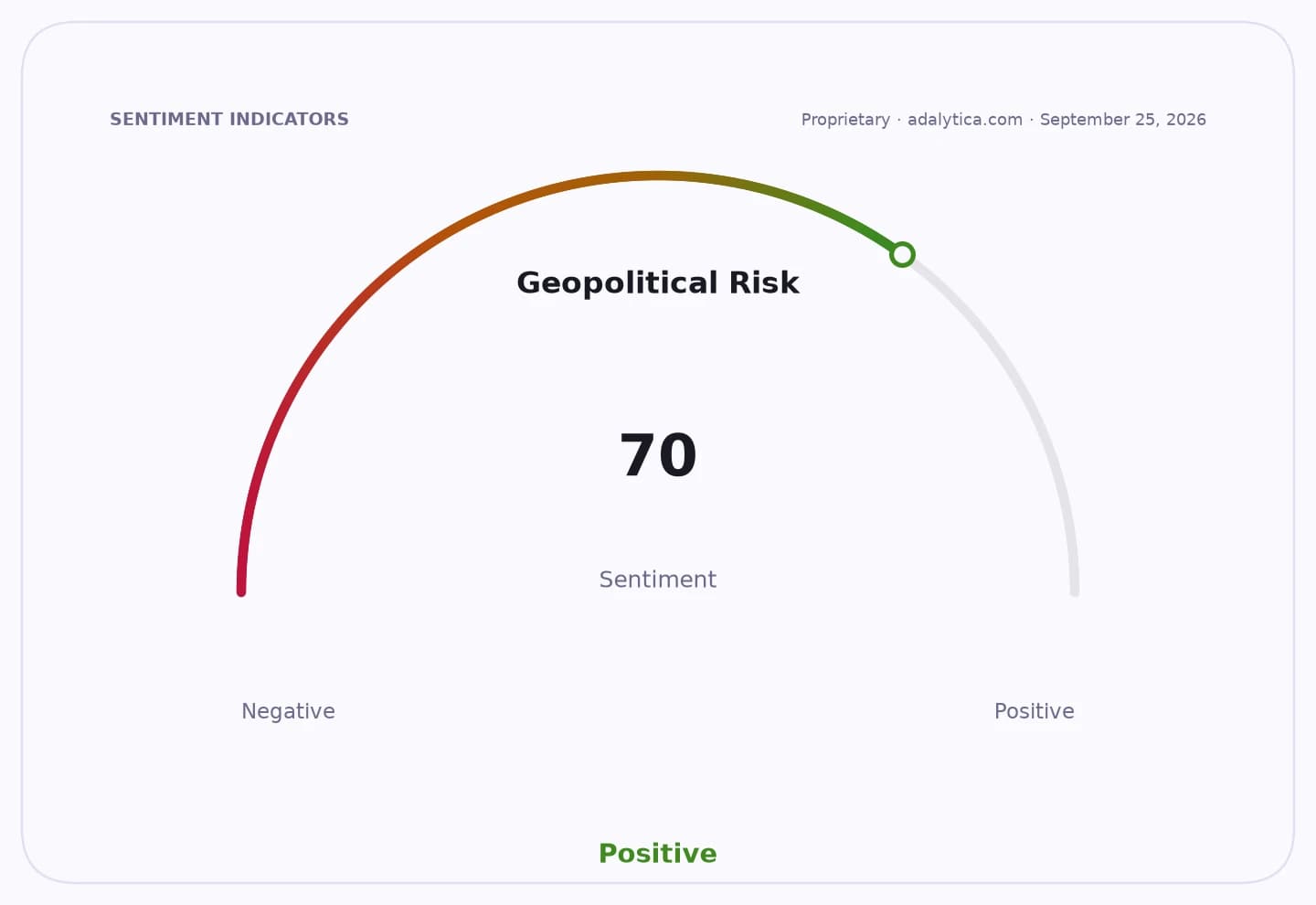
The Federal Reserve looks set to keep its benchmark rate unchanged through 2026, a call that reflects a policy regime still anchored by inflation risk even as growth cools and markets price in only a shallow path for easing or tightening.
Fed Hold Bias Supports Banks, Pressures Long Bonds
That matters because the Fed is no longer being asked to rescue the economy so much as to keep it from re-accelerating. With the policy rate forecast at about 3.627% in July 2026, essentially flat from 3.63% in June, the central bank is signaling that it sees no urgent case to move. At the same time, consumer prices remain elevated relative to the pre-pandemic era, with the CPI index forecast to edge higher to 335.5 in July from 332.6 in June, while the 10-year Treasury yield has climbed back to about 4.64%. That combination suggests the Fed is more worried about losing its inflation fight than about missing out on a near-term growth boost.
Sentiment IndicatorsⓘProprietary · adalytica.com · July 23, 2026
This is a snapshot — live sentiment, awareness and momentum for 130+ markets update continuously in the dashboard.Open AlphaPulse

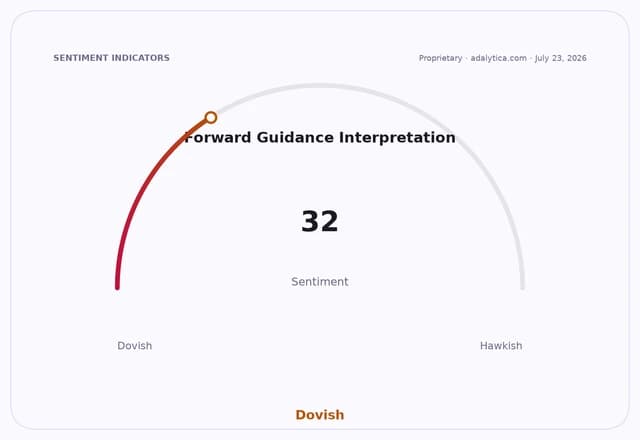
For investors, the significance is straightforward: a hold in rates in 2026 implies a longer period of restrictive real financing conditions, even if the next move eventually proves to be a cut. The market has already been leaning that way. Adalytica’s market-expectations gauge shows extreme greed around the Fed’s rate path, while its forward-guidance sentiment remains neutral and the hawkish-vs-dovish policy gauge points firmly toward a hawkish bias. In plain terms, traders are positioning for policy to stay tighter for longer, but with enough uncertainty to keep volatility alive.
That tension is visible in rates markets and rate-sensitive assets. The 10-year yield’s move to the mid-4% range has pushed back against any easy disinflation trade, while TLT, the long-duration Treasury ETF, has been under pressure and recently traded below its 50-day average. Its RSI has fallen into oversold territory, which may invite short-term contrarian buying, but the broader trend still reflects a market struggling with higher-for-longer yields. By contrast, SHY, the short-duration Treasury ETF, has stayed relatively stable around its moving averages, underscoring how the front end remains the safer harbor when the Fed is not signaling imminent easing.
FEDFUNDS vs CPIAUCSL — macro contextadalytica.com
Explore this data interactively — full history, time series and cross-market comparisons.Open AlphaPulse
Equities are telling a similar story. SPY has held near record levels, but the rally has become more sensitive to rate expectations and bond yields. The index sits above its 50-day and 200-day moving averages, yet momentum has cooled from earlier highs, suggesting investors are willing to buy growth and earnings resilience only if rates do not break higher. If the Fed does stay on hold in 2026, that supports the valuation case for large-cap equities better than a renewed tightening cycle would. But it also limits the upside for the most duration-sensitive areas of the market, including real estate, small caps and high-multiple software.
The banking sector is a key beneficiary of this backdrop, at least in relative terms. Filings from Bank of America and peers show how closely lenders watch long-end rate moves through economic value of equity and net interest income sensitivity. A flatter policy path can preserve deposit spreads and keep asset yields elevated for longer, which helps earnings at money-center banks and some brokers. But if long rates keep rising while the Fed stays on hold, funding costs and mark-to-market volatility could offset that benefit. That is why the market is treating the current setup as supportive but not unambiguously positive for financials.
The bigger narrative is that the Fed is entering 2026 with little room for error. Officials have indicated they would raise rates if inflation stays stubborn, even after softer data, and the latest framework changes around their preferred inflation gauge have only complicated the decision-making. A steady policy rate in that environment would not mean victory over inflation; it would mean the Fed believes the cost of moving again exceeds the benefit.
For investors, the base case is a range-bound policy backdrop with higher-for-longer yields, selective support for cash-rich equities and banks, and continued pressure on long-duration bonds. The key catalysts to watch are whether CPI re-accelerates, whether the 10-year yield pushes meaningfully above current levels, and whether growth weakens enough to force the Fed off its hold stance. Until then, the central bank’s inaction may be the most important policy signal in the market.
| Entity | Gains | Losses |
|---|---|---|
| Banks | ▲Wider lending spreads | ▼Higher funding pressure |
| TLT holders | ▲Short-term mean reversion | ▼Duration losses |
| SHY holders | ▲Cash-like stability | ▼Limited upside |
| Equities with pricing power | ▲Valuation support | ▼Rate-sensitive sectors |