Fast-moving consumer goods companies are facing a tougher path to growth as inflation, slower income gains and changing consumer budgets force households to spend more on electronics, durables and lifestyle products instead of staples, Kotak Institutional Equities said.
FMCG growth faces pressure from inflation and shifts
The brokerage’s warning matters because FMCG is a defensive sector only when consumption is stable. When inflation outpaces income growth, volume expansion tends to weaken, pricing power gets tested and companies are pushed to defend margins rather than drive meaningful top-line acceleration. Kotak said the headwinds are structural enough that sustaining or accelerating revenue compound annual growth over the next three to five years will require stronger execution in core businesses and a shift into faster-growing categories.
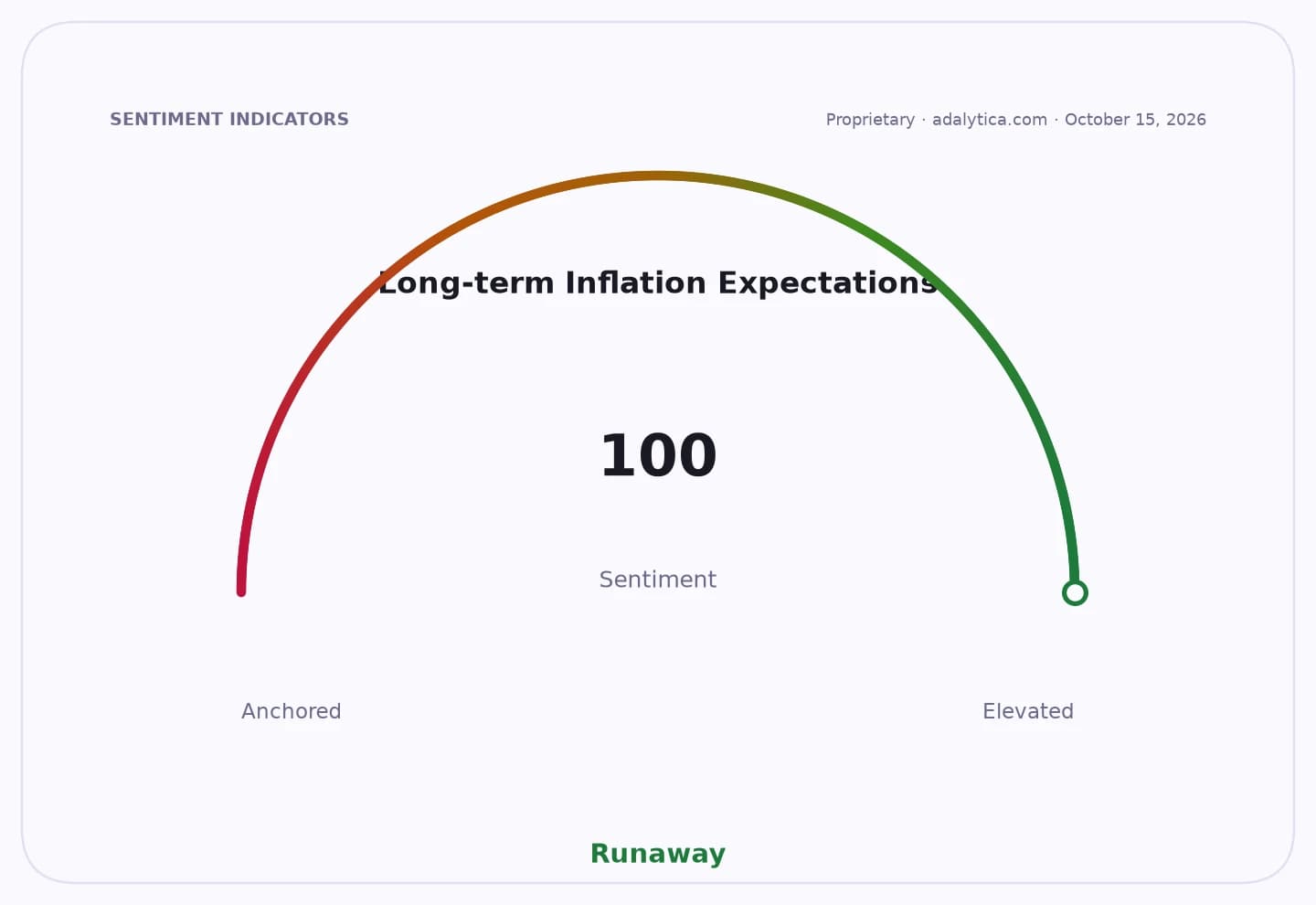
Sentiment IndicatorsⓘProprietary · adalytica.com · October 15, 2026
This is a snapshot — live sentiment, awareness and momentum for 130+ markets update continuously in the dashboard.Open AlphaPulse
That challenge is showing up in the macro backdrop. Inflation has remained sticky, with the consumer price index still near 336 in September 2026 after a 40.72% jump from the series point recorded in May 2026, while personal consumption expenditure has climbed to 22,308.5 from 20,458.7 at the end of 2024. Even where spending is rising, the pace is uneven, leaving less room for broad-based FMCG volume gains. Adalytica’s Long-Term Inflation Expectations sentiment gauge is at an extreme 100, underscoring how entrenched price pressure remains in the consumer mindset, while its wage inflation gauge is also at 100, suggesting household budgets are still being squeezed.
Kotak said the sector has already seen growth moderate as per capita income and private consumption expenditure have expanded only modestly relative to inflation. Consumers are devoting a larger share of wallets to categories such as consumer electronics, durables and lifestyle goods, creating a tougher environment for traditional packaged foods, household products and personal care names.
CPIAUCSL vs PCE — macro contextadalytica.com
Explore this data interactively — full history, time series and cross-market comparisons.Open AlphaPulse
Competition is adding another layer of strain. Direct-to-consumer brands, private labels, quick commerce and e-commerce are fragmenting some categories, even if their impact has been limited so far. For FMCG groups, that means growth increasingly depends on portfolio reshaping rather than simple distribution expansion. Kotak said some companies have limited scope to widen distribution further or deepen penetration in mature categories, forcing them to rely on product launches, brand revamps and acquisitions to unlock new demand pools.
Raw material inflation remains a second-order but important risk. Kotak revised estimates for higher costs in crude-linked packaging inputs, palm oil, sugar and select agricultural commodities, citing the war and El Nino-related disruptions. That combination leaves FMCG firms caught between softer demand and elevated input costs, a mix that typically compresses operating leverage.
Investors are already rewarding the companies that can prove they can manage through the cycle. Procter & Gamble and Coca-Cola have held up better than the broader consumer space as they lean on pricing, mix and brand strength, while Walmart has also benefited from trading-down behavior as households seek value. The market message is clear: in an inflationary consumer environment, scale alone is not enough. Companies that can shift portfolios toward premium, health-led or faster-growing categories may preserve earnings power; those still dependent on mature staples could see revenue growth and margins stay under pressure into FY2028, even if input costs eventually moderate.
| Entity | Gains | Losses |
|---|---|---|
| Premium FMCG players | ▲Better mix, pricing power | ▼Volume growth pressure |
| Value retailers and large grocers | ▲Trading-down traffic | ▼Margin pressure from costs |
| D2C brands and private labels | ▲Share gains in fragmented categories | ▼Incumbent pushback |
| Traditional staples makers | ▲Portfolio transformation opportunity | ▼Slower revenue CAGR |