Rising gas prices are beginning to feed through to food inflation, raising the risk that a localized energy shock turns into a broader squeeze on household budgets and margins for grocers, restaurants and packaged-food companies.
Food Inflation Rises as Gas Prices Increase
Romania’s agriculture minister warned that the increase in gas prices could trigger a “chain effect” on food costs, a dynamic that matters because energy is embedded across the food supply chain — from fertilizer and farm inputs to processing, transport and retail refrigeration. When gas prices move higher, producers rarely absorb the full cost for long, and the pressure tends to show up later in shelf prices.
Sentiment IndicatorsⓘProprietary · adalytica.com · October 2, 2026
This is a snapshot — live sentiment, awareness and momentum for 130+ markets update continuously in the dashboard.Open AlphaPulse
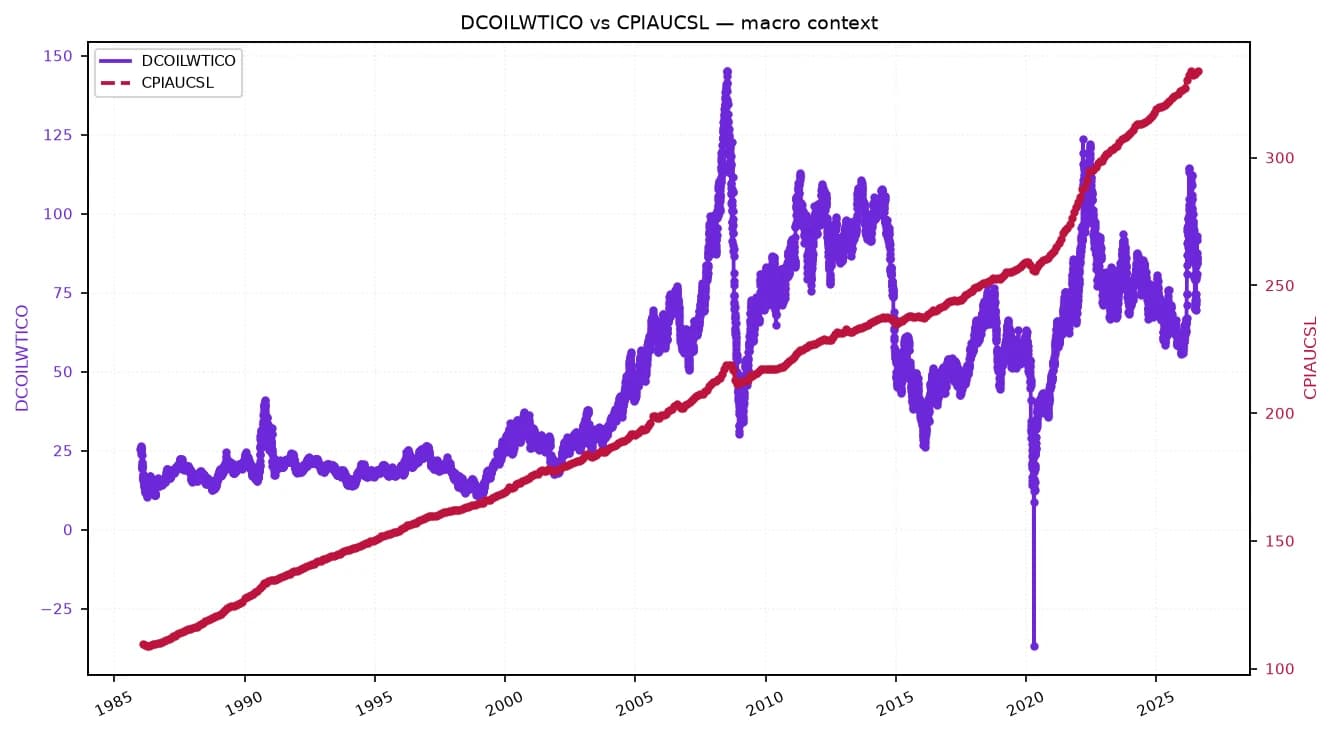
The warning lands at a sensitive point for inflation. U.S. benchmark West Texas Intermediate crude, tracked via USO, closed at $150.02 on Oct. 1 after a volatile run, still well above its 200-day moving average of $114.78 even after a pullback from recent highs. The exchange-traded fund’s RSI, a standard momentum gauge, fell to 45.4 from overbought levels earlier in the month, suggesting the market has cooled but remains elevated. Adalytica’s oil trade snapshot still shows a neutral sentiment reading of 66, even as awareness remains at “Extreme Fear,” underscoring how quickly energy stress can reprice inflation expectations.
That matters because the transmission from gas to food is usually slower than the initial fuel spike, but often broader in scope. Grains and vegetables are energy-intensive to produce and move. In export-oriented markets and urban retail systems alike, higher fuel bills can filter into logistics costs, cold storage, restaurant menus and processed-food pricing. In places already seeing higher gas cylinder prices and festival-season demand, the pass-through can be even faster.
The macro backdrop does not look friendly. U.S. consumer prices, as proxied by the CPI series, rose to 334.131 in August from 332.813 in July, while producer prices climbed to 287.928 from 285.181 over the same period, indicating that cost pressures are still embedded in the pipeline. Adalytica’s CPI sentiment gauge sits at 95, or “Extreme Greed,” a sign that markets are increasingly focused on inflation persistence rather than disinflation.
For investors, the immediate read-through is mixed. Energy producers and fuel distributors benefit from higher fuel prices, while consumer staples with pricing power may be able to defend margins. But the risk is that food inflation erodes demand at supermarkets, compresses restaurant traffic and forces retailers into a tougher balancing act between protecting volume and protecting gross margin. Companies such as Costco, Kroger and Walmart have all flagged the tension between holding prices and absorbing input costs in recent filings.
The bigger question is whether this becomes a temporary seasonal spike or a second-round inflation impulse. If gas stays high into winter, the pressure on transport, agricultural processing and food service could broaden, making it harder for central banks to argue that inflation is fully contained and harder for consumers to absorb yet another increase in essentials.
| Entity | Gains | Losses |
|---|---|---|
| Energy producers | ▲Higher fuel revenues | ▼Slower demand if prices spike too far |
| Food processors and retailers | ▲Ability to pass through some costs | ▼Margin pressure if consumers resist |
| Households | ▲— | ▼Higher grocery and dining bills |
| Central banks | ▲— | ▼Less room to declare inflation risk contained |