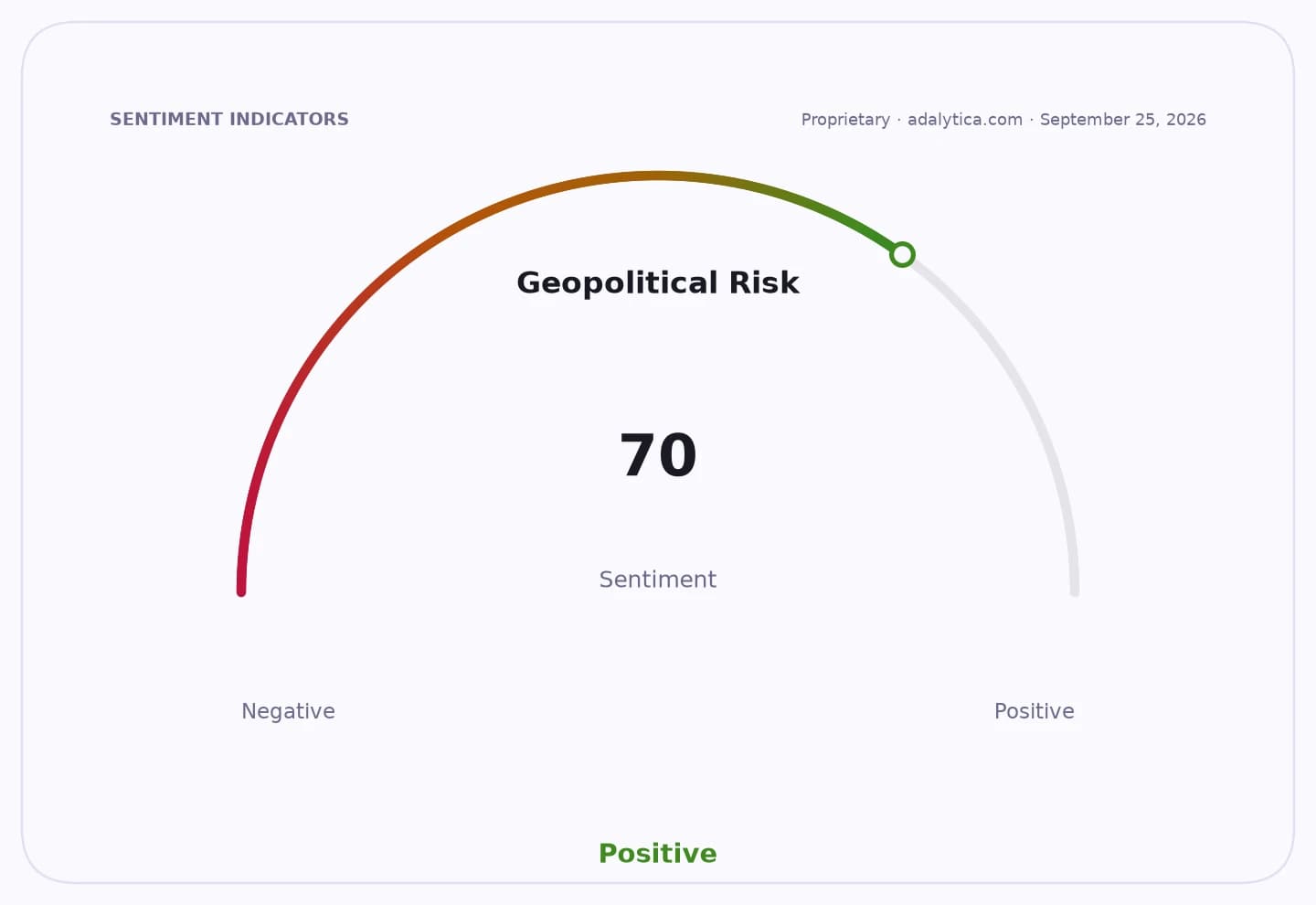
The Paris Stock Exchange closed lower as investors pulled back from French equities amid renewed geopolitical caution and a market still looking for earnings proof to justify recent gains.
French Stocks Slip as Sentiment Turns Cautious
The selloff matters less because of one weak session than because it shows how quickly sentiment can reverse in a market that had been leaning on improving technical momentum and a rebound in risk appetite. On the session, the EWQ France ETF fell 1.9% to $44.67, with trading volume lighter than the recent peak, suggesting sellers were not panicking but were willing to take profits as uncertainty rose. The move left the fund below its 50-day moving average of $44.90 and close to its 200-day average of $44.11, a sign that the rally remains intact but vulnerable.
Sentiment IndicatorsⓘProprietary · adalytica.com · July 23, 2026
This is a snapshot — live sentiment, awareness and momentum for 130+ markets update continuously in the dashboard.Open AlphaPulse
That vulnerability is important economically. French equities are exposed to the same cocktail unsettling broader global markets: geopolitical risk, sticky macro uncertainty and a lack of conviction that earnings can deliver enough upside to offset it. The latest backdrop includes a fresh heat-health alert in the UK, which is not a direct market-moving event for Paris, but it underscores the broader theme of climate-linked disruption and policy strain that can weigh on growth expectations and sector margins across Europe. More immediately for equities, a stronger U.S. dollar and elevated gold demand point to a defensive turn in cross-asset positioning, typically a headwind for risk assets outside the U.S.
Technical readings suggest the Paris market’s recent bounce is losing momentum. The EWQ’s relative strength index fell to 36.4, moving out of neutral territory and closer to oversold conditions, while its MACD indicator has edged down toward the signal line. That combination usually reflects fading buying pressure rather than a full trend break. Still, the fund is above both its 50-day and 200-day averages only marginally, so the margin for error is thin if geopolitical headlines worsen or if earnings season disappoints.
For investors, the issue is not just whether France can hold a technical floor, but whether corporate results can re-establish leadership in a market increasingly sensitive to macro shocks. A softer Paris close can be read as a warning that investors are no longer willing to pay up for European cyclicals and banks without clearer evidence of profit resilience, especially if rates, currencies and risk premiums turn less supportive. The broader signal from global trade and sentiment gauges is mixed: U.S. risk appetite is neutral, the dollar is firm, and gold is attracting strong safe-haven flows. That combination tends to favor capital preservation over beta.
The next catalyst will be whether incoming earnings and guidance can re-ignite demand for French shares, or whether geopolitical uncertainty keeps driving allocations toward defensive assets. If results hold up, the recent decline may prove a pause in an ongoing recovery. If not, Paris could struggle to defend the gains built over the past month.
| Entity | Gains | Losses |
|---|---|---|
| Defensive assets | ▲Safe-haven demand | ▼Equity risk appetite |
| Gold | ▲Inflows on caution | ▼Cyclical stocks |
| U.S. dollar | ▲Stronger positioning | ▼European exporters |
| French equities | ▲Potential rebound on earnings | ▼Near-term sentiment |