The Trump administration is leaning on an unlikely front-line player — the U.S. communications agency — to drive its China policy, a sign Washington is widening the fight beyond tariffs and technology into the information space. The shift matters because it raises the odds of a more sustained and unpredictable U.S.-China confrontation, with knock-on effects for trade, advertising, supply chains and risk assets.
FXI at $36.49 as U.S.-China tensions rise

The move comes as U.S. rate markets remain sensitive to geopolitical stress. The 10-year Treasury yield was around 4.648%, while the 2-year hovered near 4.193%, levels that keep borrowing costs elevated and make any escalation in trade or policy risk more costly for corporations and consumers.
Sentiment IndicatorsⓘProprietary · adalytica.com · August 11, 2026
This is a snapshot — live sentiment, awareness and momentum for 130+ markets update continuously in the dashboard.Open AlphaPulse
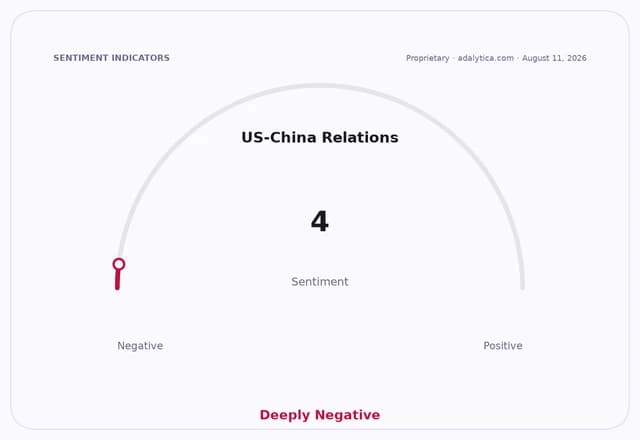
Investors are already treating U.S.-China relations as a fast-moving risk event rather than a slow-burn policy issue. Adalytica’s U.S.-China Relations Sentiment gauge shows “Extreme Fear” at 4, with awareness at 96, underscoring how closely markets are tracking every new sign of escalation.
That fear is showing up in China-exposed ETFs and in the broader risk tape. The iShares China Large-Cap ETF, FXI, has rebounded to $36.49 from a recent low near $34.13, but it remains below its 200-day moving average of $36.86 and is still just under the 50-day average of $34.32, a sign the rally is fragile even as momentum improves. The fund’s RSI reading of 77.4 points to stretched near-term buying.
US-China Relations — 30-day sentimentadalytica.com
Explore this data interactively — full history, time series and cross-market comparisons.Open AlphaPulse
The Hong Kong tracker EWH is in a similar position. It closed at $22.80, above both its 50-day average of $21.92 and 200-day average of $22.21, but its gains have come in a market still shaped by policy headlines rather than conviction about earnings or trade normalization.
For companies with China exposure, the policy backdrop remains more important than near-term fundamentals. Meta has disclosed that a small group of resellers serving China-based advertisers generates meaningful revenue, while Apple has warned tariffs and other measures can hurt business through supply chains and component access. Those kinds of links are exactly why a communications-led China strategy matters to investors: it can influence ad spending, export flows, platform access and procurement decisions without waiting for new tariffs to be announced.
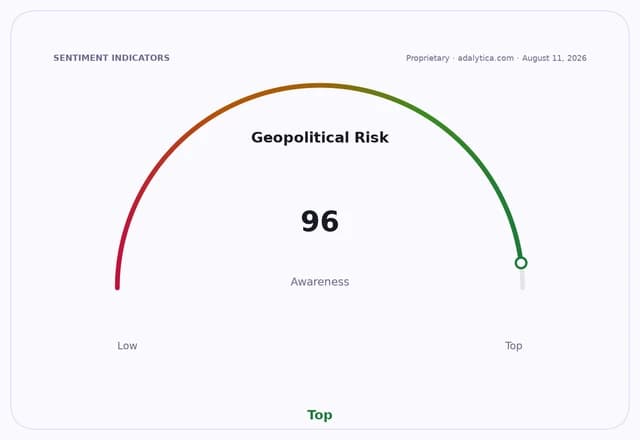
The broader market backdrop is also unusual. Adalytica’s global stability gauge sits at 96, and the dollar signals are flashing “Extreme Greed,” suggesting investors are simultaneously pricing in geopolitical stress and refuge demand for the greenback. That combination often benefits U.S. assets relative to China-linked risk, but it also raises the cost of capital for emerging-market and trade-sensitive businesses.
The key question now is whether Washington uses communications pressure as a supplement to tariffs and export controls, or as a substitute for them. If the former, China-facing assets could see more volatility; if the latter, markets may get brief relief, but only until the next policy move lands.
| Entity | Gains | Losses |
|---|---|---|
| U.S. communications agency | ▲Policy influence | ▼Diplomatic distance |
| Trump administration | ▲Broader China leverage | ▼Policy predictability |
| China-linked equities | ▲Short-term relief on moderation | ▼Volatility from headlines |
| U.S. multinationals | ▲Clearer policy signals | ▼China revenue and supply-chain risk |




