GBP/NZD has managed a modest bounce, but the move looks more like a pause in a broader downtrend than the start of a lasting recovery. For investors and traders, that matters because currency pairs often reverse only when the underlying macro story changes — and right now, the weight of the evidence still leans against sterling.
GBP/NZD Bounce Looks Like a Bear Market Pause

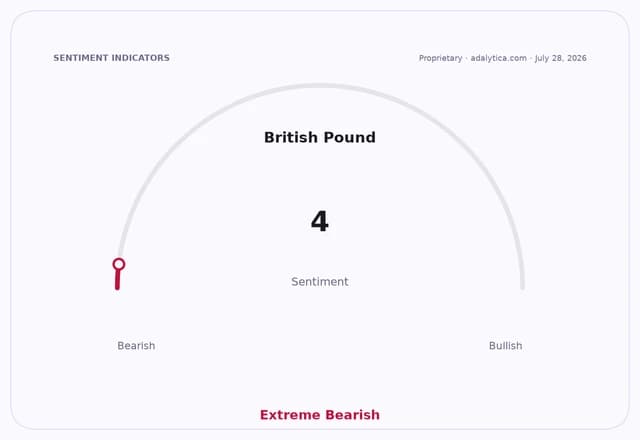
The clearest message in the current setup is that the British pound is under pressure while the New Zealand dollar is not offering enough weakness to change the balance of power. Adalytica’s British pound gauge shows sentiment at just 4, an “Extreme Fear” reading, even as awareness remains elevated at 94, a sign that the market is highly focused on sterling but not in a constructive way. In simple terms, investors are paying attention, but they are not willing to bid the pound up aggressively. That combination usually keeps rallies fragile.
Sentiment IndicatorsⓘProprietary · adalytica.com · July 28, 2026
This is a snapshot — live sentiment, awareness and momentum for 130+ markets update continuously in the dashboard.Open AlphaPulse

That’s why the bounce in GBP/NZD should be treated cautiously. When a currency has strong attention but deeply negative sentiment, it often means bad news is already being priced in — yet it can also mean every rally runs into sellers. For long-term investors with exposure to UK assets, that matters because a weaker pound can help exporters and multinational companies earn more in sterling terms, but it can also signal lingering confidence problems around the UK economy and its policy backdrop.
The broader cross-currency picture reinforces the bearish tilt. Adalytica’s U.S. dollar signal also shows extreme fear, but the pound has deteriorated more sharply on a short-term basis, with sentiment down 85 points over seven days and 44 points over 30 days. That kind of drop suggests sterling has lost momentum quickly. Meanwhile, the euro’s sentiment is also soft, but not nearly as stretched as the pound’s. Against that backdrop, GBP/NZD may bounce tactically, but the pair still looks vulnerable if investors continue to prefer currencies with cleaner macro narratives.
For investors, the practical lesson is straightforward: don’t confuse a countertrend bounce with a trend change. Currency markets can be noisy over days and weeks, but over months they usually follow relative growth, rate expectations and risk appetite. Unless the UK’s economic outlook improves or New Zealand’s position weakens meaningfully, the path of least resistance for GBP/NZD still looks lower.
That makes this a pair worth watching, not chasing. For long-term portfolios, the bigger takeaway is that currencies can quietly shape returns across exporters, importers and overseas investors, even if they are not the main event. GBP/NZD’s rebound may have some room, but the bearish bias remains the story that matters most.
| Entity | Gains | Losses |
|---|---|---|
| New Zealand exporters | ▲Better pricing power | ▼Stronger NZD upside risk |
| UK exporters | ▲Softer pound tailwind | ▼Imported cost inflation |
| GBP bulls | ▲Short-covering bounce | ▼Weak trend and sentiment |
| GBP/NZD bears | ▲Trend still intact | ▼Squeezed by rebounds |




