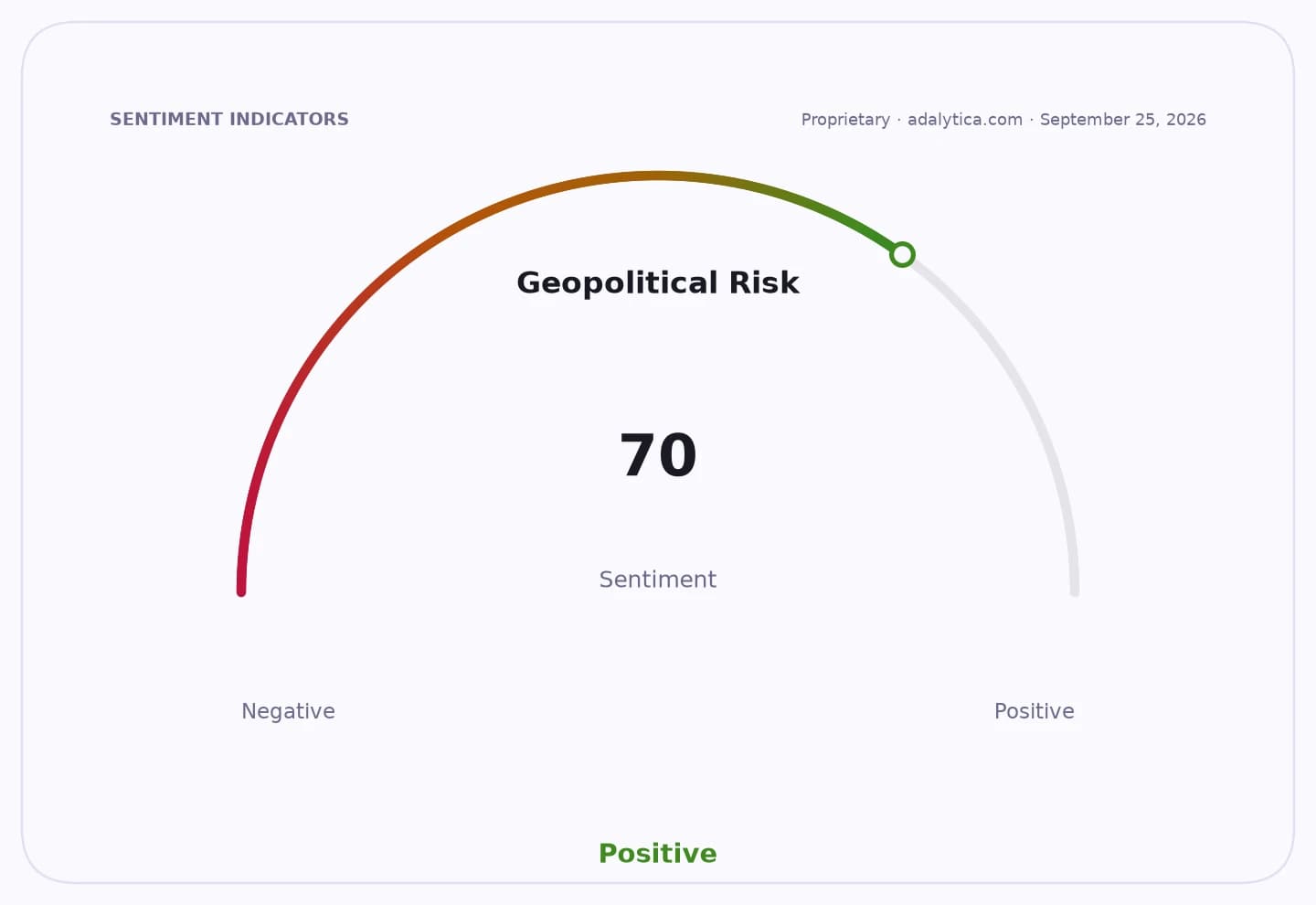
The biggest market move is not the dollar’s mixed tone — it is the way investors are retreating from risk as U.S. strikes against Iran deepen geopolitical uncertainty and hit the most richly valued corners of the market, especially chip and AI stocks.
Geopolitical Risk Hits Chips and AI Stocks

That matters because when conflict escalates in the Middle East, the first economic transmission is often through oil, inflation expectations and financial conditions. Even before any hard supply disruption shows up, investors start asking whether energy costs, shipping routes and central-bank policy will become less friendly to growth assets. That is why yields are slipping even as the dollar trades unevenly: money is moving toward safety, not toward a confident risk-on trade.
Sentiment IndicatorsⓘProprietary · adalytica.com · July 17, 2026
This is a snapshot — live sentiment, awareness and momentum for 130+ markets update continuously in the dashboard.Open AlphaPulse
The S&P 500 is softer, but the damage is sharper in semiconductors. The SOXX semiconductor ETF fell to 530.5 from 555.27 a day earlier, a drop of about 4.5%, as investors kept selling the group that has powered much of the market’s AI enthusiasm. Nvidia, the face of that trade, slipped to 207.4 from 212.5. Its 50-day moving average sits near 209.68, so the shares are now hovering just below a closely watched technical level even after months of outsized gains. The broader chip fund is still far above its 200-day moving average, which tells you the long-term trend remains intact, but the recent slide shows how quickly sentiment can turn when macro risk rises.
For long-term investors, this is the kind of pullback that can separate durable compounding stories from crowded momentum. AI demand has not disappeared. Data-center spending, cloud buildouts and advanced chip design still look like secular growth engines. But the market has become less forgiving of valuations that assume smooth execution and uninterrupted demand. When geopolitical headlines flare, the stocks that have run the hardest often get hit first because they are owned the most and priced for perfection.
The bond market is sending a similar warning. The 10-year Treasury yield eased to 4.55% and the 2-year to 4.13%, with forecasts pointing only slightly higher from here. Lower yields usually help growth stocks in the long run, but in the short run they are also a sign that investors are reaching for safety. Adalytica’s trade signals show fear in Treasury bonds and neutral sentiment in the dollar, while awareness around the S&P 500 remains low enough to suggest plenty of nervousness beneath the surface.
That leaves the dollar in a classic in-between position. It is firmer versus the euro, pound, Australian dollar and New Zealand dollar, but weaker against the yen, Swiss franc and Canadian dollar. That split makes sense in a market where investors are not betting on a clean macro winner. The greenback can still benefit from safe-haven demand, yet softer inflation data and lower yields are limiting its upside.
For investors, the takeaway is simple: geopolitical shocks can pressure the most popular growth trades even when the underlying investment thesis remains sound. The best response is not to abandon AI or semiconductors, but to keep position sizes sensible, diversify broadly and use volatility to buy strong businesses at better prices. If the Middle East tension fades, these stocks could rebound quickly. If it lingers, the market may keep rewarding balance sheets, cash flow and valuations over pure story stocks. Either way, this is worth watching, not panicking over.
| Entity | Gains | Losses |
|---|---|---|
| Safe-haven assets | ▲Higher demand | ▼Risk appetite |
| Chip and AI stocks | ▲Long-term thesis intact | ▼Near-term valuations |
| Treasury bulls | ▲Lower yields support prices | ▼Yield-hungry investors |
| U.S. dollar vs. some peers | ▲Broad safe-haven bid | ▼Euro, pound, Aussie, kiwi |