Germany’s opposition politics are tilting toward tactical alliances as the Left Party signals it could support conservatives in regional contests to block far-right AfD gains, a move that could reshape coalition arithmetic in key states and reduce the odds of a stronger anti-establishment vote spilling into national policy.
Germany EWG ETF at $44.02 as AfD risk rises

The immediate economic relevance is not a policy pivot from the Left so much as a bid to contain political fragmentation in Europe’s largest economy. Any sign that mainstream parties can coordinate against the AfD lowers the risk premium tied to German governance, particularly at a time when investors are already balancing weak growth, industrial stagnation and pressure on the euro-area policy backdrop.
Sentiment IndicatorsⓘProprietary · adalytica.com · August 9, 2026
This is a snapshot — live sentiment, awareness and momentum for 130+ markets update continuously in the dashboard.Open AlphaPulse
That matters for markets because Germany remains the anchor for the euro zone’s fiscal and industrial framework. A more stable regional election outcome would support confidence in policy continuity on spending, labor and industrial support, while a deeper AfD advance could complicate budget negotiations and intensify concerns about migration, EU cohesion and long-term reform capacity.
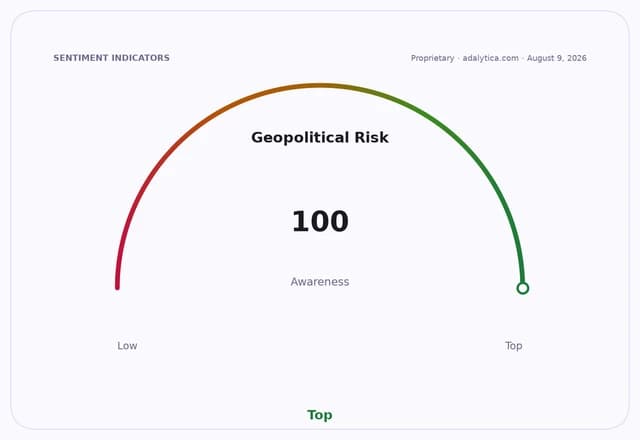
The broader market tone underscores that sensitivity. Adalytica’s global stability gauge is at 100, or “Extreme Greed,” while its euro trade signal sits at 83, suggesting investors are currently leaning toward calmer conditions even as political risk remains elevated. The iShares MSCI Germany ETF, EWG, has also rallied sharply, closing at $44.02 on Aug. 7 after gaining more than 10% from its late-July level, with the relative strength index at 79.5 — a technically overbought reading — and the price above both the 50-day and 200-day moving averages. That leaves German assets exposed if political headlines turn less cooperative.
Geopolitical Risk — 30-day sentimentadalytica.com
Explore this data interactively — full history, time series and cross-market comparisons.Open AlphaPulse

The Left Party’s willingness to back conservatives also highlights how the anti-AfD strategy is beginning to override ideological barriers. For centrist and conservative investors, that can be read as a sign that Germany’s mainstream parties may be moving to preserve governability even in a more polarized electorate. For the AfD, it suggests the party’s rise is now significant enough to force unusual parliamentary behavior from rivals.
Still, the near-term investment case depends less on rhetoric than on whether tactical cooperation translates into durable electoral arithmetic in Berlin and other states. If the mainstream can corral the far right without triggering a backlash, German political risk should remain contained. If not, the market’s recent optimism in German equities and the euro could prove fragile.
| Entity | Gains | Losses |
|---|---|---|
| Conservative parties | ▲Easier anti-AfD alliances | ▼Less need for fresh mandates |
| Left Party | ▲Influence in local coalitions | ▼Ideological purity |
| AfD | ▲Protest vote visibility | ▼Mainstream containment |
| German equities/euro bulls | ▲Lower policy risk | ▼Less upside from volatility |




