Germany’s strongest job opportunities are increasingly clustering outside the country’s biggest metropolitan centers, with Bremen, Heilbronn and the Rhein-Neckar region among the standouts in LinkedIn’s latest “Cities on the Rise” ranking.
Germany LinkedIn ranking lifts Bremen, Heilbronn
That matters because the report points to where hiring momentum is building now, not where the labor market is already tightest. In a country where more than half of workers say finding a job feels more difficult than a year ago, the data suggests opportunity is shifting toward medium-sized cities that are combining investment, industrial change and research-led growth.
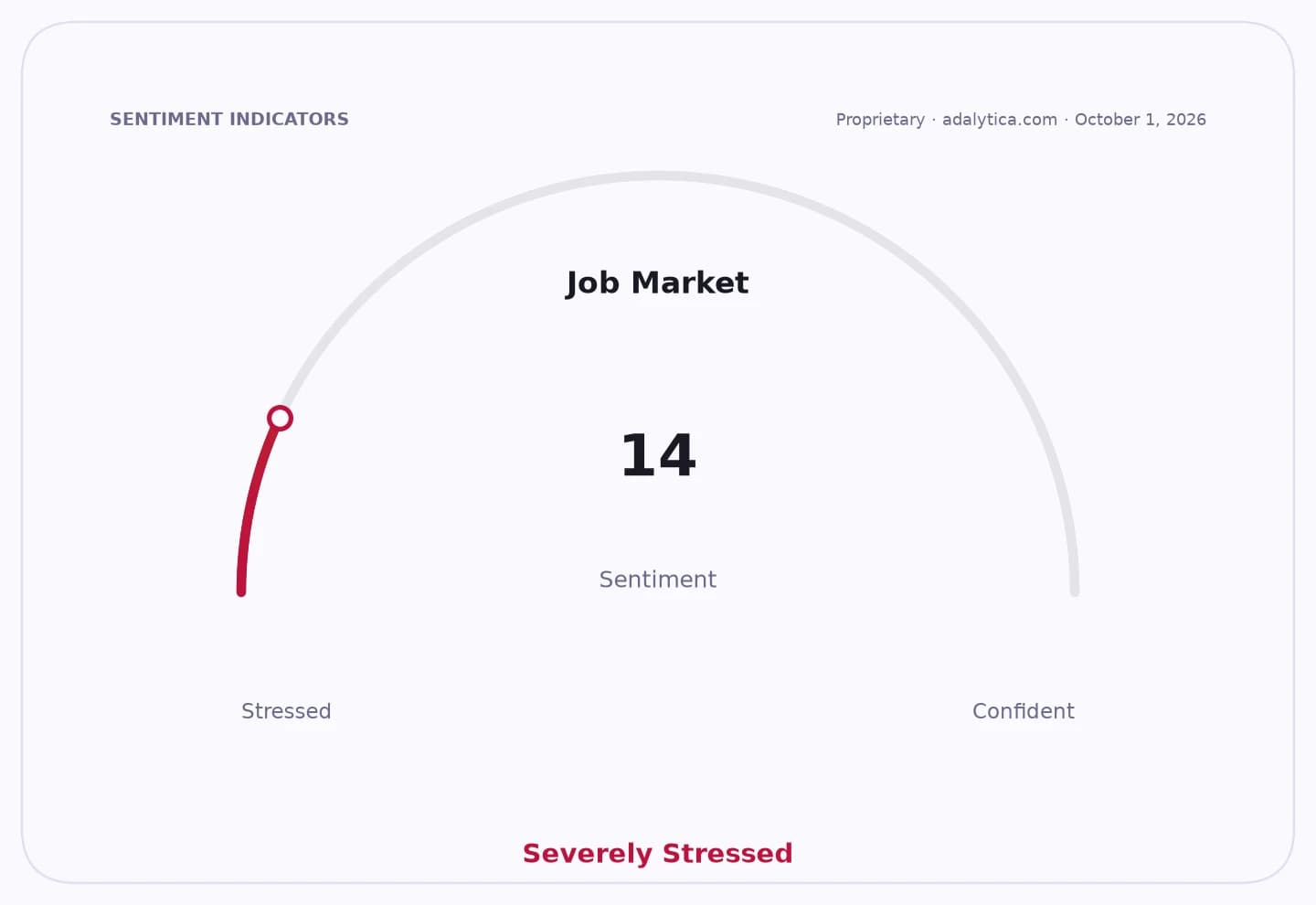
Sentiment IndicatorsⓘProprietary · adalytica.com · October 17, 2026
This is a snapshot — live sentiment, awareness and momentum for 130+ markets update continuously in the dashboard.Open AlphaPulse
LinkedIn’s ranking is based on platform data for hiring, new job creation and the inflow of skilled workers, excluding giants such as Berlin and Munich to focus on mid-sized hubs. Bremen moved up to first place from fifth a year earlier, while Heilbronn jumped to second and the Rhein-Neckar region took third. Tübingen, Karlsruhe and Freiburg also made the top 10 in Baden-Württemberg, alongside Münster, Düsseldorf and Leipzig.
The pattern is economically significant because it highlights a more dispersed growth map for Germany at a time when the broader labor market remains under strain. The national unemployment rate was 4.2% in September, down sharply from the pandemic peak but still above the ultra-tight labor conditions of the post-reunification boom years. More telling for investors and employers, hiring is not concentrated only in the traditional financial and corporate centers. Instead, it is increasingly tied to sectors with structural tailwinds: defense, artificial intelligence, deep tech, life sciences and university-driven ecosystems.
Bremen is the clearest example. The city still has an unemployment rate above 11%, but LinkedIn’s ranking is built around relative labor-market dynamism rather than headline joblessness. The city’s rise reflects the defense and aerospace buildout, with companies such as OHB SE benefiting from a stronger order backdrop. For investors, that points to a familiar German theme: pockets of industrial weakness can coexist with highly investable growth clusters, especially where public spending and strategic security priorities are feeding private-sector demand.
Heilbronn’s advance underscores the same shift, but in a different form. The city is building out an innovation park focused on artificial intelligence, with support from the Schwarz Group and plans to cluster as many as eight Fraunhofer institutes. That kind of infrastructure can create a multiplier effect: it attracts engineers, researchers and suppliers, while also supporting local housing, services and transport demand. Rhein-Neckar, anchored by Mannheim, Ludwigshafen and Heidelberg, benefits from a similar mix of industrial scale and academic depth, with BASF at the center of one of Europe’s most important chemical hubs.
The ranking also helps explain why investors continue to pay close attention to Germany’s regional economy rather than just its national cycle. A city like Münster, which remains in the top 10, is being supported by steady population growth of roughly 0.4% to 0.6% a year, a large university base and a growing start-up scene. Düsseldorf’s inclusion reflects the pull of established corporates as well as service-sector breadth, while Leipzig stands out for public investment, having allocated about 1.3 billion euros to infrastructure and urban development in 2024.
For equity investors, the immediate read-through is not just about labor availability but about where capital is likely to follow. Regions with rising skilled-worker inflows often see stronger demand for commercial real estate, transport links, digital infrastructure and local services. Companies exposed to defense, advanced manufacturing, AI infrastructure and research commercialization may also find these cities more attractive for expansion or hiring.
The bear case is that the ranking may overstate the durability of some gains. LinkedIn itself says the report measures trends rather than the current static state of the economy, and some of the cities highlighted still carry elevated unemployment or structural industrial pressures. A softer German economy, tighter corporate spending or a setback in export demand could quickly cool hiring. But for now, the report suggests that opportunity in Germany is broadening beyond the traditional magnets, with medium-sized hubs becoming the places where growth is most visible.
| Entity | Gains | Losses |
|---|---|---|
| Bremen, Heilbronn, Rhein-Neckar | ▲Hiring momentum | ▼Traditional job hubs |
| Defense, AI, research clusters | ▲Skilled-worker demand | ▼Legacy industrial sectors |
| Local employers and universities | ▲Talent inflows | ▼Regions with weak attraction |
| Jobseekers willing to relocate | ▲More openings | ▼Workers tied to big-city markets |