Gold prices in Egypt were still trading near record territory at Tuesday’s close, underscoring how a weaker dollar and a firm global bullion market are keeping local buyers and jewelers on edge even after a sharp run-up. The key question for investors is not whether gold has already moved, but whether the forces behind the move — falling confidence in the dollar, sticky real yields and renewed demand for hard assets — are still powerful enough to extend the rally.
Gold in Egypt Holds Near Record on Dollar Weakness
In local terms, 21-karat gold had climbed to about 6,280 pounds per gram on Monday, after a 20-pound gain, and the market remained elevated into Tuesday’s close. That matters because Egypt is not just a passive price taker: when international gold pushes higher, it quickly feeds through to household savings behavior, jewelry demand and the cost of protecting purchasing power in a currency market that remains highly sensitive to imported inflation.
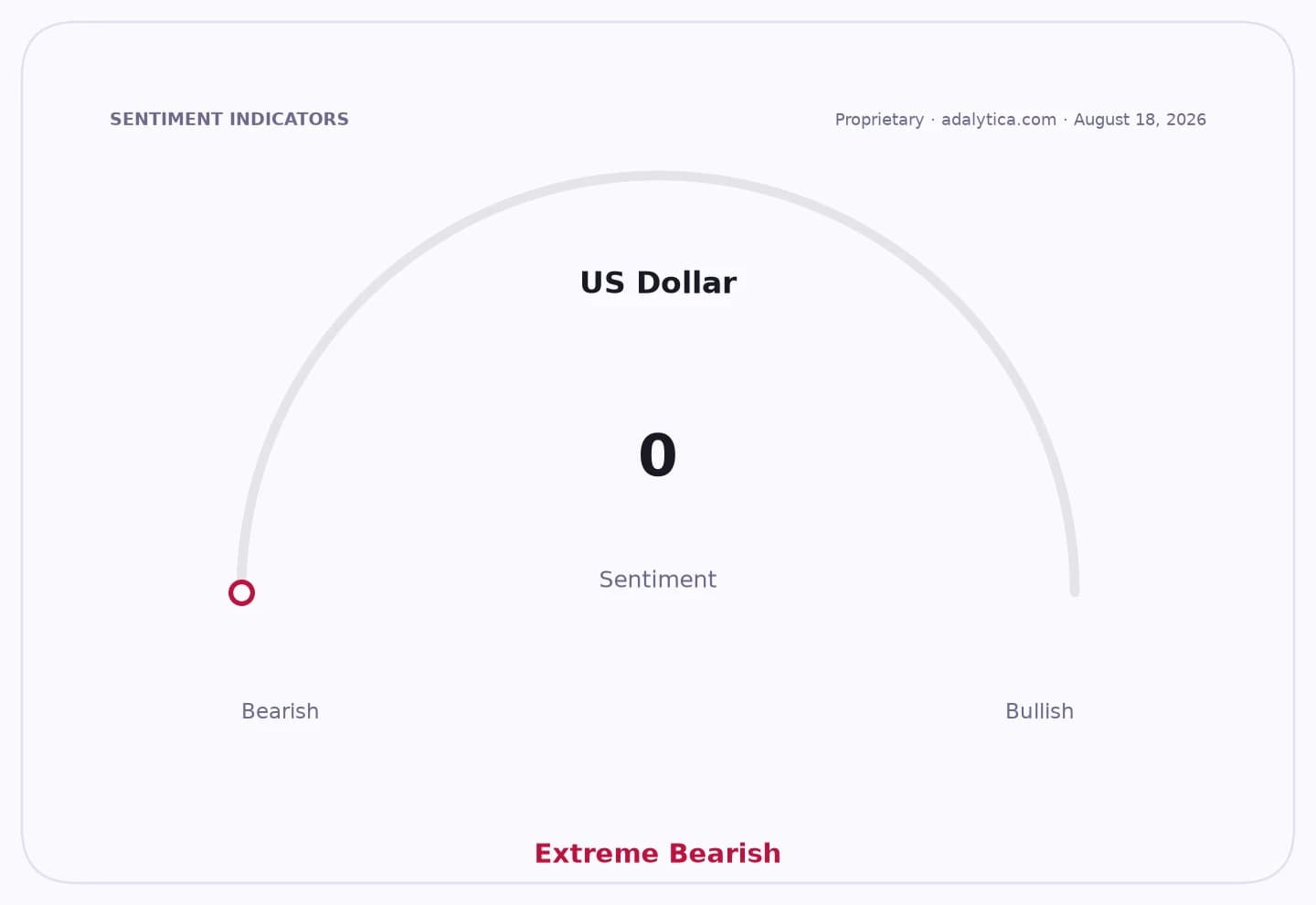
Sentiment IndicatorsⓘProprietary · adalytica.com · August 18, 2026
This is a snapshot — live sentiment, awareness and momentum for 130+ markets update continuously in the dashboard.Open AlphaPulse
The broader macro backdrop is still doing the heavy lifting. The 10-year U.S. Treasury yield sat around 4.694% on Aug. 18, near its recent highs, yet gold held firm anyway, a sign that investors are still treating bullion as a hedge against policy and currency risk rather than simply a bet on falling rates. At the same time, U.S. dollar signals from Adalytica.com flashed “Extreme Fear,” with the dollar trade score dropping to zero, while gold’s sentiment remained neutral at 65. That divergence is telling: the market is not euphoric, but it is clearly still leaning toward precious metals over cash.
Exchange-traded funds are reinforcing that message. GLD, the largest gold ETF, finished Aug. 18 at $398.55 after trading as high as $406.23 the previous day, while the 50-day moving average sits far above the 200-day? No — the important point is that GLD is still holding well above its longer-term trend after a steep breakout from June lows. GDX, the gold miners ETF, also stayed elevated at $88.95, suggesting investors are not only buying the metal, but also reaching for operating leverage in miners, a classic sign that the market sees the move as more than a short-lived hedge.
For Egyptian investors, the implication is straightforward: gold remains one of the clearest ways to preserve value in an inflation-prone environment where the local currency and global reserve currencies both matter. For miners and bullion-linked ETFs, that creates a second-order opportunity. If the dollar remains under pressure and global macro volatility persists, the upside is no longer just in the metal itself — it is in the companies and funds that capture the margin expansion from every incremental rise in bullion.
The market may be assuming gold is already crowded after its rally, but the setup argues otherwise. With U.S. dollar sentiment still in the basement, central-bank and investment demand intact, and Egyptian retail pricing continuing to reflect global strength, the more actionable trade is to stay long the gold complex on pullbacks rather than chase the next commodity headline.
| Entity | Gains | Losses |
|---|---|---|
| Gold buyers in Egypt | ▲Inflation hedge | ▼Higher gram prices |
| Jewelry retailers | ▲Stronger demand for savings metal | ▼Softer discretionary demand |
| GLD holders | ▲Safe-haven exposure | ▼Near-term volatility |
| U.S. dollar | ▲None | ▼Weak sentiment, capital outflows |




