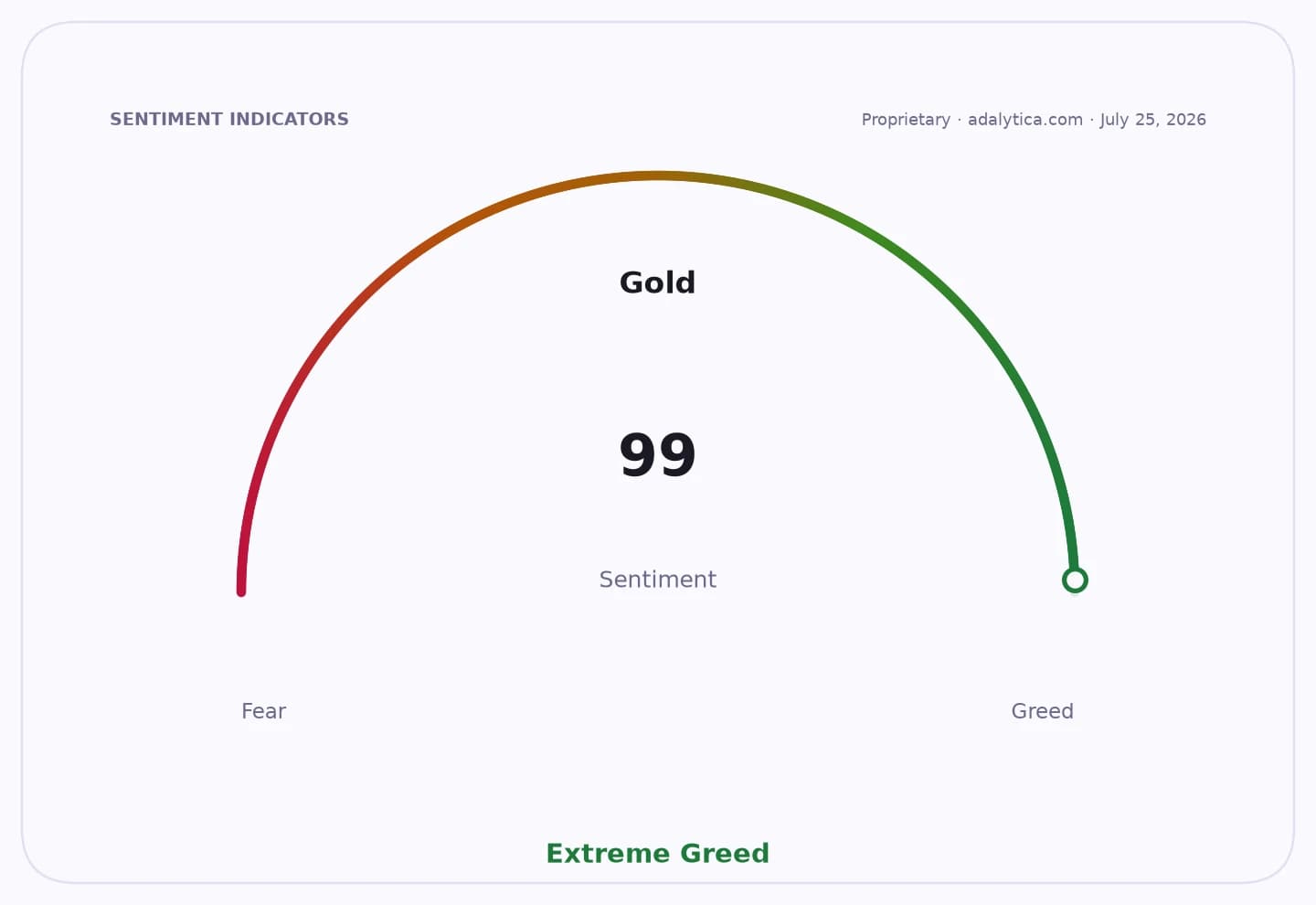
Gold is flashing one of the clearest contrarian signals in months: the metal has surged into overbought territory, but the easiest trade may now be the other side of the boom. With bullion-linked funds like GLD still up sharply from spring lows, Adalytica’s Gold Fear & Greed Index is at 99 — extreme greed — even as GLD has slipped back toward its 50-day moving average and well below the 2025 peak, while the 10-year Treasury yield has climbed to 4.749%, a level that raises the opportunity cost of holding non-yielding assets.
Gold Signals Overbought as Yields Pressure Bullion
That matters because gold’s latest advance was built on a powerful but fragile mix of macro fear, central-bank buying and momentum chasing. When yields rise, the dollar can strengthen and real returns improve, and that combination tends to cap further upside in precious metals unless the market is entering a full-blown risk-off phase. Right now, the data suggest the trade is crowded. GLD’s relative strength has cooled, its RSI has fallen to 41.3 from deeply overbought levels, and the price is hovering just under its 50-day moving average while still below the 200-day line. That is not the profile of a fresh breakout; it is the profile of an asset that has already priced in a lot of good news.
For investors, that sets up a simple asymmetry. The market has been treating gold as if inflation hedging and geopolitical anxiety alone can keep pushing prices higher. I think that underestimates how quickly speculative positioning can unwind when rates back up and the fear premium stops expanding. The move does not need to become a full collapse to create opportunity. Even a moderate retracement in bullion could be a windfall for jewelry demand, especially in price-sensitive markets where retail buyers have been sidelined by record highs. That is the real “jackpot” buried in the headline: if gold rolls over, consumers get relief and downstream jewelry names can see a volume rebound.
The divergence is already visible in related vehicles. IAU, a lower-cost gold ETF proxy, has also slipped back beneath its 50-day moving average, and miners through GDX have lost momentum after an explosive run. Miners are especially exposed because their earnings leverage works both ways: when gold rises, margins expand fast; when gold stalls, operating costs stay sticky and sentiment can reverse even faster. That makes the sector vulnerable if the current euphoria fades.
Gold — 30-day sentimentadalytica.com
Explore this data interactively — full history, time series and cross-market comparisons.Open AlphaPulse
There is also a broader macro story here. The 10-year yield’s move above 4.7% changes the calculus for investors who had been rotating into hard assets as a hedge against policy uncertainty and fiscal strain. At these levels, gold has to compete not just with fear, but with income. If Treasury yields remain elevated, the case for chasing gold at these prices weakens further — and the case for taking profits strengthens.
The best positioning now is not to assume gold is “going to zero,” but to recognize that a halving scenario in the seed headline is really shorthand for a sharp normalization after an extended melt-up. The market underestimates how quickly that can happen once greed reaches an extreme. For investors, the trade is to look past the metal itself and into the beneficiaries of lower input costs: jewelry retailers, luxury brands with gold exposure, and eventually select consumer names in markets where physical demand has been price constrained.
If gold weakens from here, the next big move may not be in bullion at all — it may be in the companies that sell more product when the metal finally becomes affordable again. That is where the asymmetric opportunity sits.
| Entity | Gains | Losses |
|---|---|---|
| Jewelry buyers | ▲Lower input costs | ▼Less urgency to stockpile gold |
| Jewelry retailers | ▲Higher volumes | ▼Short-term margin pressure |
| Gold miners | ▲Higher gold prices | ▼Gold price pullback |
| Gold ETF holders | ▲Safe-haven upside | ▼Mean reversion risk |