Gold's latest surge matters because it is being driven by the same forces that shape long-term wealth preservation: falling real rates, a softer dollar and persistent demand for safe havens. For investors, that combination can lift bullion, exchange-traded funds such as GLD and the miners tied to the metal, while also making jewelry more expensive for consumers looking at 18-karat gold prices.
Gold rises as yields ease and dollar softens
The benchmark 10-year Treasury yield has eased to about 4.65% from 4.70% earlier in the week, a small move on the surface but an important one for gold, which pays no interest and tends to compete with government bonds for investor capital. At the same time, the dollar has softened, with trade-signal data showing weakening momentum over the past month. When the dollar slips, gold becomes cheaper for overseas buyers and often finds support.
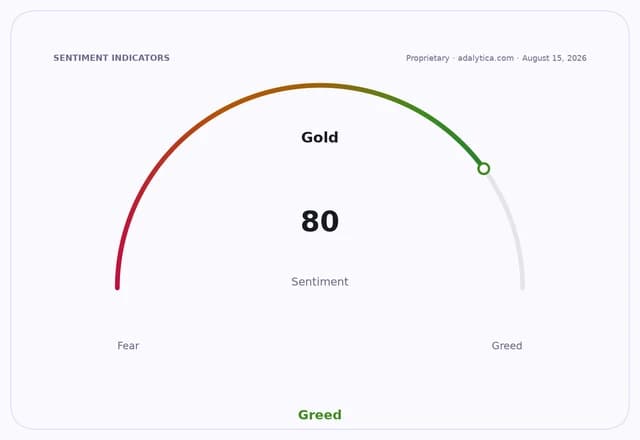
Sentiment IndicatorsⓘProprietary · adalytica.com · August 15, 2026
This is a snapshot — live sentiment, awareness and momentum for 130+ markets update continuously in the dashboard.Open AlphaPulse
That backdrop helps explain why gold futures recently pushed back toward the mid-$4,300s an ounce, while GLD, the largest gold-backed exchange-traded fund, remains far above its 200-day moving average even after some profit-taking. The fund’s recent readings show the metal still trading well above its long-term trend line, a sign that the broader uptrend is intact even after bouts of volatility.
For long-term investors, the key point is that gold is not acting like a trading fad. It is behaving like an asset people turn to when they want protection from inflation, currency weakness and policy uncertainty. Adalytica’s Gold Fear & Greed Index still sits in “Greed” territory, which suggests enthusiasm remains elevated, but not all that enthusiasm is speculative. Central bank buying, geopolitical risk and concern about the durability of global growth continue to support demand.
That matters economically because gold’s rise tends to ripple through the system in different ways. Higher bullion prices can improve margins for major miners such as Newmont and Barrick Gold, though only if rising costs do not swallow the benefit. Recent SEC filings show some miners are still contending with higher all-in sustaining costs, which means a stronger gold price is welcome, but not a guarantee of better profits.
For jewelry buyers asking about 18-karat gold today, the answer depends on the local market and making charges, but the direction is clear: when spot gold rises, retail gold prices usually follow. Eighteen-karat pieces contain 75% pure gold, so they track the metal closely, even if retail pricing includes craftsmanship and taxes.
Investors should view this as a reminder that gold can still play a useful role in a diversified portfolio, especially over a 3- to 10-year horizon. It is not a substitute for productive businesses, but it can help offset shocks when stocks and bonds stumble together. The smartest approach remains balance: own quality equities, broad index funds and a measured allocation to hard assets rather than trying to time every move in bullion.
If gold can hold these gains while yields drift lower and the dollar stays soft, the trend may have more room to run. For investors, that keeps gold, GLD and the top miners worth watching — not as a quick trade, but as a durable hedge in an uncertain world.
| Entity | Gains | Losses |
|---|---|---|
| Gold bulls | ▲Higher prices | ▼Overbought pullbacks |
| GLD holders | ▲Hedge value rises | ▼Short-term volatility |
| Gold miners | ▲Better revenue leverage | ▼Higher operating costs |
| Jewelry buyers | ▲Store-of-value protection | ▼Pricier 18-karat gold |