September food inflation in Greece is expected to be negative again, a sign that the government’s broad price-cut initiative is finally reaching supermarket shelves and giving consumers a rare break in an otherwise costly inflation backdrop.
Greece September food inflation seen negative again
For investors, the bigger message is that food remains one of the few categories where policy can still move prices quickly. Sources at the Ministry of Development said the National Price Reduction Initiative covering 1,740 product codes has worked positively, helping keep food inflation below zero for another month despite the difficult international environment and persistent cost-of-living pressure elsewhere.
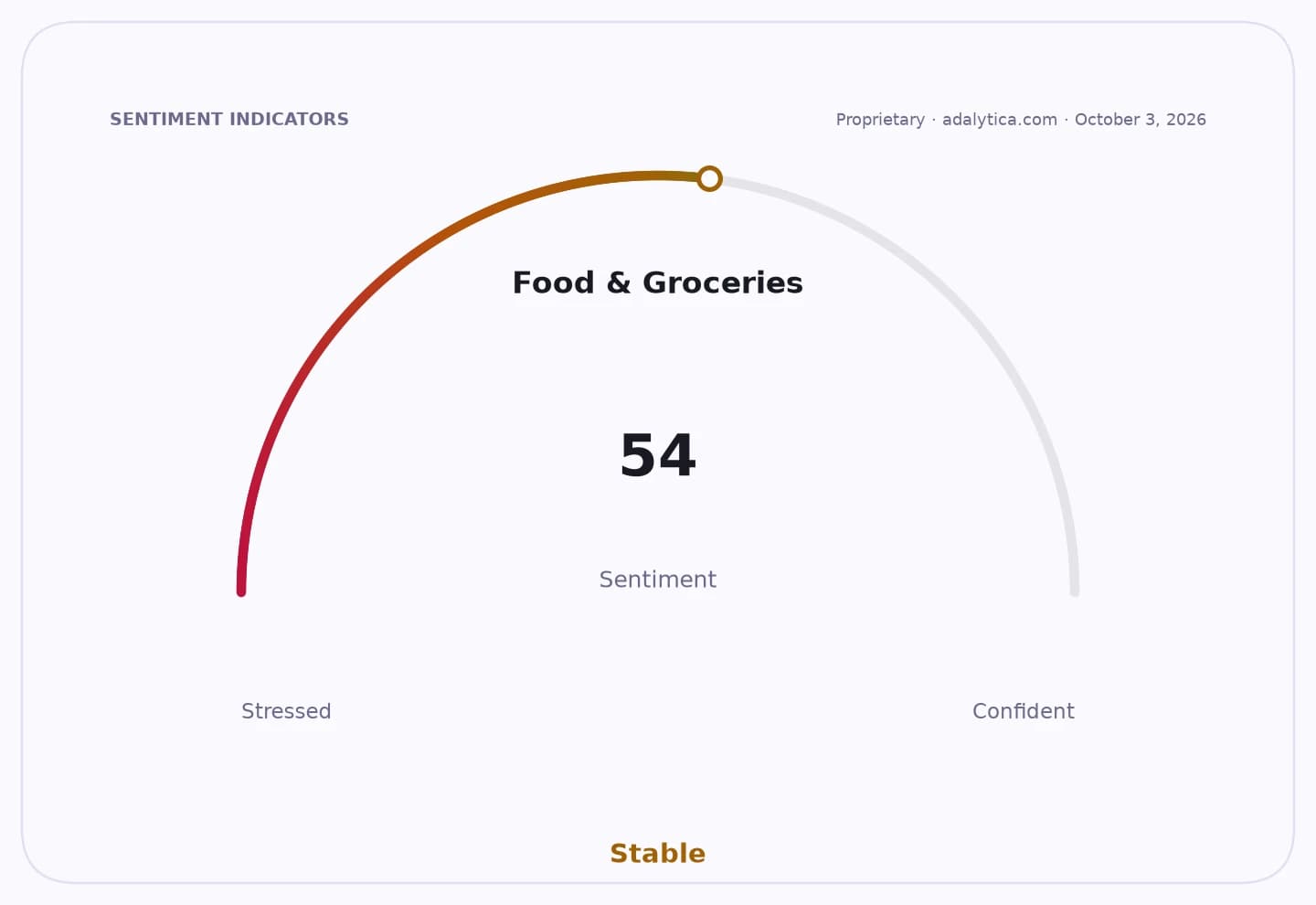
Sentiment IndicatorsⓘProprietary · adalytica.com · October 2, 2026
This is a snapshot — live sentiment, awareness and momentum for 130+ markets update continuously in the dashboard.Open AlphaPulse
That matters economically because food is the most visible line item in household budgets and a key driver of inflation expectations. If food prices are flat or falling, real incomes stabilize faster, especially for lower-income consumers who spend a larger share of their budgets at the grocery store. It also gives policymakers a cleaner inflation story at a time when headline price pressures in many countries remain sticky.
The setup is interesting for markets because it reinforces a theme investors often underappreciate: in a high-cost, geopolitically noisy world, pricing power is becoming more selective, not universal. Global food prices have been climbing, according to the United Nations, but Greece appears to be bucking that trend temporarily through direct intervention. That puts pressure on retailers and branded food suppliers to absorb more of the squeeze, at least in the short term, while consumers and volume-sensitive chains gain relief.
The likely beneficiaries are household staples names with broad distribution and the ability to defend traffic through value offers. The losers are suppliers that depend on steady price realization and any retailer unable to offset lower basket inflation with higher volumes. For investors watching the sector, the real trade is in second-order effects: if government-led disinflation holds, it can support consumption, improve sentiment and reduce the odds of a renewed squeeze on discretionary spending.
The market should treat this as more than a one-month data point. If Greece can keep food inflation negative while the global food complex stays elevated, it strengthens the case for selective consumer resilience and for investing behind low-price, high-turnover retail models rather than chasing pure pricing power. The opportunity, in our view, is to own the businesses that win when governments force value back into the system.
| Entity | Gains | Losses |
|---|---|---|
| Greek consumers | ▲Lower grocery bills | ▼Less pressure on household budgets |
| Ministry of Development | ▲Policy credibility | ▼Less room to claim victory if inflation returns |
| Grocery retailers with scale | ▲Higher traffic from value pricing | ▼Margin pressure |
| Food suppliers with weak pricing power | ▲Volume support if demand holds | ▼Lower price realization |