Business parks in Groningen and Drenthe are getting a 10 million euro upgrade fund, and that matters because the north of the Netherlands is trying to turn underused industrial real estate into a growth asset at a time when companies are choosier about locations, logistics and energy access.
Groningen and Drenthe get 10 million euro park fund
The money is not just cosmetic. It is a bet that better park quality — cleaner sites, improved access, more modern utilities and a more investable industrial environment — can help unlock private capital that has been sitting on the sidelines. For regional economies, that is how you translate public spending into jobs, tax revenue and new business formation. For investors, it points to a simple truth: the value is increasingly in the infrastructure around the real economy, not just in the factories themselves.
Sentiment IndicatorsⓘProprietary · adalytica.com · October 3, 2026
This is a snapshot — live sentiment, awareness and momentum for 130+ markets update continuously in the dashboard.Open AlphaPulse
That is why the timing matters. Dutch industrial activity has remained resilient, with the broader production backdrop still hovering just above the 103 level in recent readings, while unemployment stays near 4.1%-4.2%. In other words, this is not a rescue package for a collapsing market. It is a competitive repositioning move in a country where growth is tight, land is scarce in stronger regions, and municipalities are under pressure to make every square meter of commercial space work harder.
The investment case runs deeper than regional pride. Business parks often become the hidden toll roads of local capitalism: they determine where warehousing, light manufacturing, repair shops, distribution and circular-economy firms can scale. If Groningen and Drenthe improve their parks faster than rival provinces, they can win the next wave of investment from companies that care about electricity capacity, road access, labor availability and permitting speed more than headline rents. That is especially relevant as supply chains continue to favor shorter, more resilient regional networks.
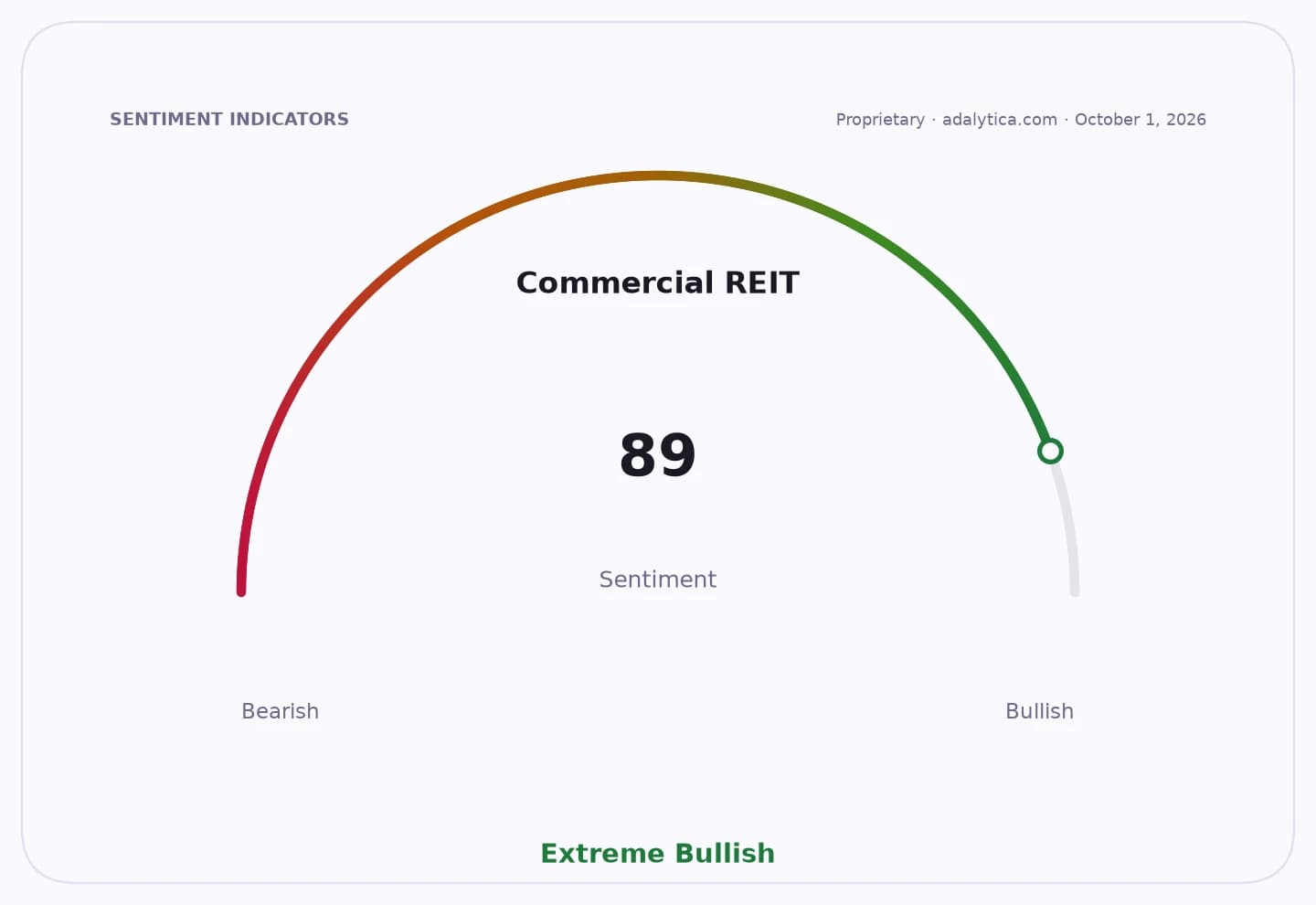
The market backdrop also supports the thesis. Commercial real estate sentiment has strengthened sharply in the past month, according to Adalytica.com’s Commercial REIT Sentiment gauge, which now sits in “Greed” territory at 77, after a 61-point gain over 30 days. Meanwhile, the VNQ real estate ETF has been volatile but remains well above its 200-day moving average, suggesting investors are still willing to pay up for property exposure when the macro and rate outlook stabilizes. That makes public upgrades to industrial parks more than a local policy story; they can act as a catalyst for landlords, developers and infrastructure suppliers positioned to benefit from renewed site demand.
Our thesis is that the market underestimates how much value can be created by making secondary regions investable again. Ten million euros will not transform the north overnight, but it can trigger a much larger second-order effect if it improves occupancy, accelerates permitting and pulls in private redevelopment. The winners are likely to be local industrial landlords, construction firms, utilities and logistics operators; the losers are owners of outdated sites that fail to keep up.
If Groningen and Drenthe execute, this becomes a template for the broader Dutch industrial market: public money goes in first, private capital follows, and the strongest assets in the best-connected parks capture the upside. For investors, the actionable takeaway is to look beyond the headline grant and toward the companies that build, service and finance the next generation of industrial space.
| Entity | Gains | Losses |
|---|---|---|
| Groningen & Drenthe business parks | ▲Upgraded infrastructure | ▼Aging, underinvested sites |
| Local developers and contractors | ▲Public-funded projects | ▼Slow-moving competitors |
| Utilities and logistics operators | ▲Better site demand | ▼Inefficient park operators |
| Private investors in industrial property | ▲Higher occupancy potential | ▼Owners of obsolete assets |