Harvard Business School is moving to “clone” its professors with artificial intelligence, a sign that elite universities are trying to use generative AI to expand teaching capacity without proportionally increasing faculty costs.
Harvard Business School tests AI professor clones
The shift matters because higher education is confronting the same economics that are reshaping other labor-intensive industries: rising demand for personalized instruction, pressure to modernize curricula and a need to do more with constrained budgets. If successful, AI replicas of professors could let schools answer routine student questions, deliver case-based guidance at scale and preserve faculty time for higher-value teaching and research.
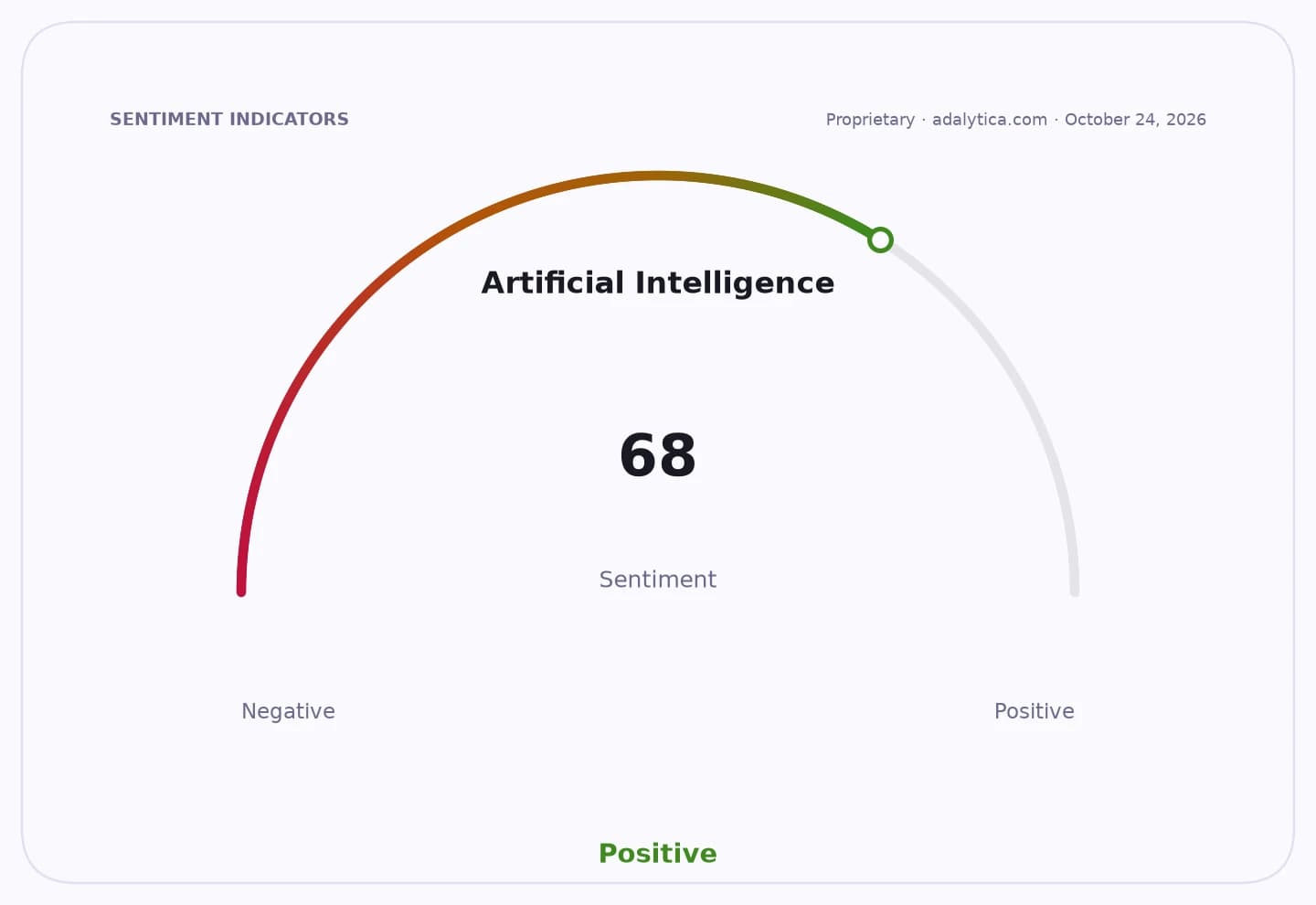
Sentiment IndicatorsⓘProprietary · adalytica.com · October 24, 2026
This is a snapshot — live sentiment, awareness and momentum for 130+ markets update continuously in the dashboard.Open AlphaPulse
That makes the development bigger than a novelty experiment. Harvard’s business school has long been a bellwether for how institutions package premium education. If one of the world’s most influential schools is testing AI versions of professors, other universities are likely to follow, especially as they face scrutiny over tuition levels, enrollment growth and return on investment.
The commercial logic is straightforward. Universities are under pressure to provide 24/7 support, more individualized feedback and better student outcomes, while staff costs remain sticky. AI can lower the marginal cost of delivering repeated explanations and administrative responses, potentially improving student access without a linear increase in headcount. For faculty, the technology could free time for advising, research and higher-level discussion. For administrators, it offers a way to address one of education’s most persistent bottlenecks: scale.
But the risks are equally clear. Schools will have to draw a hard line between augmentation and substitution, especially as U.S. institutions face growing skepticism over AI-assisted work and concerns about whether students are actually learning. Maryland’s ban on AI in public schools and broader distrust of AI in the U.S. underscore the reputational sensitivity. In higher education, the challenge will be to prove that AI makes instruction better, not merely cheaper.
For investors, the story reinforces the broader AI adoption trade. Demand should continue to grow for cloud infrastructure, model deployment tools and enterprise software that can support institution-specific AI assistants. Microsoft, Alphabet and Nvidia remain central beneficiaries of that spending trend, though the recent volatility in their shares shows how quickly sentiment can shift when investors question the pace of monetization. The Adalytica AI gauge shows neutral overall sentiment but extreme fear in awareness, highlighting how adoption enthusiasm coexists with caution.
The more important takeaway is that AI is moving from back-office experimentation to frontline service delivery in knowledge industries. Universities are now part of that change. If Harvard can reliably “clone” its professors, the next debate will not be whether AI belongs in education, but how much of the teaching stack it should be allowed to run.
| Entity | Gains | Losses |
|---|---|---|
| Harvard Business School | ▲Higher teaching scale | ▼Some faculty control |
| Students | ▲More access to instruction | ▼Privacy and quality risks |
| AI vendors | ▲New education demand | ▼Slower adopters |
| Traditional tutoring staff | ▲— | ▼Automation pressure |