Higher crude prices are making non-condensable gas injection more valuable in heavy oil, shifting the technique from a niche recovery tool toward a more economic option for fields that need better sweep efficiency and lower lifting costs.
Heavy Oil Gains From Non-Condensable Gas Injection
That matters because heavy oil sits at the margin of global supply growth: it is abundant, but expensive to produce without improved recovery methods. When WTI trades near $92 to $94 a barrel, as it did in the latest sessions, more reservoirs can justify the capital, compression and surface infrastructure needed to inject gases such as nitrogen, methane or flue gas to maintain pressure and mobilize viscous oil. The economics are even more sensitive in a world where the 10-year U.S. Treasury yield is around 5.2% and the dollar is firm, raising financing hurdles for upstream projects while forcing producers to seek higher returns from existing barrels.
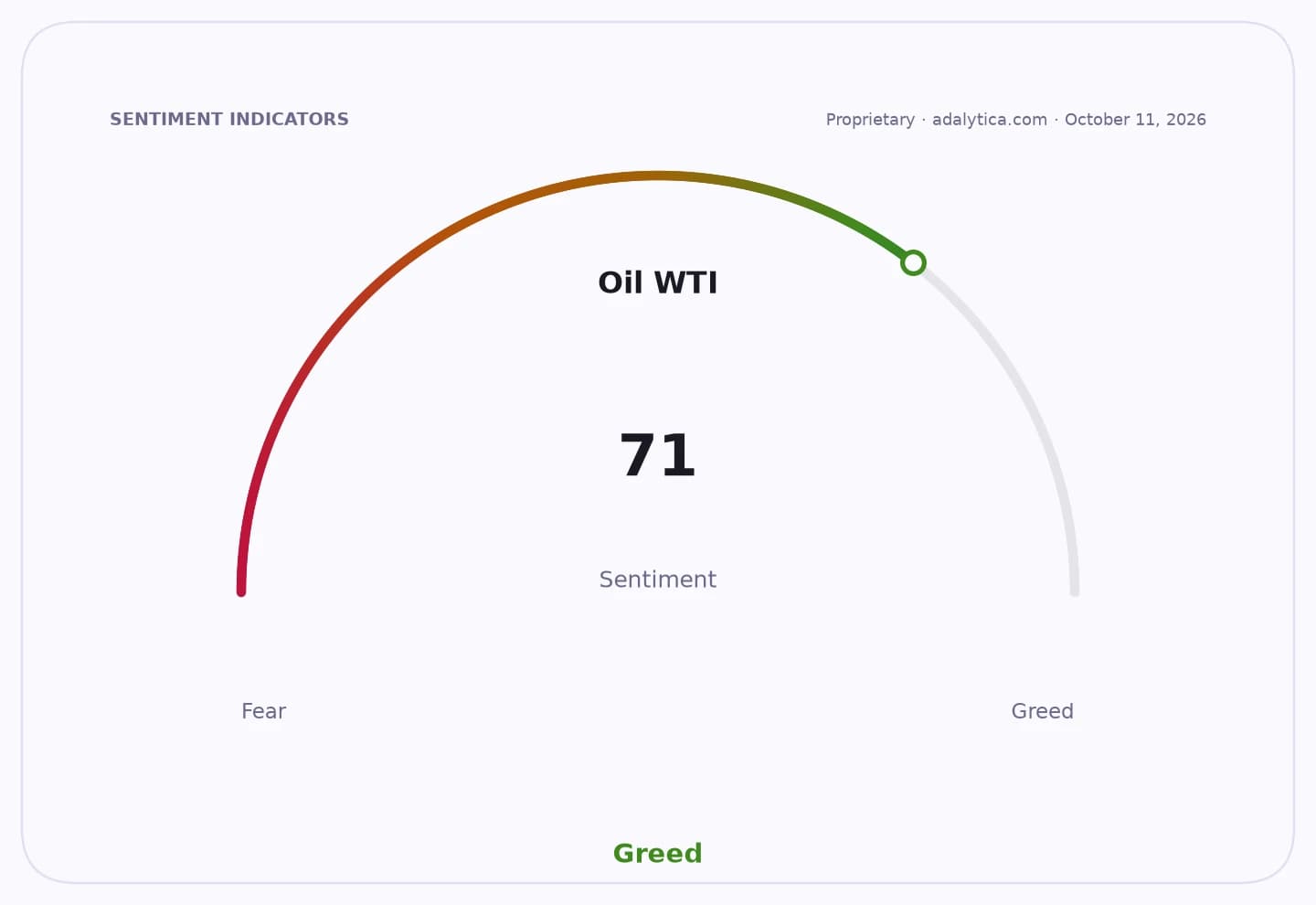
Sentiment IndicatorsⓘProprietary · adalytica.com · October 12, 2026
This is a snapshot — live sentiment, awareness and momentum for 130+ markets update continuously in the dashboard.Open AlphaPulse
The recent oil rally has been sharp enough to alter operator behavior. WTI jumped above $100 in early October before easing back, while the U.S. Oil Fund has remained elevated after touching the 150s, reflecting a market that is still pricing tight supply and geopolitical risk. Adalytica’s oil trade signals show “Greed” at 84, even though awareness remains at “Extreme Fear,” a combination that suggests traders are bullish on price but still uneasy about the durability of the move. For heavy oil, that kind of backdrop can be decisive: once benchmark prices stay high enough, recovery projects that were marginal at $60 to $70 oil become investable.
The appeal of non-condensable gases is operational as much as financial. Unlike steam-only approaches, gas injection can be used to improve reservoir pressure support, reduce gas breakthrough in some settings and extend field life where thermal methods are too expensive, too water-intensive or constrained by emissions. The method also fits a broader industry push to squeeze more out of existing assets rather than relying only on new frontiers. That is especially relevant as U.S. industrial production continues to grind higher and integrated producers such as Chevron, ConocoPhillips and EOG report strong upstream output, underscoring how capital is being concentrated on high-return barrels and recovery optimization.
For investors, the story is less about a single technology than about margin preservation. If non-condensable gas injection increases recovery factors even modestly across heavy oil reservoirs, it can lift reserve life, defer abandonment costs and improve project economics for producers, oilfield service firms and equipment suppliers tied to compression, reservoir simulation and enhanced-oil-recovery services. Halliburton and SLB stand to benefit from more field testing and pilot deployments, while operators with large heavy oil positions gain the most from incremental reserves that cost less than frontier discoveries.
The bear case is that the method remains technically complex and highly reservoir-specific. Performance depends on pressure, permeability, heterogeneity and how the injected gas is sourced and recycled. In some fields, the gains may be offset by compression costs, emissions compliance and infrastructure buildout, particularly if oil prices retreat from current levels or if funding costs stay elevated. A sustained pullback in crude would quickly narrow the pool of heavy oil projects that can support the required capital intensity.
Still, the broader narrative is clear: in a market where conventional supply growth is constrained and new discoveries can carry political risk, the fight is increasingly about recovering more from what is already in the ground. Non-condensable gas injection is benefiting from that shift, and the next catalyst will be whether pilots and field implementations can show consistent gains at commercial scale rather than only in simulations and laboratory tests.
| Entity | Gains | Losses |
|---|---|---|
| Heavy oil producers | ▲Higher recovery factors | ▼Capital-intensive projects |
| Oilfield service firms | ▲More EOR contracts | ▼Weak crude pricing |
| Investors in upstream assets | ▲Reserve life extension | ▼Marginal field operators |
| Consumers/importers | ▲Supply stability | ▼Higher input costs |